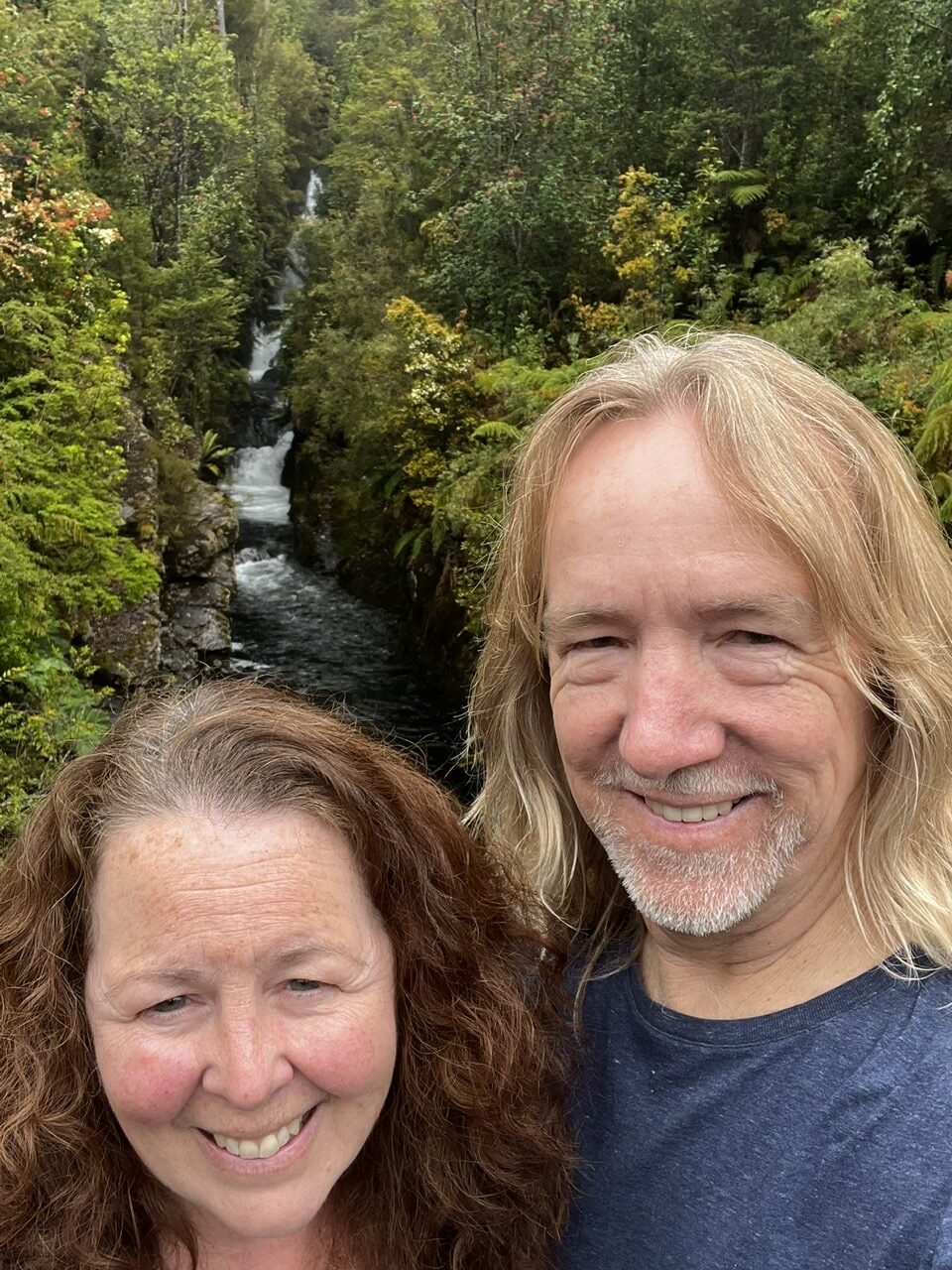
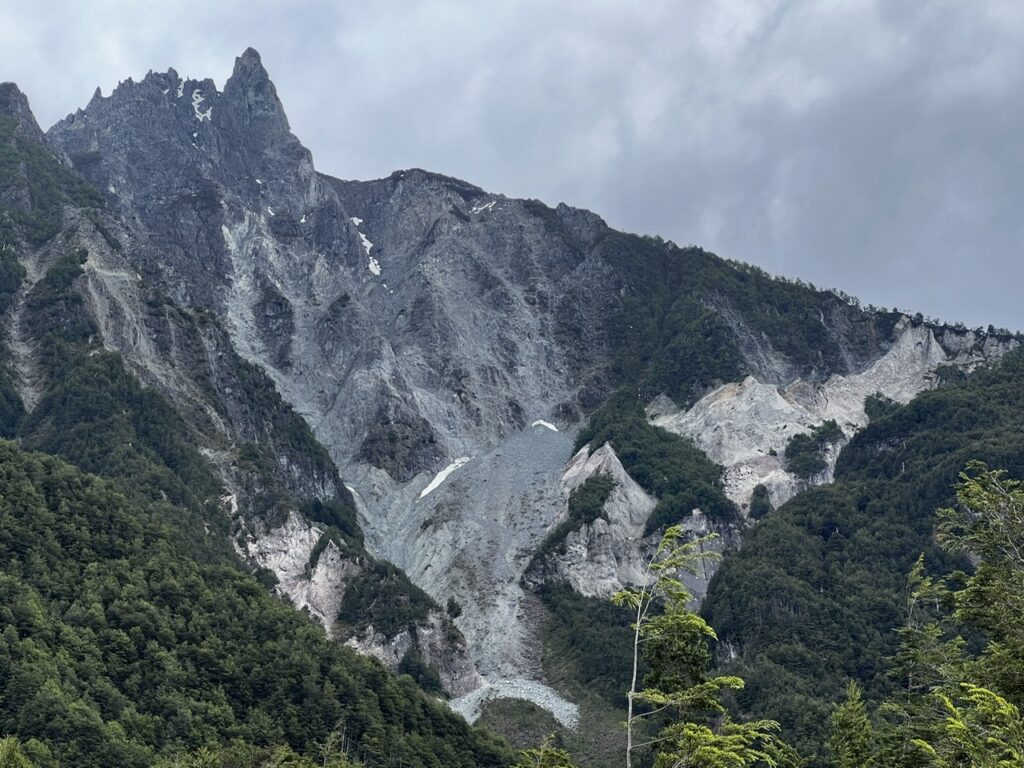
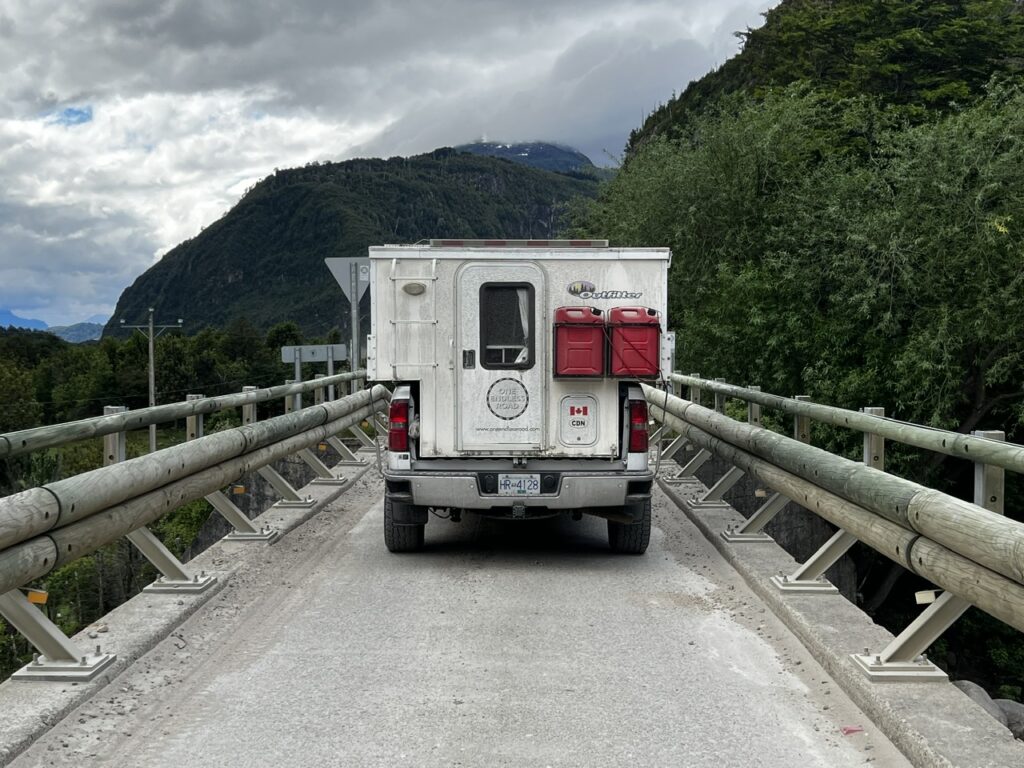
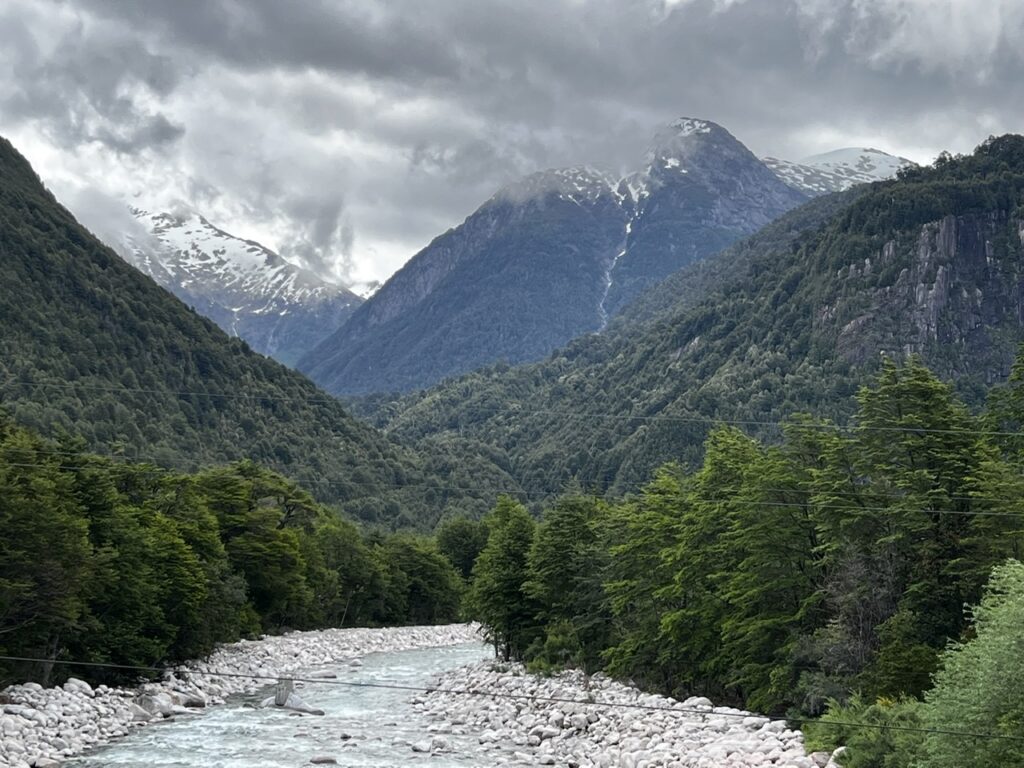
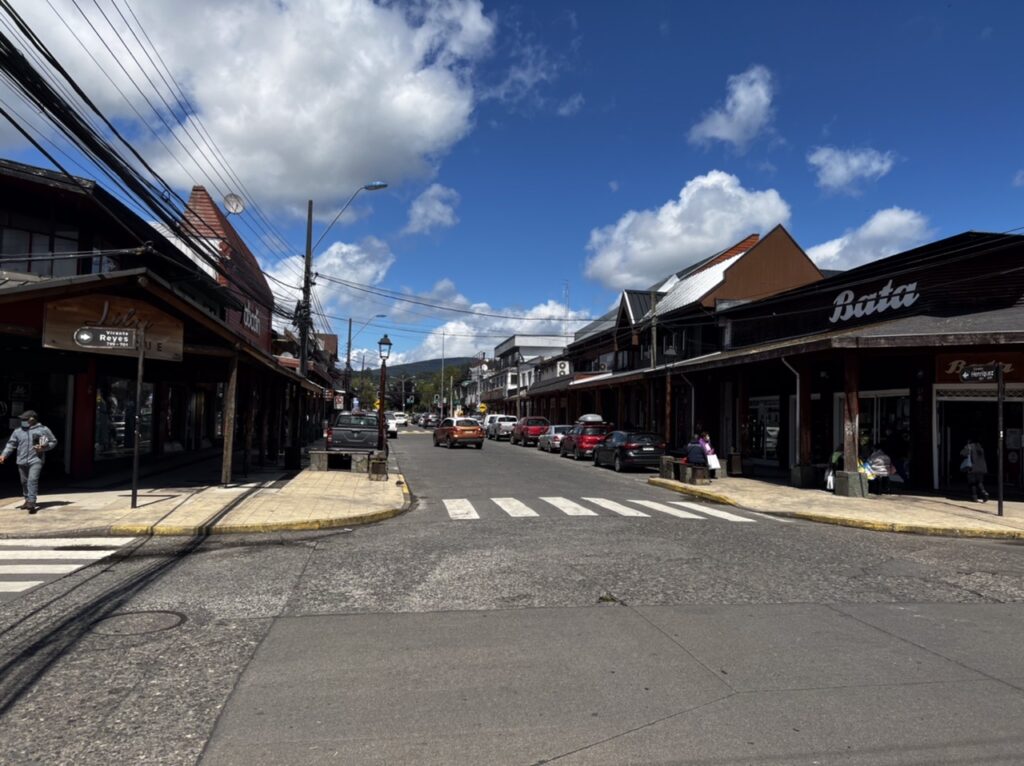
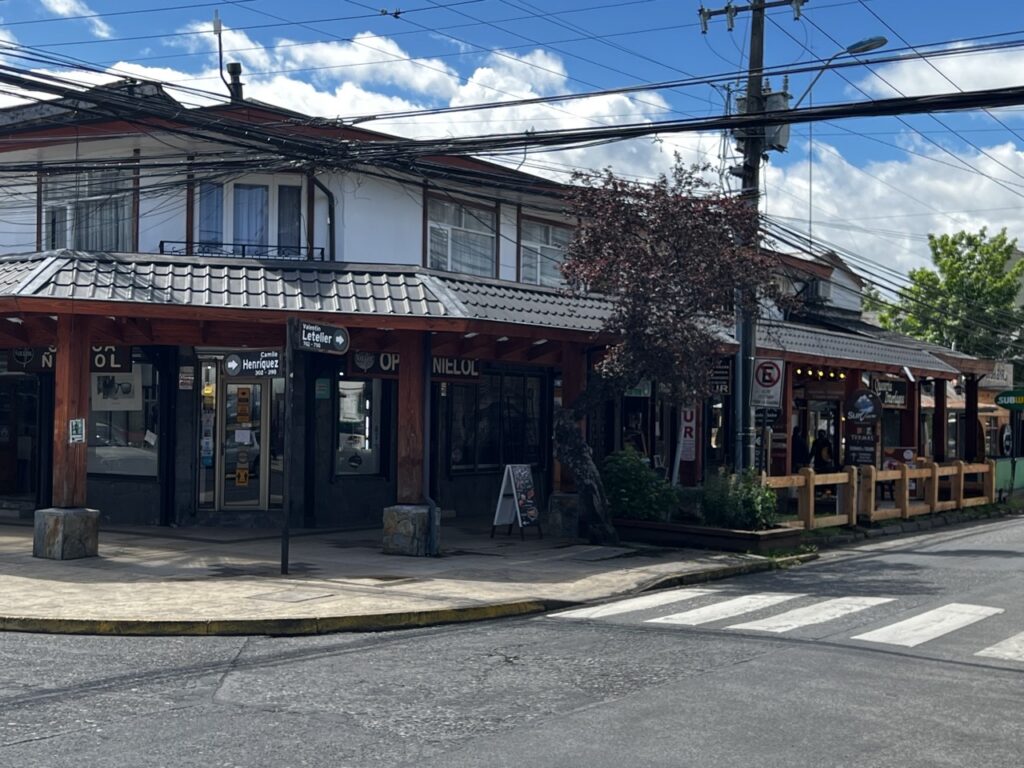
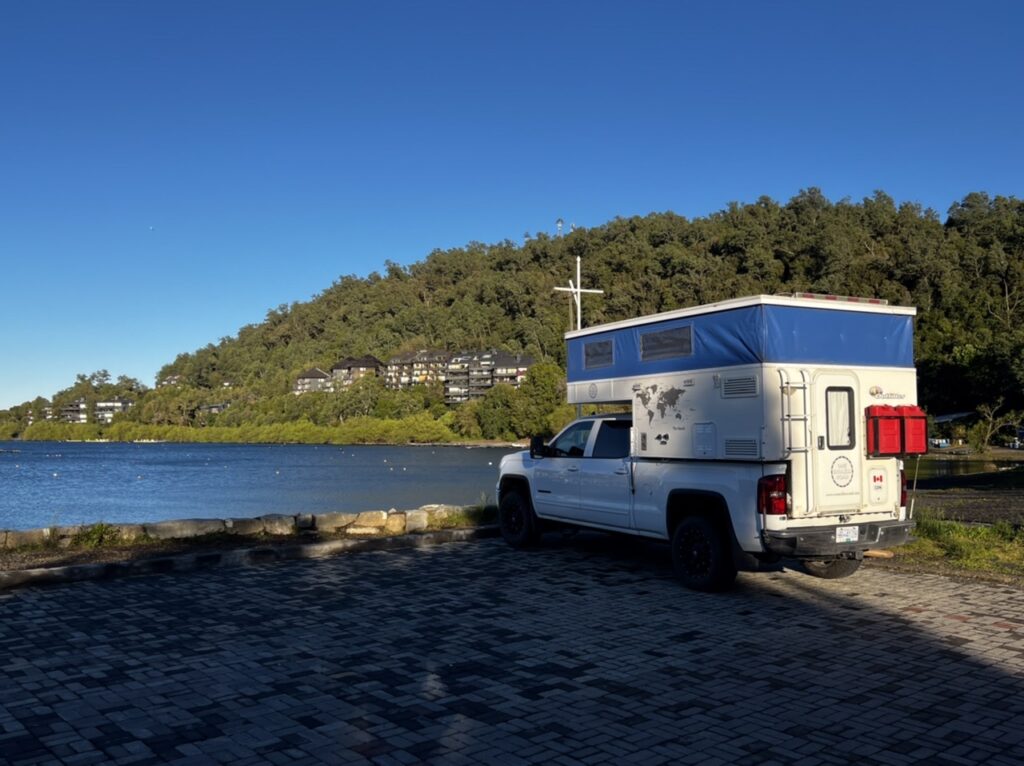
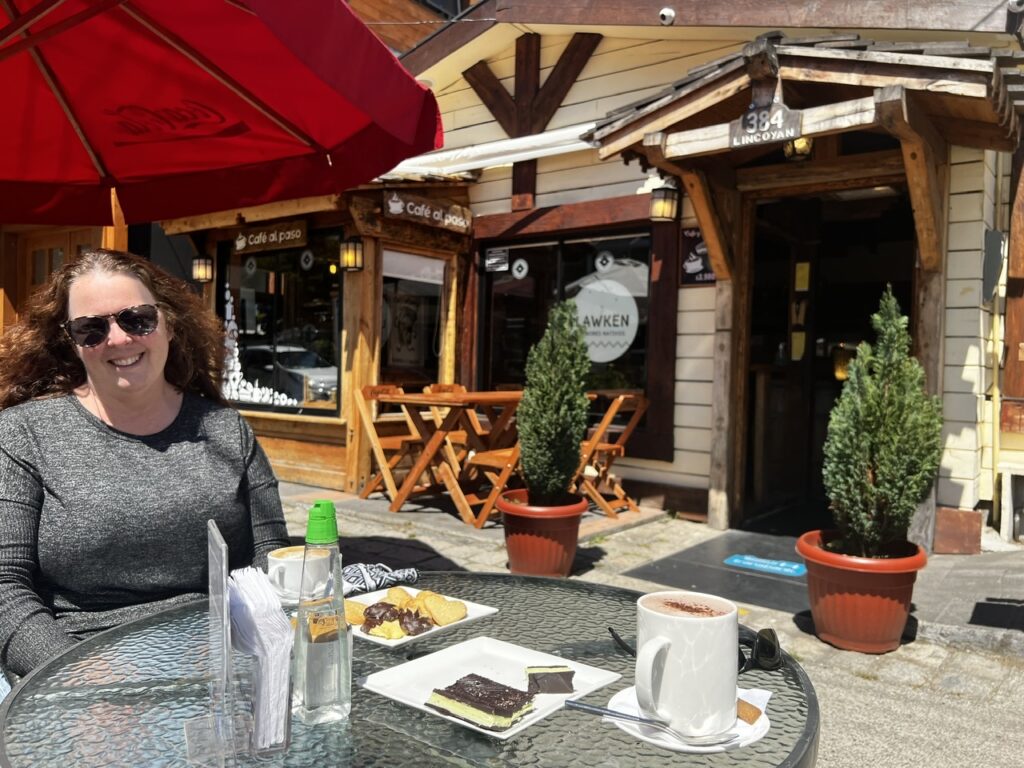
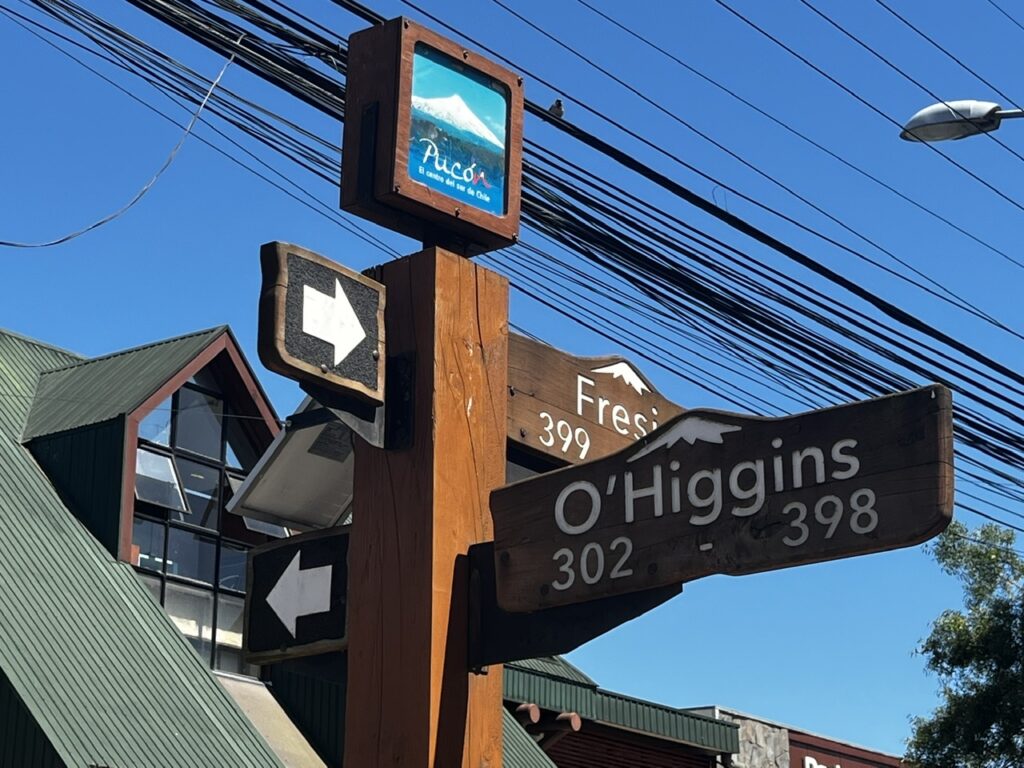
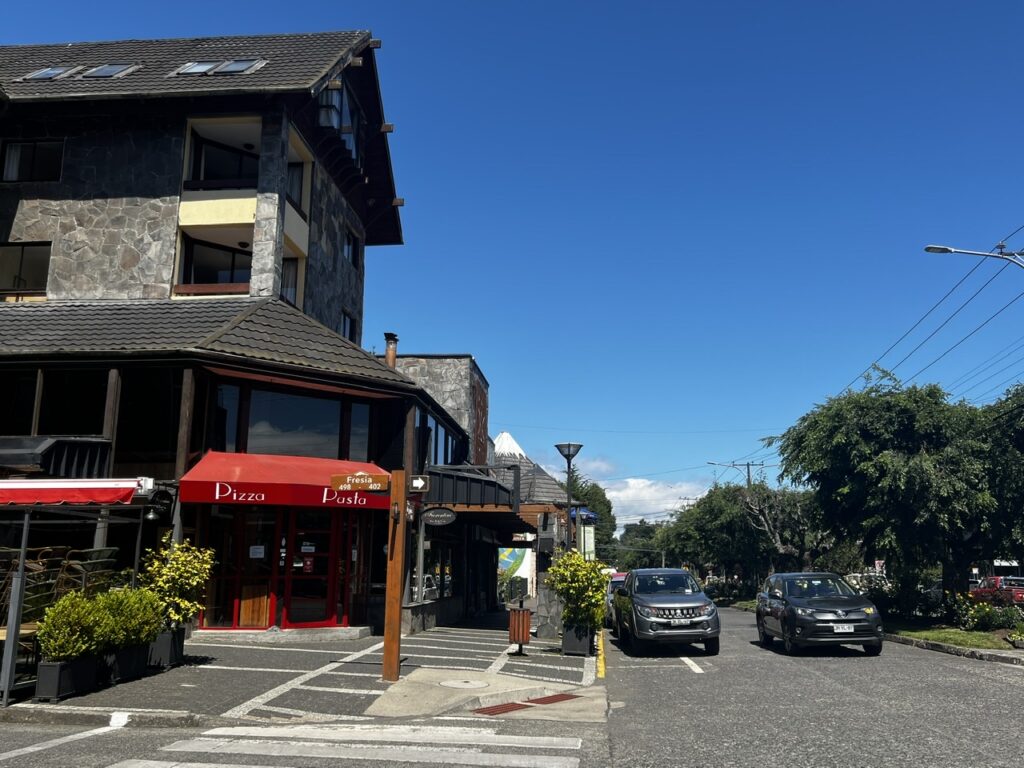
”Artsy and hippie-ish El Bolson”, says Lonely Planet, “is about as close to Berkeley, California as you can get in Argentina”. There is indeed an unmistakably organic or “granola” vibe to the place and it attracts alternate life-stylers not just from Argentina but from around the world. You get the feeling that if ever there was a South American “Woodstock” this would be the venue. We didn’t stay long enough to do a deep dive into the place but did enjoy its local artists markets and laid back feel in the few days we spent there.
“Artesenal” fair at El BolsonWalking across a park in El Bolson, I heard what I thought was the unmistakable sound of a didgeridoo. Turns out it WAS a didgeridoo! He attracted quite an audienceAll over Patagonia, in Chile and Argentina, we have noticed these beautiful birds ( they make a laughing sound a bit similar to a Kookaburra ). Found out they are called Andean Ibis. Saw many in El Bolson
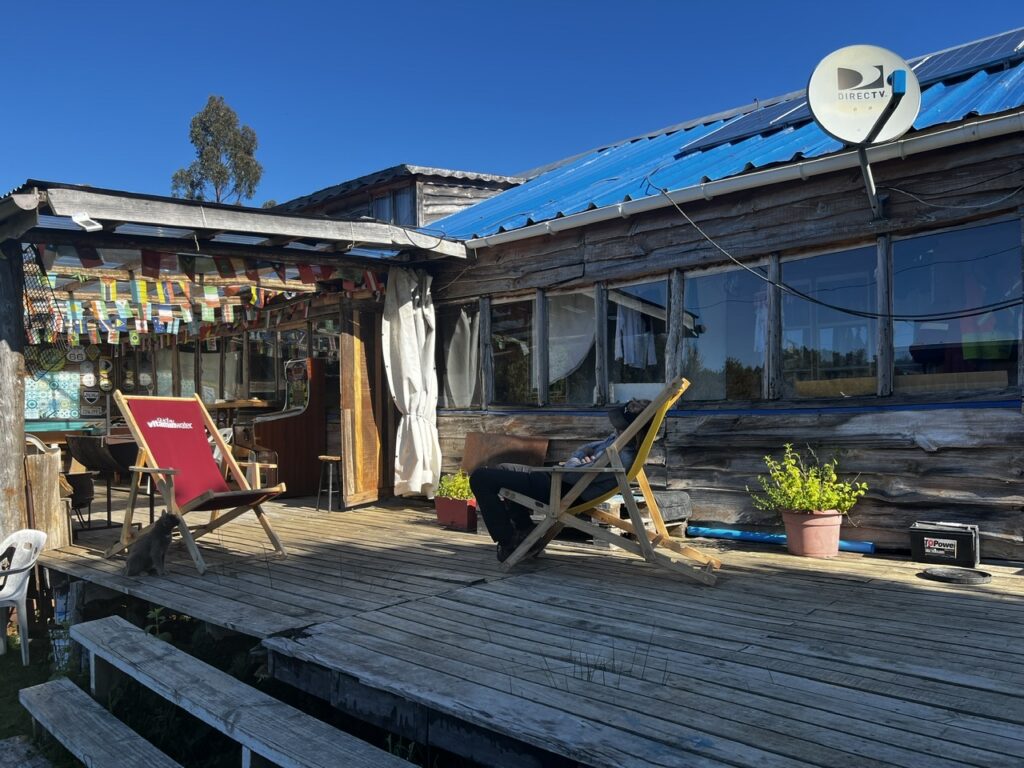
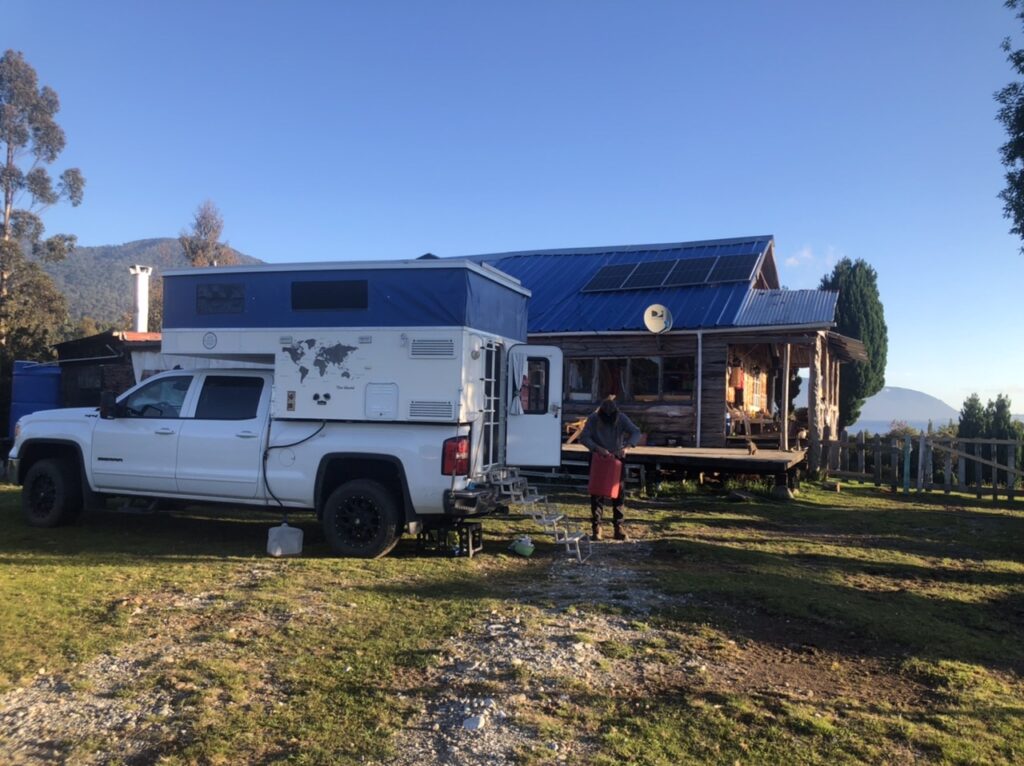
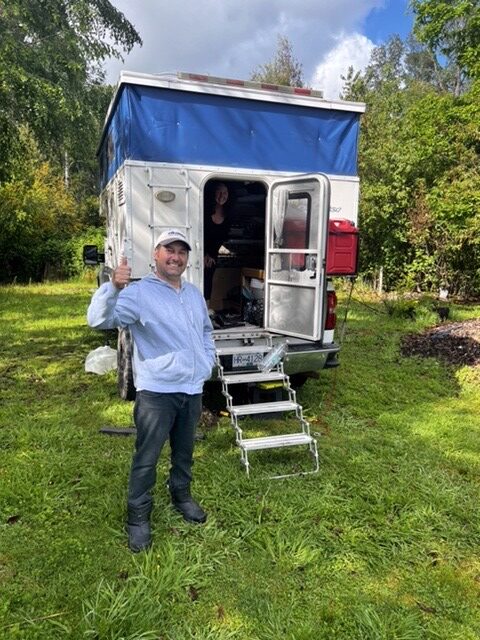
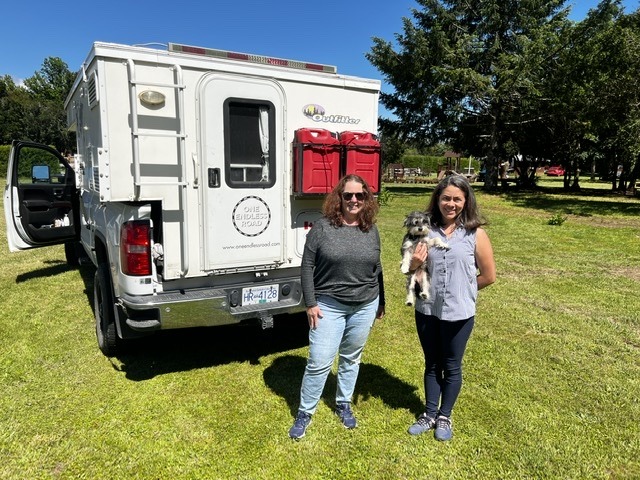
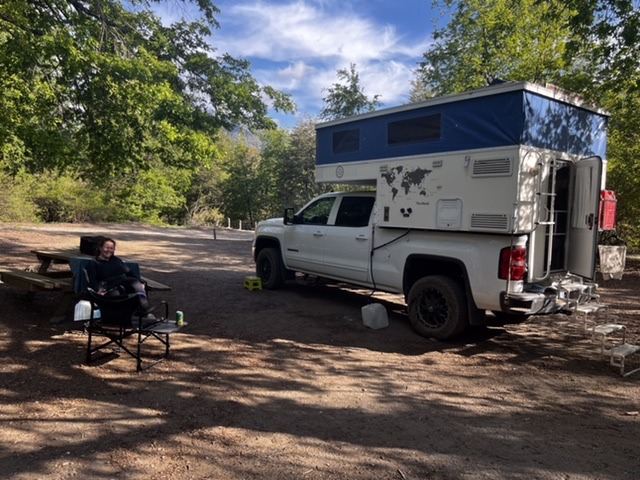
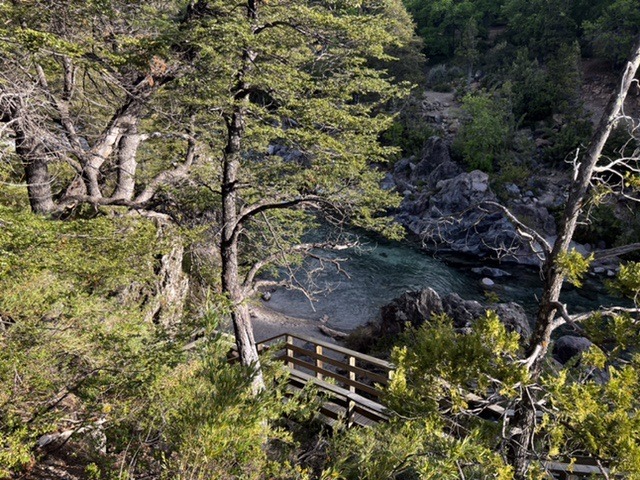
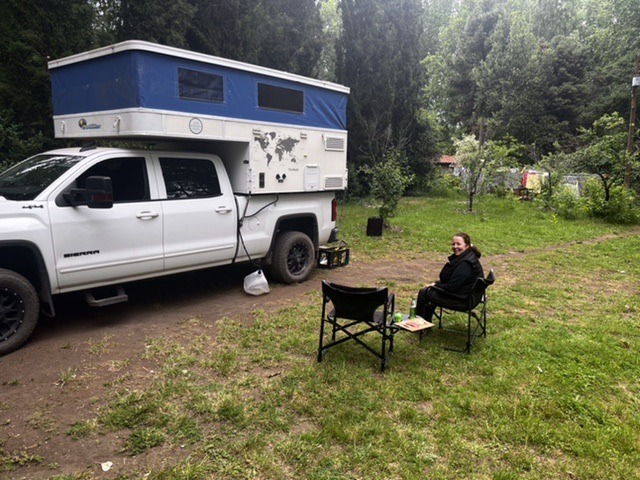
We’d also been looking forward to a pit stop just north of El Bolson at the home of an expat German couple who have a long history of overlanding themselves and now provide an invaluable service arranging South American vehicle insurance for people like ourselves with foreign vehicles. We had some documents to collect, wanted to meet them in person, and were glad to be able to spend a night chatting and camping on their farm. They live by a river in a beautiful secluded valley – first time we can recall in South American not being woken by barking dogs and roosters crowing that seems to be the norm around most South American campsites.
The farm of our European friends near El Bolson. Very tranquilWe camped by this river at their property. Better lulled to sleep by a babbling brook than a barking dog !
Just two hours north of El Bolson lies San Carlos de Bariloche ( “Bariloche” as it’s more widely known ) – despite the proximity the two cities share almost nothing else in common ( well, they do both have ski hills nearby ). Bariloche is an upscale, architecturally heavily German/Swiss influenced resort city that draws wealthy Argentines ( and others ) to its picturesque setting on Lake Nahuel Huapi. Summer and winter the place is packed, the day we arrived being no exception. Very lucky to get a spot in one of the few campgrounds with space available and never have we seen so many people, cars, bikes, motorbikes and camping vehicles compressed into such a small space. May have to start making reservations ( ughh ! ).
Clock tower, Bariloche. The wood and rock elements give the city a very alpine lookBariloche, “Centro” ( downtown )Bariloche downtownStreet scene, BarilocheWe had never seen camping as crowded as it was at Colonia Suiza, near Bariloche – jam packed ! Our rig just visible in the rear
Had a few administrative and routine vehicle things to attend to while there but after dealing with that it was nice to simply enjoy wandering the city and exploring the surrounding lakes. The views were beautiful no matter where you looked.
Oil change at 96,000 kms. The Goodyear guy said no need for a tire rotation – couldn’t believe how the tread has lasted and how even the wear was considering the roads driven and distance covered. Go Toyo A/T !Generally we can just drive in and get fuel anywhere. Five to six car waits in Bariloche in summer. They say it’s like this for two months solid Lake scene near Colonia Suiza, a small, originally Swiss, settlement near BarilocheSelfie time – Bariloche in the background seen across Lago Nahuel HuapiOur itinerary up Route 40 through the Lakes District around Bariloche
Given the history of German immigration to the area it’s probably no surprise that at least one ( and likely more ) famous Nazi fugitive settled here after the war. Especially well known in Bariloche is the story of Erich Priebke, an SS officer, who lived freely in the city for almost 50 years until his identity and whereabouts were uncovered by an American ABC journalist in the 90’s. He went on to live to 100, dying only in 2013. The first impromptu interaction between the journalist, Sam Donaldson, and Priebke was recorded and makes for astonishing viewing. It’s short, but powerful- check it out here.
While Bariloche is the southern end of the 7 Lakes circuit, the lakes extend all the way up to San Martin de Los Andes further north on Route 40. On the way is beautiful Villa La Angostura where we stopped for a couple of nights. Much smaller and thus more walkable than Bariloche it is no less popular and the streets there were also filled with holidaying Argentines. This area must surely be one of the most popular destinations in the country. While camping there we met a couple of Brazilian families ( seems to be a lot of them in Argentina ) and had a great chance to chat with two young ( 18 year old ) Argentine lads who jumped at the chance to practice their ( already excellent ) English – they gave us an interesting perspective on the country, it’s opportunities, it’s struggles and it’s political and economic challenges. These were two very worldly and well educated young guys and it was educational for us just to make their acquaintance.
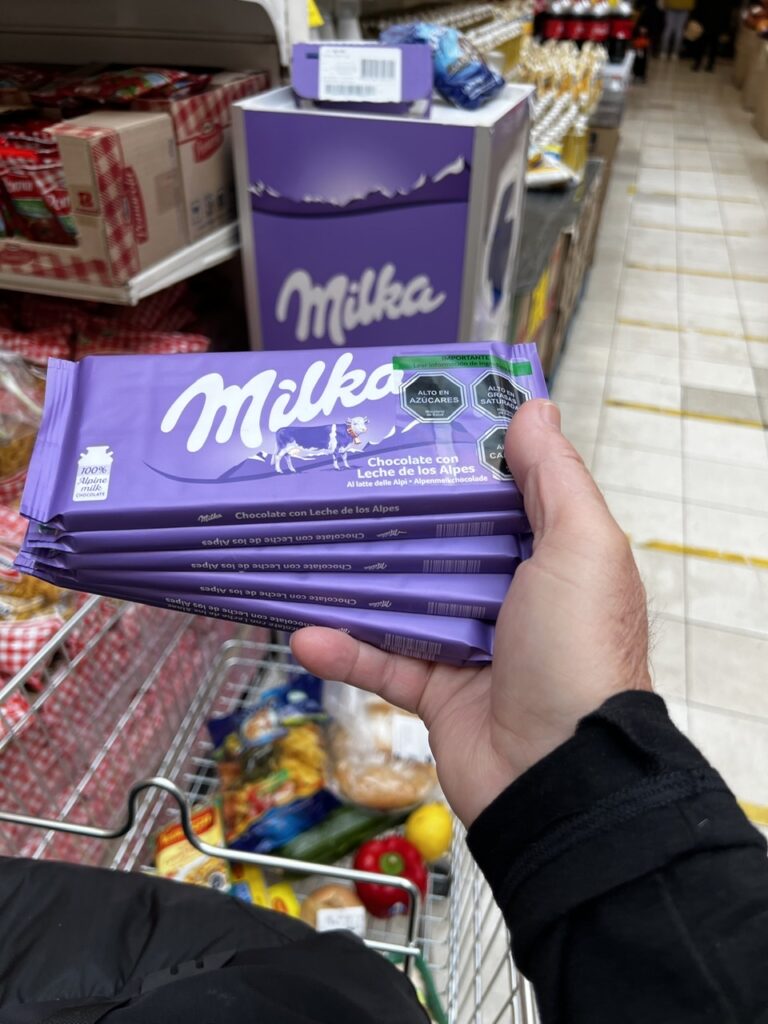
Relaxing, camped at Lago Correntoso, near Villa la AngosturaThe lakes are crystal clear here, but not always warm ! Here near Villa La AngosturaLike chocolate ? Fill your boots in Bariloche and/or Villa la Angostura ! Here in Villa La Angostura
Sometimes travel is about the places you go and sometimes it’s the interesting folks you meet. This past week we were fortunate to have a generous amount of both !
Stay on the road long enough, and one is bound to have a disappointing experience, particularly after arriving at a place with rather lofty expectations. Such, sadly, was our experience in El Chalten, home to the majestic Mount Fitz Roy. Fitz Roy is to Argentina what Torres Del Paine is to Chile – an unbelievably magnificent and truly iconic peak ( or set of peaks ); in fact the two are geographically not far apart, both set in beautiful national parks and both attract hikers and mountaineers from all over the world. Both can be a little shy, often hiding behind the ever present Patagonian clouds, but while the towers of TDP ultimately revealed themselves to us in their full glory, we were not so fortunate with Fitz Roy. The lesser peaks we did see and almost had the largest peak show itself, but just not quite. Bummer ! While still a mystical image even while partially shrouded this is one that people come from far and wide to see. Two and half days in El Chalten where we did manage a few nice hikes, and saw some amazing condors ……. but never saw the “full Fitz Roy”. Lying at the bottom of Patagonia and not far off Route 40 El Chalten was fun nonetheless – much smaller and its pleasures more “outdoorsy” than nearby El Calafate.
The peaks near Fitz Roy in El Chalten – this was as clear as it got for us ( could not see all of Fitz Roy sadly )Route 40 sign – the road is legendary in ArgentinaOur drive north, mostly following Route 40. Seemed soooo long until we looked at it in the context of Argentina overallWaterfall near El Chalten At the “Eagles Lookout” where we saw no eagles but several condors Saw this condor on a hike to the Mirador ( Lookout ) of the Eagles – but saw no eagles
The attractions in El Calafate and El Chalten are well known and attract travellers in their thousands but the next areas of interest along Route 40 lie further north; in fact, much further north. If miles and miles of desert highway interspersed only with wandering guanaco are your bag, then you have about 3 days of unadulterated joy as this national highway winds it’s way north. While the remoteness was interesting at first, that soon wore off – the town of Esquel could not come soon enough ! There were, though, a few highlights and surprises along the way.
La Leona Hotel. A historic stopover in southern Patagonia made a little more famous by some “infamous” visitors in 1905 – none other than Butch Cassidy and The Sundance Kid. They would die a few years later in a shootout in BoliviaThe story of the connection between Butch, Sundance, and the La Leona Hotel. We knew about the shootout in Bolivia but never knew they came this far south.Gas station at Bajo Caracoles, Route 40, plastered with stickers – and stickers on stickers ! Seems it’s the done “thing” down here to carry stickers describing your trip ( we must be the only ones with no stickers )
If there is a long and boring part of Route 40 then for the past 3 days we surely just drove it. There really is not much between El Chalten and Esquel although the monotony was broken by a short detour through Route 41 and, fortunately, by some impressive wildlife sightings along the way – foxes, condors, armadillos and several rheas no less ! We didn’t even count the ever-present guanacos that practically line the highways no matter where you are in Patagonia.
There were occasional breaks, but much of it looked like this. For hours and hours on end !This little armadillo ran across the road in front of us. I stopped, managed to catch up with it and managed a close up. Had always imagined they were much bigger but this one was only the size of a tortoise.Saw a couple of foxes on the highway …this one having a yawn ! Seemed unperturbed by us.A Rhea, South American flightless bird similar to ( but smaller than ) ostriches and emus. Have seen many in both Chilean and Argentine Patagonia At times the monotony of the tumbleweed and dry brown desert scenery was broken by a splash of color – here, near Los Antiguos just off Route 40 near the Chilean borderRoute 41, hugging the east side of the Andean foothills – the scenery was a bit better than the monotony of Route 40
In 1979 American author Paul Theroux set out from his home in Massachusetts on a quest to travel as far south in the Americas as he could by train. His written account of the journey, ending in the quaint Argentinian town of Esquel on board a short narrow gauge railway that bore the name “Viejo Expreso Patagonico”, later became a travel epic, “The Old Patagonian Express”. The train still runs, though on a shortened length of the original track, but still gives riders a sense of what travel was like in those earlier days. Hugely popular with Argentines and foreigners alike (there are fewer and fewer of these narrow gauge lines left in the world ) we throughly enjoyed the journey on this railway icon – fun it is, “express” it is not though this one is all about the journey, not the destination.
“La Trochita” as the train is affectionately known locallyThe train, rounding a bend en route to Nahual PanDistant view of same
Esquel, nestled in the foothills of the Andes, is surrounded by a beautiful national park (Los Alerces), a popular ski hill ( La Hoya )and a host of other attractions that kept us occupied for a few days as we enjoyed the city’s sights and the surrounding area. For now it was simply nice to be back in a small city that had all the trappings of civilization. A few things hit home as we were nearing Esquel – it was getting considerably hotter, it was getting considerably busier and we would be touched soon, and for the first time, by the petty crime that can be an issue in Latin America.
Los Alerces National Park – as pretty a park as we had seen, but the first place in South America where we could not just walk in and get a campsite. What ? We have been spoiled………Esquel has a small ski hill, La Hoya, so we drove up to take a peek. Nice, but very small. Suspect Bariloche provides much better skiing just an hour or so north
Happy to be away from the constant winds of southern Patagonia, seems we traded wind for heat. While 31 degrees is not hot on anyone’s scale it was a sudden shock after wearing long pants, long sleeves and usually a coat pretty much since we arrived. No complaints though, we’ll take the heat any day, and we knew it was coming. What we were unprepared for, though we should have been, was the full force of Argentine summer holidays – suddenly the roads were very busy, and the campgrounds ( at least those in Los Alerces National Park ) were all full. Until now we had been very spoilt ( and had been loving it ! ) having things pretty much our own way. Nice while it lasted.
Could not camp inside Los Alerces NP but found a very nice “farm” campground just outside the park. Enjoyed the solitude and rural ambience at first but by 9pm it too was packed with Argentine holiday-makers. We had super nice neighbors but did I mention that they stay up late ? And like their music………….loud…!
Just got into El Bolson and I was finishing this blog. We then walked out to the truck only to find that a second hubcap trim piece was missing from the passenger side rear wheel ( the cap on other side had similarly “disappeared” at Torres Del Paine in Chile and we suspected young kids we saw loitering near the vehicle then ). Now we knew it was theft – they simply don’t fall off. Hugely valuable ? No, but they keep road grime from the bolts/nuts and do enhance the look of the wheel. What on earth anyone would want with them here ( they are not even sold in South America as far as we can tell ) is beyond me. And they are irreplaceable here. Alas, they won’t get the front two; decided to just remove them ourselves – now at least the wheels all look the same again.
Missing inner hub cap from passenger rear wheel – stolen just as we arrived in El BolsonEl Bolson downtown, by the park. A beautiful setting, the city is known for its “hippy” influence and general bohemian ambience. Saw plenty of dreadlocks here !We often find people staring at our vehicle plates – unlike South American plates ( which all state the country of registration ) ours just say “British Columbia” – it clearly confuses the heck out the locals ! We’ve even been told “Colombia” is spelt wrong on our plates ( seriously ). This lady could not resist and took a picture.
After a lengthy delay at the Argentine border we finally bid Chile adieu on Christmas Eve and crossed over, making a beeline for El Calafate, 4 hours drive away. Chile had been amazing, we loved every minute of it – the sights, the scenery and certainly the people who had been overwhelmingly kind and generous to us everywhere we went. But Argentina had much in store as well and from our experience here in 2003 we knew what to expect, albeit this time at a much less frantic pace. Our loose plans ( such as one can plan at all these days ) would have us in Argentina for most of the rest of this trip – so big and quite simply so much to see.
Our first border crossing since returning. Chile to Argentina. Initially it looked a lot like Chile…..
Things looked very similar to Chile but with one big difference – travelling in Argentina was a fraction of the cost of travelling in Chile. People had told us that everything was much less – the first gasoline fill up and first supermarket visit certainly bore that out. Time to indulge a bit ( everyone does here ! ) so decided to enjoy a few nights in a nice hotel over Christmas – a welcome change from the confines of a pop up camper !
El Calafate offered more than just nice hotels ( though there were plenty of those ) – a vibrant cafe culture, countless bars, restaurants and pastry shops were all reason to stay a little longer ( and we did ), but the crown jewel among all its sights, and probably it raison d’etre, was the world famous Moreno Glacier.
Gasoline at just 38 cents US/litre. A nice change from Chile, where it is 3 times the priceThey made fine cappuccinos….…and there were cake and pastry shops everywhereTito’s – awesome Italian ice cream !
There is no shortage of glaciers to see in South America but the Moreno glacier has a couple of facets that distinguish it from the rest – it’s huge, it ends as a sheer wall of ice (giving it a more dramatic look) and most significantly, it is one of very few glaciers in the world that is actually advancing ( most are shrinking/receding ). Google “most impressive glaciers” and you’ll see that many sites rank it number 1 in the world. We have not seen enough to confirm that but it’s definitely top of our list, so no arguments here.
Moreno glacier from the nearby viewpoint – over the years the glacier has actually advanced closer to the viewpointOut on the tour boat. Gets to within 300 metres – it used to be 200 metres but 2 years ago a large piece of ice calved off and pieces of ice hit a nearby tour boat Cruising by the sounds are almost eerie – the creaking and splitting of the ice make for a great audio backdropIn one place a “cave” has formedThe sheer face of the ice……a substantial piece calved off in front of us. Loud !
Hard to top the Moreno glacier so for the next few days we simply enjoyed the many pleasures of El Calafate. Reconnected with our Belgian friends ( first met in Pucon, Chile and who had arrived in Argentina just ahead of us ) and enjoyed spending time with a group of Brazilians camped beside us who were also making their way south to the bottom of South America. Lots of tip sharing both ways, always one of the delights of bumping into other travellers along the way.
El Calafate sits on the edge of turquoise Lago Argentina which is fed from the nearby southern Patagonian glaciers. It always stays this color
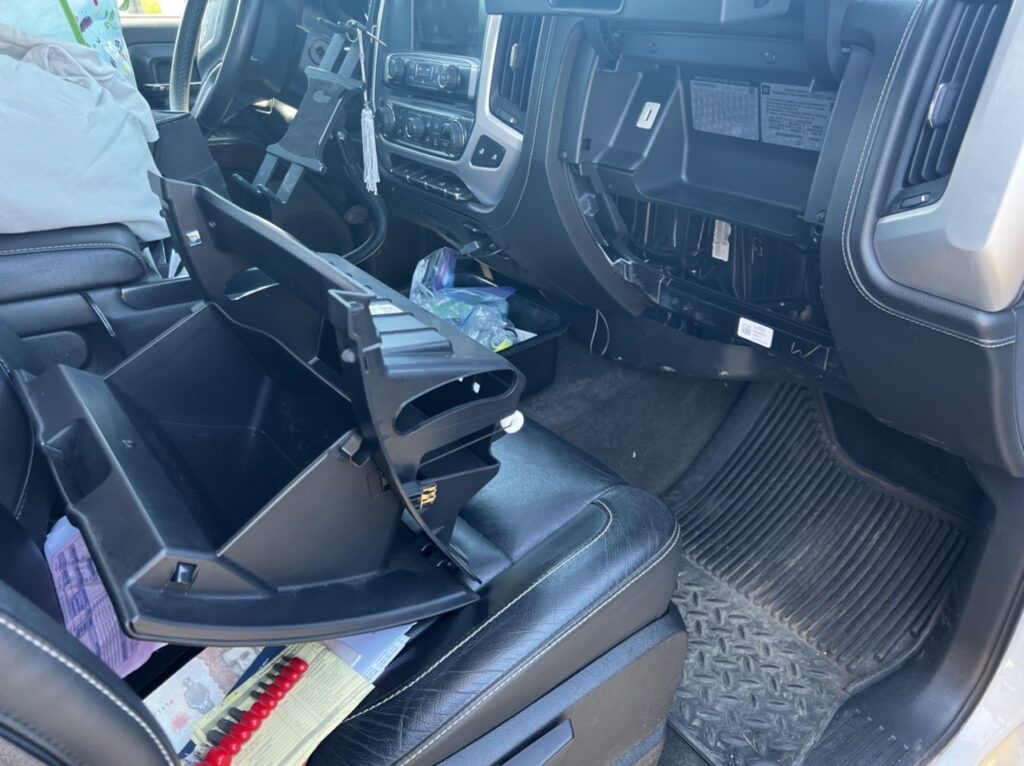
North of El Calafate, when travelling Argentina’s famous Route 40 ( our plan ) there really isn’t a major centre until Bariloche, over 1,400 kms away so we needed to address a nagging issue we had with the vehicle air bags. Essentially, a clamp that held the drivers side airbag in place had worked its way loose but could not be tightened. It rattled loudly on rough roads ( so, quite often ! ) and with more of that ahead we just decided to replace it. Fortunately an English speaking mechanic was found ( and they are rare ! ) – in a few hours “Nico” had the old clamp cut off and a shiny new one put on in its place- no more rattles !
Nico, and thumbs up to a job all done !
Amost two months back on the overland trail had made our rig disgustingly dirty – I mean, the real baked on stuff ! This would need a high pressure wash bay where we could take our time and just clean it top to bottom. Found just one such in town so the two of us spent two hours getting the shine back on ( which likely won’t long on Route 40 north ) ! What is it that just seems to make a car/truck drive better when it’s been washed thoroughly- not sure but it always seems to !
The truck looked like new afterwards !Street scene El Calafate Street scene El Calafate The Swiss – always have the biggest rigs. This one seen in El Calafate You never travel far in Argentina without seeing a sign, poster or mural referencing the 1982 Falklands/Malvinas conflict with Britain. Very emotional topic down here. The mural recognizes their 649 lost heroes and says “Malvinas – yesterday, today, and always Argentine”
That’s a long blog subject but the last 10 days have indeed been busy, exciting, and ( for us personally ) very momentous !
The signature attraction in ( or rather, near ) Puerto Natales is the trekkers “Mecca”, Torres del Paine National Park ( locally referred to as “TDP” ). Whether you come for the famous “W” or “O” ( lengthy and challenging hiking circuits whose routes resemble those letters ) or simply to drive, ride or take the myriad shorter walks through the park as many do ( the latter not requiring advance booking and reservations ), one is never disappointed. The place is, in a word stupendous – we enjoyed 3 leisurely days there, did several shorter hikes, and never tired of the unique mountain shapes ( especially the famous “towers” and “horns” ), turquoise lakes, glaciers and abundant wildlife (highlights being the sighting of several condors and 2 pumas – well beyond our expectations ! ). Below are some of the shots we took- it really is a place like no other…!
In these parts one sees many guanacos ( a camelid, related to llamas and alpacas ). They often stared at us…..……and sometimes poked their tongues out at us !A quintessentially South American image………literally visible around every corner in TDPThe famous “towers” of TDP. Covered in cloud as we arrived they later showed themselves in all their glory ! As photographed as they are we were more impressed by the “horns” or cuernos ( see below )Bumped into this friendly Chilean family at Lago Azul in the northern part of TDP, a good viewpoint for the towers The ranger at the entrance suggested pumas might be visible near Lago Sarmiento so off we went. Not too long after we saw these two. Amazing to see them in the wild !The picture resolution drops with a long lens but they can be clearly seen walking away in the top of the picture. The view was very impressive with binoculars Typical scene around the parkAnd another, showing the “horns” ( black topped peaks on the left of the picture )One of the many waterfallsA hike to the viewpoint shown below – 80km/h winds are nothing to worry about – onwards !The “horns” of TDP from another angleMountain backdrop to beautifully turquoise Lago NordernskjoldCamping Pehoe at TDP…..probably one of the most beautiful settings of any campground we have ever visited !A picture stop on the way to Lago GreyThe glacier at Lago Grey
As hard as it was to drag ourselves away from TDP, not far south were two other “attractions”. Representing both the purpose and in a way the climax of this long drive, (but, hopefully, by no means the end of it ) the first of the two was the Fin de Camion ( “end of the road“ ) at Fuerte Bulnes, just south of Punta Arenas.
The Chileans ( and Argentines ) make much of the fact that you are at the bottom of the world with road signs everywhere reminding you just how far south you are ( “Fin Del Mundo” )
Our journey on the PanAmericana started at the northernmost road/community in continental North America, ( the Dalton Highway at Deadhorse, Alaska, USA ) back in May 2019, and concluded ( albeit significantly Covid interrupted ! ) this past Sunday, over 43,000kms later at the southernmost road/community on the South American continent, on Route 9 near Fuerte Bulnes, Chile.
Us, at the Fin de Camino ( end of the road ) sign near Fuerte Bulnes, south of Punta Arenas Chile. One can go no further south ( by road ) in continental South America ( some history of Fuerte Bulnes here )Map showing the end of the road with the end of the land itself, Cape Froward, just a bit further south
From here, the truck finally now points ( mostly at least ! ) north ! In case you wondered, no, we do NOT intend to drive it all the way back to Canada ( but it’s amazing how many people ask us that ) !!! Omicron travel restrictions permitting, we will drive up through most of Argentina, Uruguay and possibly southern Brazil before shipping it home from either Santiago, Buenos Aires or Montevideo sometime in the northern Spring.
Our trusty steed in front of the sign ( almost obscured by stickers ! ) and end of the road barrier near Fuerte Bulnes, Chile
Rather fitting that the last 18kms to the “end of the road” sign and road barrier on Route 9 was gravel ( getting used to it down in these parts ! ) since that is exactly what we started on in Alaska’s far north. A great feeling of accomplishment ( and much perseverance! ) to have completed it, but at the same time a little sadness that our biggest milestone was now behind us. The Fuerte Bulnes area is very scenic and peaceful, right on the Straits of Magellan and fittingly perhaps, we wild camped right there, toasting to the completion of this part of our overlanding journey – very serene listening only to the birds and the waves and watching ships pass through the very same strait that Ferdinand Magellan first navigated 500 years ago, way back in 1520 – this part of Chile, known as Magallanes, bears the Spanish spelling of his name on streets, plazas and buildings everywhere.
Wild camping on the Straits of Magellan at the “end of the road”The seaside road to the “end of the road”
A short ( 2 hour ) ferry ride across the above-mentioned straits brought us to the mystical island of Tierra del Fuego ( “Land of Fire” in English, known as TDF locally ) and the second of the two “attractions” south of Puerto Natales. Known for its remoteness, colder temperatures, arid landscapes, lots of sheep and unbelievably strong winds, Tierra del Fuego is split between Chile and Argentina and has attractions of its own, most immediately for us being the King Penguin colony just east of Porvenir (and still on the Chilean side). We’d not seen this during our 2003 visit to TDF (which was mostly spent in Argentinian Ushuaia on the south eastern side of the island ). It’s unknown to many but there are in fact a few places outside Antarctica that offer a place to see penguins in the wild; western Tierra Del Fuego being one we were not going to pass it up. And, King Penguins no less, second only in size to the Emperor penguins
Mesmerizing to watch these flightless birds – so beautiful. Hilarious to watch them walk ( well, waddle anyway )We were told they sleep standing up, nestling their beaks under their wings – tiring I would think !These two were doing a little “fishing”
The whole “end of the road” thing is actually a bit contentious down here – speak to a Chilean and the Pan Americana ends ( as it starts ) on “continental“ South America ( at Fuerte Bulnes ). The Argentines will have none of it and say it ends on Tierra Del Fuego ( even though it’s an island and not connected to the South American “continent” ). Thought we would do the former in full and as much of the latter as border restrictions allow ! A measure of just how ridiculous these “extremity” claims have become – Chile has now reclassified the small town of Puerto Williams ( which lies just south of Argentinian Ushuaia, albeit also on an island ) as a ‘city’ so they can boast the “most southerly city in the world” taking that claim from nearby Ushuaia, Argentina. Imagine, a “city” …….with a population of less than 3,000 people !
While near the King Penguin reserve we saw this scene- reminded me very much of Australia !Typical road in western Tierra Del Fuego – mostly gravel but not nearly as rough as parts of the Carretera AustralThere is but one objective when wild camping on Tierra Del Fuego – protection from the howling winds. Managed to find this little refuge ( ocean to the right ) but it was still a rough night. Slept with the roof down and used the emergency bed – the slats I had cut back in Coyhaique were finally put to use. Invaluable !
While in TIerra Del Fuego some exciting news emerged re border crossings that was particularly relevant to us. Chile and Argentina were, it seemed, bringing forward the opening of one of the southern Patagonian crossings from January 1st to December 22nd….just days away ! We had long hoped to be in El Calafate ( Argentina ) for Christmas where we promised to treat each other to a nice hotel for a few days – if this news were true we might just be able to swing that. The wild camping of late had been great and driving the “long endless roads” of southern Patagonia appealing but the thought of a nice room, hot shower every day and a little space to spread out for Christmas was, well, tempting too ! With a PCR test possible in Puerto Natales and same day results available this just might work – the fact that we could not cross to Ushuaia on Tierra Del Fuego actually saved us a couple of precious days so a plan was hatched to head back to Natales, get our PCR test, and drive on to Argentina.
The roads down south ( when paved ) often looked like this, a nice relief from some of the rough, gravel, washboarded, cliff hangers further north and …………..our trusty navigator even offered to take the wheel !
As we ( hopefully ) close out our Chilean chapter late this week both Lois and I wanted to wish all of our regular readers a very Merry Christmas ( or rather, Felice Navidad !!!!! ) and Happy New Year. Please keep the comments coming, we love hearing from everyone !
As exhilarating as the Carretera Austral was, few want to turn around and do most of the route in reverse ( count us in that club ! ), which is one option for ultimately continuing south by land but due to Covid border restrictions with Argentina ( at time of writing ) that quite literally means going all the way back to Puerto Montt and beyond; in fact likely all the way back to Santiago because that border crossing ( to Mendoza ) is currently the only one open to Argentina. Clearly not an appealing option!
Our German and American friends checking out the camper during our last day in Caleta Tortel. Four of the five had cycled the Carretera – my hat goes off to them !
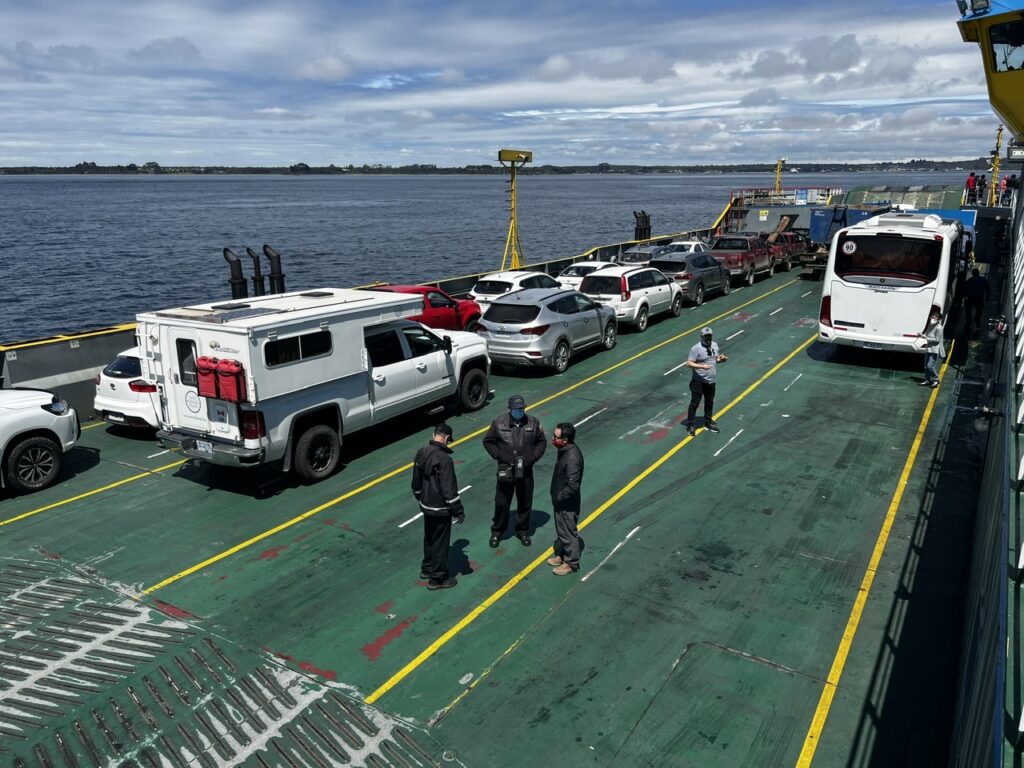
The only other option ( for those with a vehicle ) is to take the weekly ferry south from Puerto Yungay all the way to Puerto Natales in Chile’s Magallanes region, the jumping off point for both Torres Del Paine National Park as well as our ultimate PanAmericana destination, Tierra del Fuego. The choice, if there really ever was one, was simple – we’d sail to Puerto Natales !
On the way to catching the Puerto Natales ferry at Puerto Yungay we crossed paths with this Swiss/Canadian couple. They had just come north on the same ferry so provided some useful “survival” tips !
This was a bit of a leap of faith. While the 44 hour ferry trip is a wonderful experience in itself we would now be 100% counting on Chile to deliver on its promise to open the Puerto Natales land border to Argentina on January 1, otherwise we would be at the tail end of a very long queue of Chileans (who book ferry passages many months in advance) to head north again. Save for the ferry, if Argentina remains closed off in the south there is no other way out ( again, for those with a vehicle ). Mindful of the limited options and following our “fortune favours the brave” ethos, on Saturday evening the ferry “Crux Australis” pulled out of Puerto Yungay – and we were on it.
The “Crux Australis” our ride to Puerto NatalesWhen boarding we noticed the crew strapping the vehicles to the deck. Overkill, surely? Not when we saw how much they bounced around when the ferry briefly crossed a fjord in an area that was substantially open to the Pacific …!
At this point quite a few travellers who’d crossed our path before came together – in fact 7 of the passengers were known to us – two Americans, three Germans and the Belgian couple we’d bumped into way back in Pucon were along for the ride, with most having the same game plan as us – exit to Argentina overland on January 1st. As the ferry journey wound its way south we met more travellers and enjoyed chatting with them all – helped to pass what were at times some pretty boring periods.
This on board route planner showed us the stops, and sights along the way, but…………most people used Maps.me or Google Maps on their phones to track progress ( not much else to do on board at times ! )
The weather was mixed – rained a bit, then sun, then cloud, then wind – you get it all in Patagonia ! Quaint towns were passed, got real close to a shipwreck with an interesting story, and saw some dolphins and bird life. Occasionally sightings of a humpback whale ( or orcas ) are made on this route but we were not so lucky. Visibility at the time also hampered us in seeing a few glaciers that can occasionally be seen from the ferry. Still, an interesting trip, great company, reasonable food and it was relaxing to let someone else take the wheel for a few days.
The ferry was comfortable and the chairs reclined to a position comfortable enough to rest in, even if they did not guarantee a good nights sleep. Fortunately we could sleep in the camper ( and keep the roof elevated – no need, in the end, to use my “emergency” bed ! )Mostly it was calm sailing, the seas looked like this…..…and thisA highlight was passing the wreck of the Capitan Leonidas, apparently deliberately grounded on a shallow bank in an unsuccessful attempted insurance fraud in 1968. We were all surprised how shallow the water had to have been – and we were in the middle of a fjord !Along the way the ferry called in at the quaint, and remote, community of Puerto Eden. The ferry is its only regular link to the rest of ChileThe fjords narrowed at times but were never quite as steep as those in Norway or even Milford Sound in New ZealandArriving in Puerto Natales…..the mountain backdrop appeared a bit similar to ( if not quite as level as ) Table Mountain in Cape Town
Once the ferry docked in Natales it was the usual mad scramble to get off. Our first stop was the ferry company port office to see if we could score a “backup” reservation to head back to Yungay in early January in the event the Argentine border did not open. Fortunately a spot was secured for January 6, cancellable until January 2nd should our worst fears be realized with the border not opening. Nice to know we at least had a way out if needed.
Campground in Natales. Nice view of the city, the harbor and mountain backdrop, but…..windy !
Natales easily occupied a couple of days for us with much of that time being used to prepare for a few days in Torres Del Paine National Park, replenish our supplies and generally enjoy a few sights while sampling the city’s excellent restaurants and cafe’s. Natales has quite the cafe and restaurant “scene” as the city sees a massive influx of both Chileans and foreigners between December and March as tourists descend on nearby ( world renowned ) Torres Del Paine National Park – and our next stop after Puerto Natales.
Celebrated the completion of the ferry journey with fellow travellers out back of the “Base Camp” restaurant in Natales ( group had grown with the addition of some Brits, and some Dutch folks and was too big to sit inside – Chile has strict Covid rules ! ).Cafe Holaste was a favorite – the best cappuccino and hot chocolate in Natales and we went every morning !
While in Puerto Rio Tranquilo the young lady at the tourism office strongly encouraged us to take a drive to Chile Chico, a small town near the Argentine border but running almost 100 km east from the Carretera Austral. It would, she said, offer some of the most stunning views of the Andes that you will see in the area.
Pulled up for a tea break on the road to Chile Chico ( overlooking Lago General Carrera ) and spent some time just soaking it up. The road became incredibly difficult just after this shot was taken.
That endorsement in hand shortly after leaving “Tranquilo” we took a hard left and headed east towards Argentina. She was right – the views, as we ran along the southern edge of Lago General Carrera, were impressive and offered a different perspective than we had from the normal north-south route . In reality we didn’t need to go all the way to Chile Chico since the first 50 km offered the most expansive views. Given that the road got incredibly challenging about 60 km in I figured it made sense to turn around and head back towards the Carretera. Chile Chico itself did not offer a lot other than being a popular border crossing back in the days when you could cross to Argentina wherever you wanted; not possible now but what a wonderful thought!
Tea break overlooking Lago General Carrera and the Andes mountains ( a tad windy as you can tell ! )
In fact the last 10 km of that road were some of the most dangerous we had travelled – real white knuckle stuff. Steep, deeply rutted, off-camber sloped dirt tracks on the edge of a steep mountain- the kind of road requiring a deft combination of light braking, judicious use of very low gears and a steady hand on the wheel at all times. Views aside we were quite happy to finish that detour ! Back on the Carretera itself with formal camping options limited the only choice was to boondock – and the Carretera provided us a nice option near Puerto Bertrand positioning us for an easy drive into Cochrane the next day.
Roadside boondocking near Puerto Bertrand
Cochrane ( as unlikely a Spanish name as you’ll find ) and the last town of any size on Route 7, was named after a British naval commander ( Lord Cochrane ) who assisted the Chileans in establishing their own navy during their independence battle with Spain. An easy place to spend a couple of days, we topped off our supplies and fuel for the long haul south to Villa O’Higgins. On a whim I wandered into the hospital to ask about Covid shots ( Chile was well down the path of 3rd shots – boosters – and we qualified age wise). With Omicron rearing it’s head globally and our original immunity waning it seemed a prudent step to take. Could not have been easier – a walk-in clinic was being held that day and we were both jabbed an hour later ( with Pfizer, no less ! ).
Lois in Cochrane waiting for her Covid booster shot. Mild ache in the arm and a slight headache for a day or two after were the only side effects.
The final run into Villa OHiggins was an easier drive than expected – the 45 minute ferry ride from Puerto Yungay to Rio Bravo included, it was about a 5 hour trip…..hard to believe we were almost at ( quite literally ) the “end of the road” – the Fin de la Carretera. Sharing the moment with some German and American cyclists, a slew of Chilean motor cyclists and a few other Chilean vehicles was memorable – El Mosco was the campground of choice in O’Higgins. We’d all travelled the 1247kms (+ + when you include the many detours most people take ) seen some amazing sights and had some great tales from the road to share.
Ferry crossing the Mitchell fjord between Puerto Yungay and Rio Bravo en route to Villa O’Higgins. Main street, Villa O’Higgins. Never much traffic, the kind of place where everyone looks up when a new car pulls inUs, doing a selfie, in front of the “Fin de la Carretera” sign. Over 1,247kms after starting in Puerto Montt it was the end of ( this ) road. Both exciting and sad at the same time. We had been on it almost a month.Ella and Paul, two young Germans who had cycled the Carretera Austral and who we had bumped into a couple of times en routeLois, on a one of our Villa O’Higgins hikes ( there were many in the area ) with a dog that adopted us !View to Lago O’Higgins from near the mirador ( lookout )We were told the stream near O’Higgins had some of the purest water in Patagonia so we tried it. Properly boiled of course and no ill effects ( yet, anyway! )
For many of us the route south would not end there and by the time we left O’Higgins 4 days after arriving we’d met ( or knew of ) 11 other travellers that would be meeting up in Puerto Yungay for the long ferry journey south to Puerto Natales this coming Saturday. There were other foreigners around after all and a nice change after substantially flying more or less solo to date.
With a couple of days to kill prior to the ferry a side trip was made to Caleta Tortel ( a coastal village built substantially on stilts ). Extremely popular with Chileans, it was here we spent our last couple of days before the ferry. No campgrounds here either but we did manage to score prime real estate in the ( almost always full ) town parking lot up above Tortel with great views of the bay and our own ( more or less private ) deck ! Wild camping at its best……..
An impressive peak on the road to Caletea Tortel Typical road scenery between Puerto Yungay and Caleta TortelCaleta Tortel from above. The town only got road access not long ago and was for a long time only accessible by ferry In Tortel almost everywhere one walks on stilted pathways – there are no roads, nor vehicles, in the town.For boondocking in a town this is about as good as it gets ! Parked up against the walkway, a deck just behind us with a great view, and the ever present local dog to watch over us ! Taken from camper door.
The last task in Futaleufu was to visit the nearby Argentine border and get clarification from the Chilean border folks as to exactly which Chilean borders would open in the south, come December 1 and then January 1. This was critical information and would determine both our route south and the transportation method ( driving or ferry ). I’ll spare readers the intricacies of the Argentine/Chile border crossing options in southern Patagonia but suffice it to say that with none of those critical borders currently open we could be looking at an extraordinarily circuitous road route to visit both the Chilean and Argentine attractions that we had hoped to see in the Tierra Del Fuego area. Turns out it was a good news/bad news” story. The bad news was that none of the borders that we needed to cross would be open in December.
Border guys in Futualeufu telling us which borders would open next. They were extremely accommodating ( not much else to do at a closed border I guess )
The good news, as seen below, was that finally, on January 1, a critical southern border was scheduled to open ! For us, assuming it all played out as planned ( and news of Omicron was just breaking leading to new international restrictions ) this would mean being able to complete the Carretera Austral and travel all the way down to Villa O’Higgins, returning back Puerto Yungay and then taking a Chilean ferry through the southern fjords down to the very bottom of Chile. The ferry through the Chilean fjords is a spectacular journey itself, saves us a lot of driving and would have us in Tierra Del Fuego for Christmas. All going well with the border opening as scheduled January 1 it would then be possible to cross to Argentina and work our way back north through Argentina after exploring southern Argentina’s many attractions. With fingers tightly crossed the ferry was booked from Puerto Yungay to Puerto Natales for December 11.
This was important – we did not want to just ‘hear’ it, we wanted to ‘see’ it. The Chilean border officer actually showed us on his phone that the January 1 openings included Rio Don Guillermo ( near Puerto Natales ) which was just the one we needed ( in the south )
That all settled, back to planning the rest of the Carretera Austral !
Road leaving Futaleufu ….realized as we drew closer that these were sheep !On the Carretera even some of the major bridges were single laneWhile the roads got rough the views stayed consistently impressiveMap showing the end of the Carretera Austral in Villa O’Higgins. One then drives back as far as Puerto Yungay to take the ferry to Puerto Natales at the very bottom of South America.
While light rain fell almost constantly on the road to Puyuhuapi, it was a visual treat, albeit rough at times and marred with ( the ever familiar ) roadwork. Puyuhuapi is not particularly attractive but has some interesting German history and more famously is the jumping off point for one of the Carretera’s top sights – Ventisquero Colgante ( the hanging glacier ). Reached by an ( at times ) fairly challenging 3-4 hour hike, the glacier is amazing; had we arrived 10 minutes earlier we could have seen the deafening calving that we heard when we were still a few hundred metres away.
Entering Puyuhuapi a town founded by German immigrants in the 30’s. Strong German influence in Southern ChileMet up with Johannes, a German biker and the first foreigner on a foreign registered bike we’d seen in Chile. Normally there would be many and prior to Covid we had seen manyEntrance to the magnificent Vintesquero Colgante hike in Parc Nacional QueulatCrossing the first bridge to Vintesquero Colgante View on the way up…The hike required navigating some narrow creek beds….….to reach the stunning view at the top of the hike Closer view……heard some calving on the way up ( loud !! ) but missed seeing itSelfie time
The road from Puyuhuapi to Coyhaique was one of the tougher sections of the Carretera, lots of gravel, lots of rain, lots of washboarded surfaces, lots of steep hills and hairpin bends – but all in a days drive on this road. As someone told us, never a dull moment…!
Some pretty steep roads just out of Puyuhuapi , all under construction – lots of delays but the scenery was impressive Cascada ( Waterfall ) La Virgen ( on the way to Coyhaique )Roadside flowers near Coyhaique The colorful wildflowers were all along the roadside between Puyuahapi and Coyhaique Close up of the Spring flowers
Disconcertingly, on arrival in Coyhaique, it became obvious that what we thought was just a faulty ( propane ) heater was in fact more serious when the ( gas ) cooktop also suddenly stopped working. How I would explain our propane issues, in Spanish, to someone who could work on an American system ( and find needed parts ! ) in the middle of the remote Carretera Austral was a nerve wracking thought. Fortunately our camp host “knew a guy” and if ever there was a time we “needed a guy” this was it. “Juan” turned up at our camp site at 8pm, stayed till 11pm working on the system and quickly identified a faulty regulator as the issue. Of course, the regulator itself was readily replaceable, and he had one on hand, but the connections ? Of course….all different ! A colleague of his had worked on several foreign ( to a Chilean gas guy anyway ) propane systems, had some cannibalized parts left over and by a stroke of miraculous good fortune these allowed him to tightly connect the new regulator ( property leak tested while we watched ! ) and get the system working perfectly. A huge relief, we could now stay warm AND cook again !
Juan, the gas technician who worked on our propane problem Leak tested, every fitting, while we watched
Delighted to have the propane issue now resolved the next few days were spent exploring Coyhaique, a small city of about 65,000. Easy to get around, we enjoyed beautiful sunny days there after a couple of drizzly ones, and all our shopping ( and repair ) needs were met. It also seems the camping facilities are just getting better as we go south – “El Camping” in Coyhaique was one of our faves so far. Secluded, private, close to town, strong wifi, best hot showers and cleanest bathrooms we have seen yet AND they helped solve both our our bedding and regulator problems ! As seems to be a pattern in Chile they also had the most adorable animals that stood watch over our camper.
Downtown street scene in Coyhaique Another street scene in Coyhaique Candy and Blanco were always at the bottom of our steps…………while kitty just loved to sleep under the truck in the camper steps box ! Reminded us of the new pups that adopted us in Villa de Leyva, Colombia
Even got in a little emergency ‘construction’ work on the camper. With the aid of a piece of irregularly shaped plywood, our dinette folds into an emergency bed – we had kept the said plywood with us for the last 6 years until I carelessly left it at the campground in Pucon during a clean up two weeks back. We would need this for the 41 hour ferry ride to Puerto Natales ( there are no cabins on board and while we CAN sleep in the camper we will NOT be able to pop the roof up ).
Borrowed a saw from the campground owner and cut some “slats”Not the perfect platform I had lost but a few pieces of tongue and groove slats cut to length would close the gap we needed to make our emergency bed ! Voila’, an emergency bed. Better than two nights sitting bolt upright on a crowded ferry !Italian food tonite ! We seem to eat a lot of it, always washed down with excellent Chilean wine ( and beer ) ! Their cheese is pretty good too.
Leaving Coyhaique on an overcast rainy day we expected a 3 hour trip to Puerto Rio Tranquillo, renowned for the Marmol ( marble ) Caves. Between the weather, countless construction delays and some slow traffic ahead of us, we managed to turn it into a 5 hour saga. I say saga because the road was substantially gravel, and rough gravel at that – loose rocks, ruts, corrugations, steep slopes and narrow cliff edges made it well, shall we say….interesting ! But, just another day on the Carretera Austral. The trip did present some interesting sights and even the weather improved by mid afternoon to reveal the grandeur of azure Lago General Carrera as we rolled into our campsite.
The roads were indeed steep at times….but not quite as steep as this sign suggests ! Freaked us out at first though.As we drove into Villa Cerro Castillo the eponymously named mountain was covered in fog and cloud. On the way out the clouds parted to reveal this – quite impressive !Had always imagined the “gauchos” to be an Argentine thing but this horseman ( herding cattle by the road near Cerro Castillo ) sure looked the part ! I showed the picture to a local Chilean who confirmed he was indeed a gaucho ( and obviously that Chile also had gauchos ! ).Typical of the miserable conditions on this day – road and weather !Just before Puerto Rio Tranquilo, we passed this idyllic scene. Looked much like the South Island of New ZealandWe passed so many motor cyclists that we lost count ( a few hardy cyclists, too ! ). While almost all were Chilean registered motor bikes many foreigners come to Chile just to do the Carretera and rent Chilean bikes. Saves the shipping headache
Puerto Rio Tranquilo is a small, rustic Patagonian village whose sole purpose seems to be a base to tour the nearby Marmol ( marble ) caves. A pit stop for almost all who tackle the Carretera, these multimillion year old marble caves are found on the shoreline of Lago General Carrera just outside ‘Tranquilo’. We’d seen pictures and they looked impressive so we were keen to get out on the water and check them out ourselves. They did not disappoint – I probably took more than a hundred pictures but narrowed the selection down to the following handful. Definitely worth a stop for anyone who comes this way !
View from inside the caves Marmol caves – can you see the dogs head ?Marmol cavesMarmol cavesMarmol caves
Begun in 1976 under the direction of then dictator, General Augusto Pinochet, Chile’s legendary Carretera Austral ( Route, or in Spanish “Ruta”, 7 ) is considered one of the country’s most ambitious infrastructure projects. Prior to its construction most of Chile’s Patagonian land transportation had to cross the border into Argentina. It opened in stages with the last 100kms to Villa O’Higgins not opened until the year 2000. Plans exist to extend the road further south ( as far as Puerto Natales ) in the years ahead.
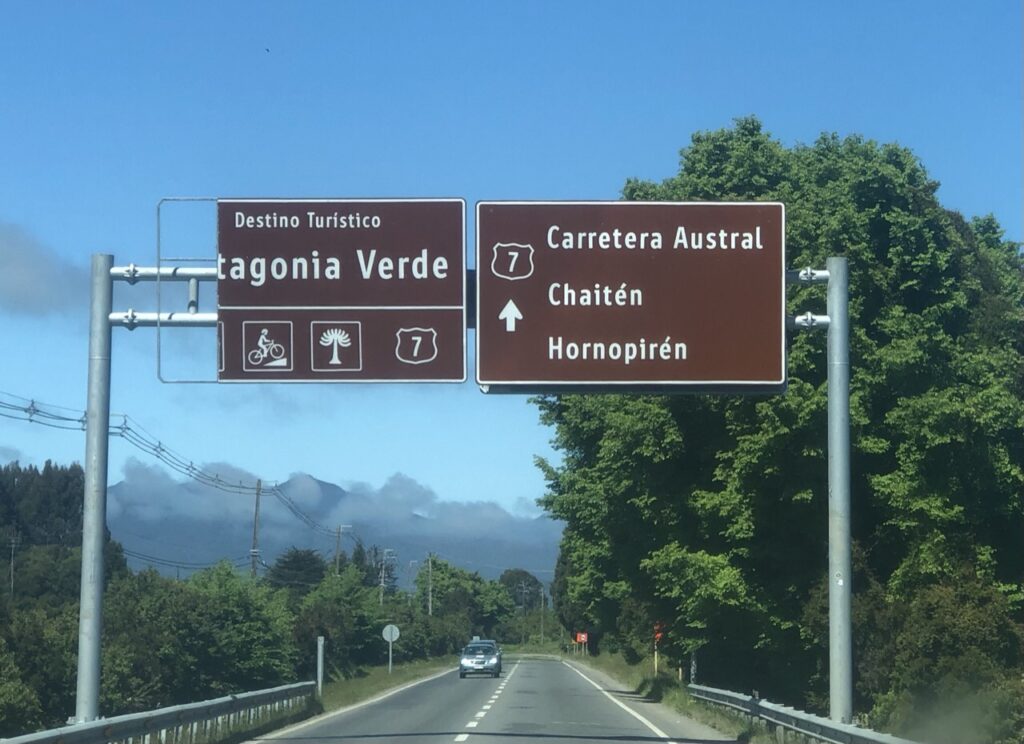
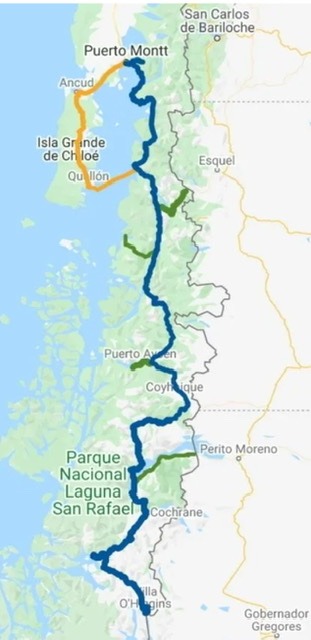
From Puerto Montt, travellers have the option of driving south east through Hornopiren with a couple of short ferries then connecting to the mainland town of Chaiten, or taking a ferry direct from Puerto Montt to Chaiten, or, a third option ( and the route we chose ) travelling southwest through the rural and more remote island of Chiloe as far as Quellon at which point a ferry makes the 4 hour crossing east to Chaiten. Since all roads/ferries lead to Chaiten it is to all practical intents the real beginning of ‘Ruta 7’. Before heading over to Chiloe we did venture down Route 7 about 50 kms – the drive was scenic and it took us to a highly recommended camp spot ( Puerto Montt’s options were not that appealing ).
Driving through Puerto MonttDriving southeast from Puerto Montt along the waterfront, the very beginning of Route 7Further down Route 7…the road still sealed at this stageThe eclectic campground we stayed at near Puerto Montt. Run by a lovely old Chilean couple and shared a with a menagerie of friendly animals We had time to do a little cleanup here. I took the opportunity to ensure our spare fuel cans were clean as we might need them further south. Rumour has it that fuel stations can run dry on the Carretera. Our range without external tanks is only 600 kms, less when heavily loaded and on hilly rougher roadsThe dogs loved us !
Chiloe island has a unique feel and distinct local flavor. More rustic, smaller towns, and miles and miles of rolling green hills, it reminded us at times of New Zealand ( albeit with fewer sheep ! ). Travel was slow with lots of construction and we managed to make a full day of the relatively short trip down from Puerto Montt. While the island offers countless side excursions and an impressive national park there would be more of that on the Carretera so our trip was limited to catching some of the sites in Castro ( capital city ) and some extensive stocking up of supplies in Quellon’s larger supermarkets – every guide we referenced suggested taking as much with you as you could carry given the limited options in Patagonia. Speaking of Patagonia, google “Where does Patagonia begin” and you will read that Chileans consider anything south of Puerto Montt to be Patagonia while Argentines reckon the boundary to be a bit further north in San Carlos de Bariloche – by either measure the Carretera Austral falls squarely within Patagonia.
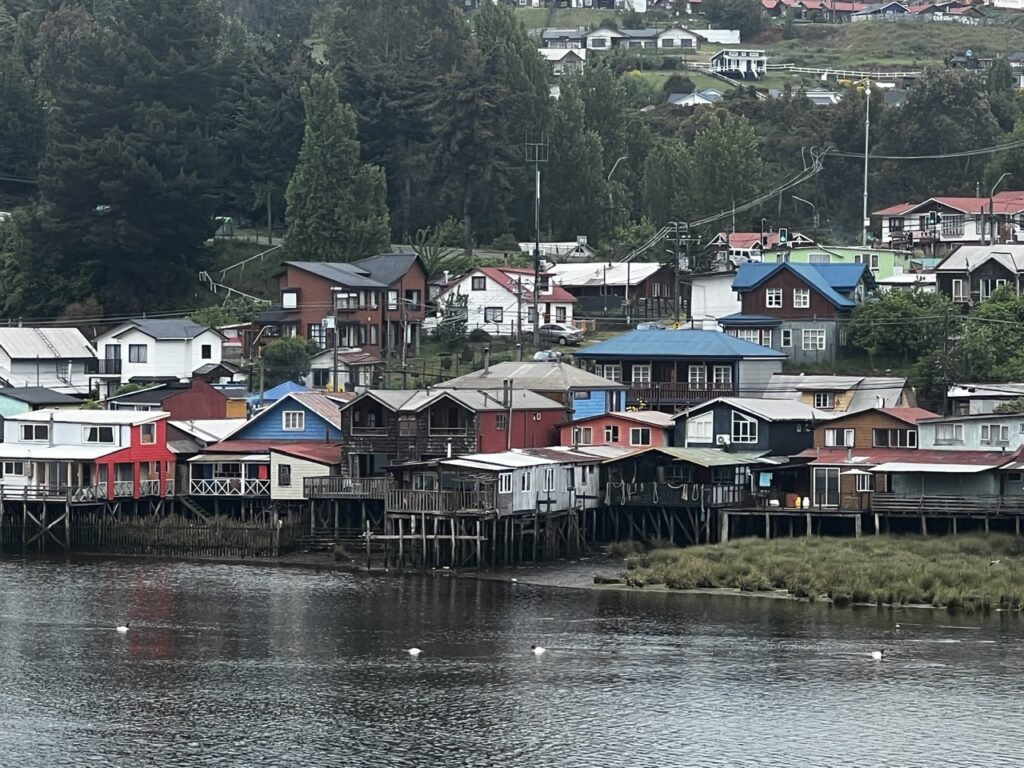
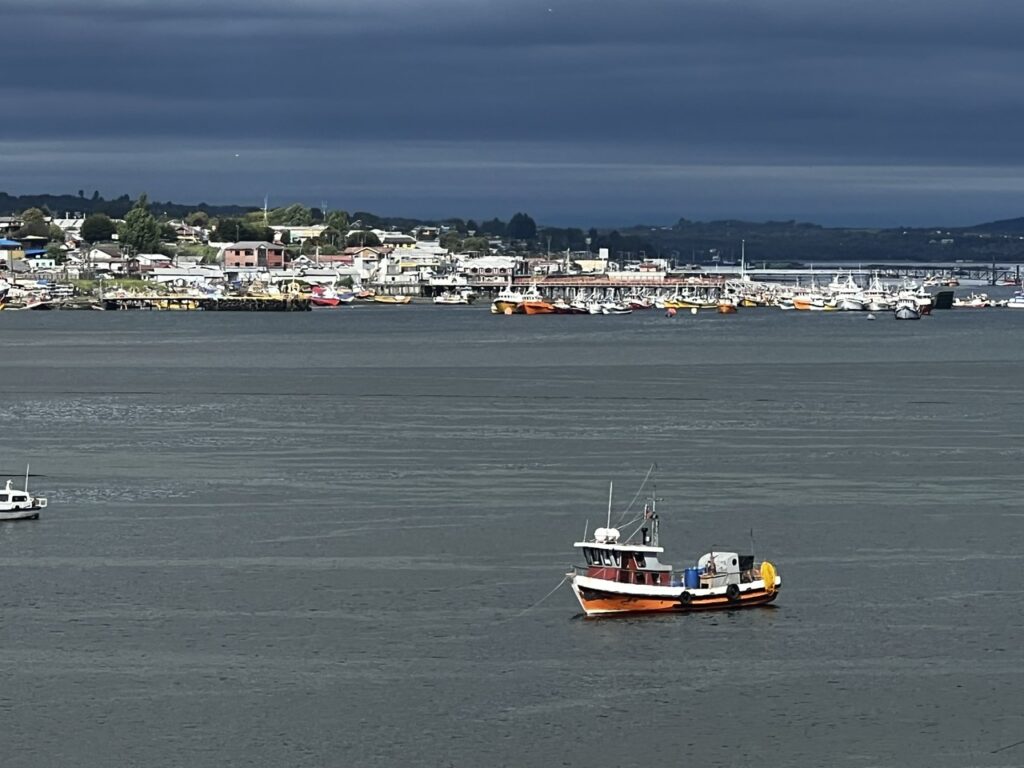
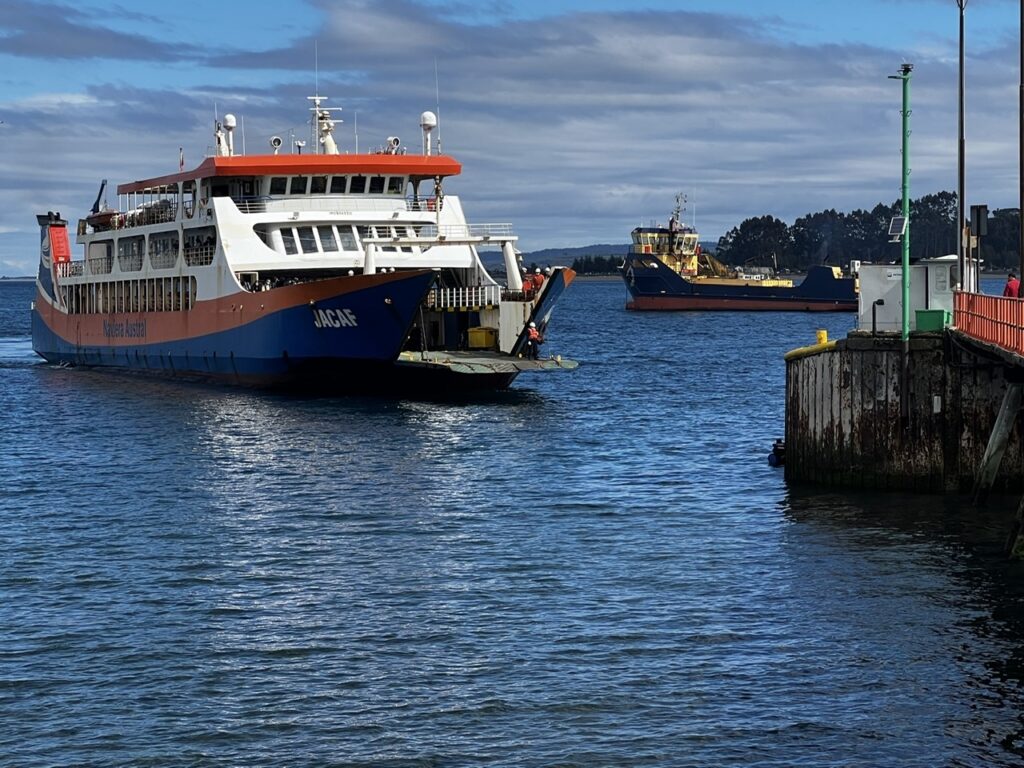
Ferry crossing to the island of Chiloe. Luckily we just made it, the last ones onCastro, capital of Chiloe, is famous for its “palafitos” or colorful stilt houses. As we travelled south the houses almost all seemed to be made of wood and tinView across the bay to Quellon harbor from Los Paicos, where we camped on our last couple of nights on Chiloe Stocking up on the “essentials” in Quellon
A pattern had emerged shortly after booking our flights back to Chile – we book, they change the flight, we rebook, they change the flights, we rebook….and on and on. There were 5 of these before actually getting to Chile…! Seems the Covid era impacts ferries as well – the original crossing to Chaiten ( from Castro ) was rerouted to Quellon, then the departure time was changed from 2pm to ( the ungodly hour of ) 11pm, then once again back to 7pm, before ultimately departing just after 8pm. One must stay flexible and always “tranquillo” as they like to say here.
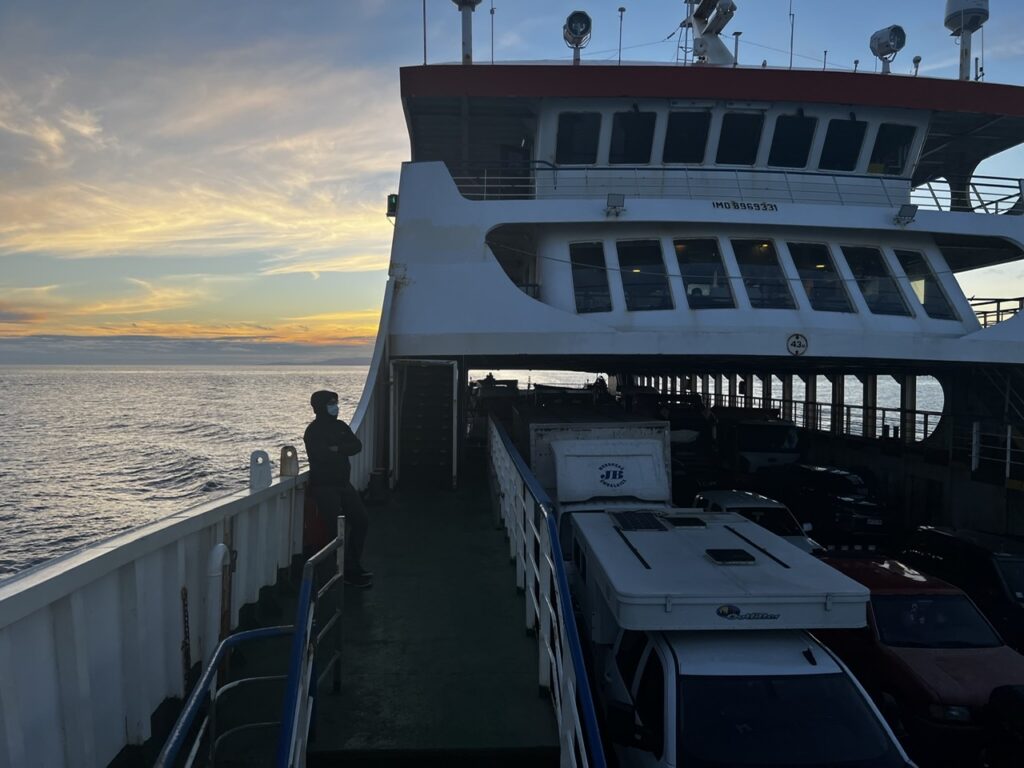
The ferry to Chaiten – 4 hours to cross the Gulf of Corcovado to the mainlandA nice sunset across the gulf as the ferry departed Chiloe
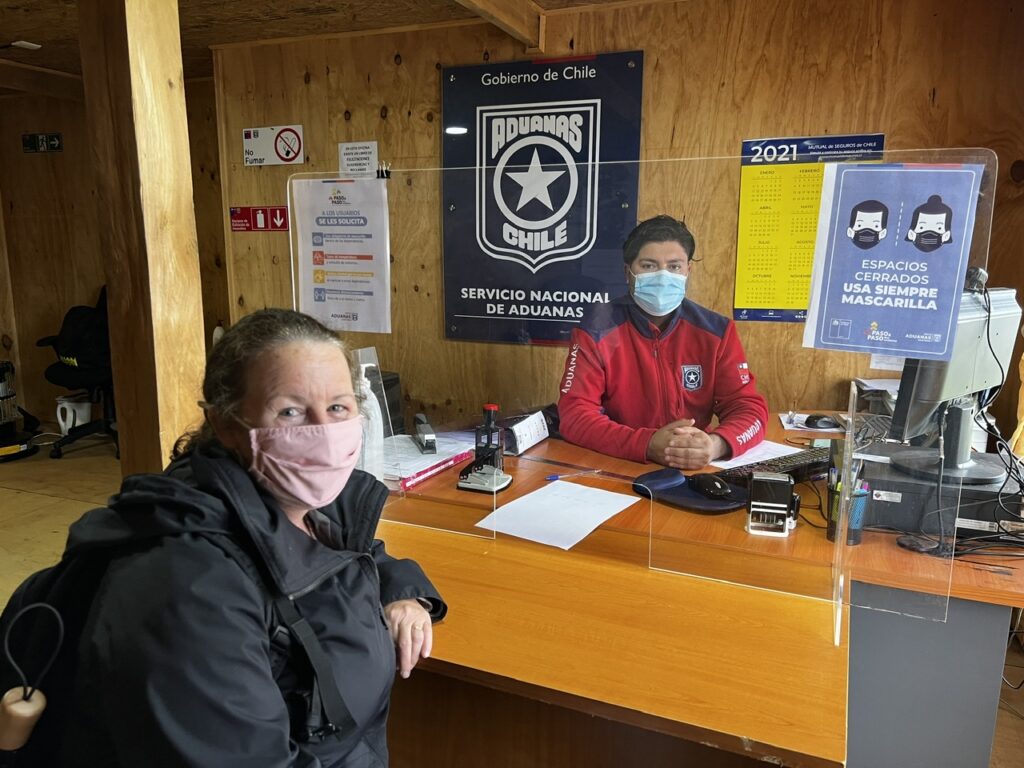
Chaiten is a rough, frontier-like town, and really just a jumping off point for destinations further south and the nearby national parks. The kind of place you can walk around in less than an hour, we used the (mostly rainy ) day to do some minor repairs, deal with a some computer issues and a last bag of laundry ( in what would likely be many rainy days ahead starting with dry clothes seemed prudent ). Most importantly, tiny Chaiten had a small ”Aduana” (Chilean customs) office and we popped in on the off chance it may be manned ( several others, in larger cities, had not been ) as we were quite desperate to address the nagging issue of our vehicle TIP ( temporary import permit ). Having left Chile suddenly, minus our vehicle, the original TIP had expired almost 18 months ago and we foresaw potential issues ( and possible penalties ) when exiting Chile and crossing to Argentina. Absent a sympathetic hearing here we’d be explaining this to a border official in a few weeks and completely at their mercy. Fortunately a most obliging Aduana agent ( Hector ) fully understood our plight and promptly made us “legal” again until January 2022 ! A huge stress gone.
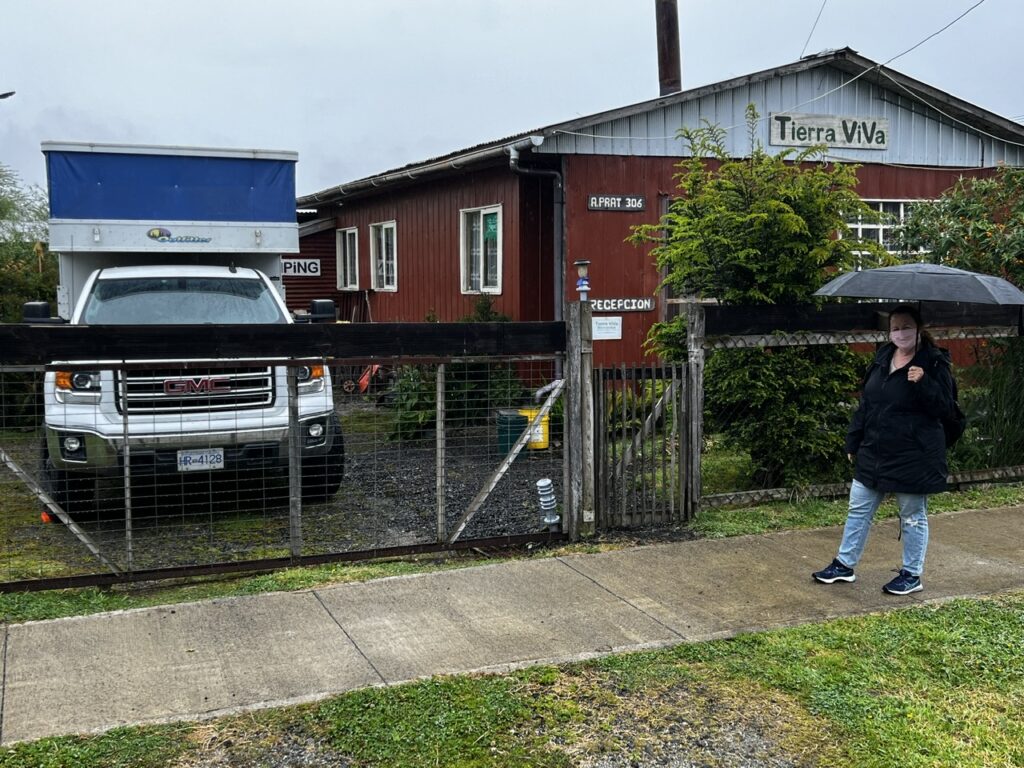
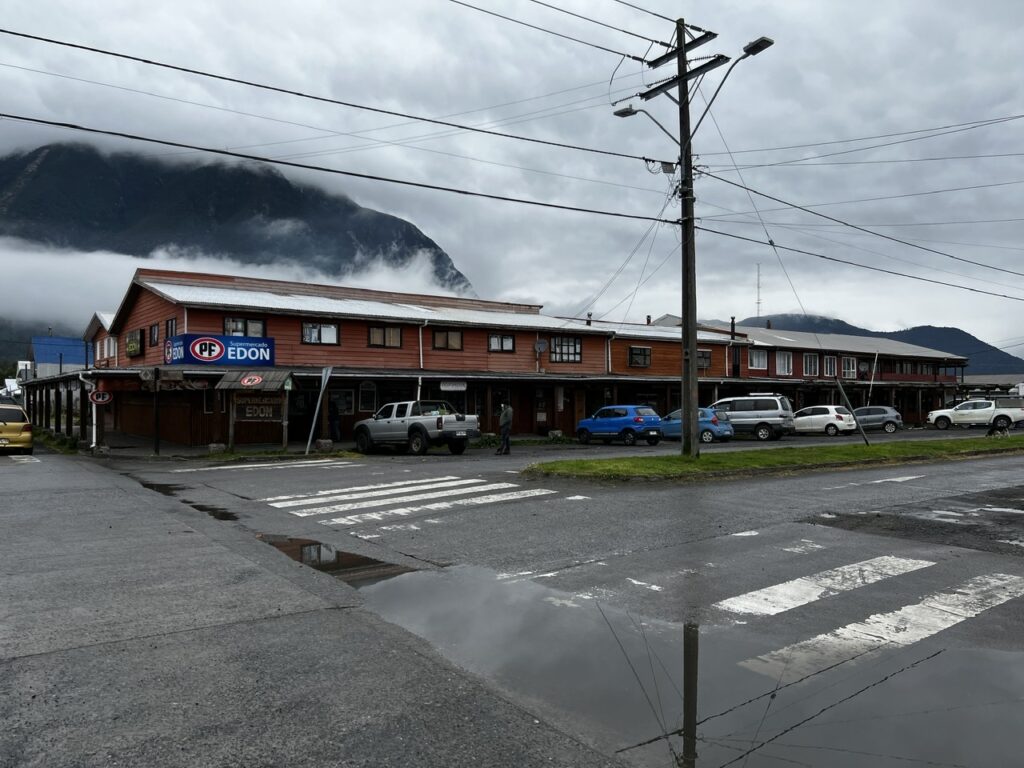
It helped I am sure that we were almost certainly his only clients that day – he seemed happy to have visitors !In the abscence of formal campgrounds, “camping” in Chile, especially in the remote corners, often means this ( squeezed into someone’s backyard ). Cozy, yes, but the steaming hot showers and strong wifi got Tierra ViVa rave reviews Downtown Chaiten – reminded us of northern BC communities with the wide open streets and often inclement weather
Based on some local recommendations from Andres, our host at Tierra Viva, we first went a little north on the Carretera before turning around and heading south. The road bisects Parc Pumaulin Douglas Tompkins, one of the more well known on the Carretera, a park established substantially due to the work of North Face ( outdoor gear ) founder Douglas Tompkins who spent significant time in the region.
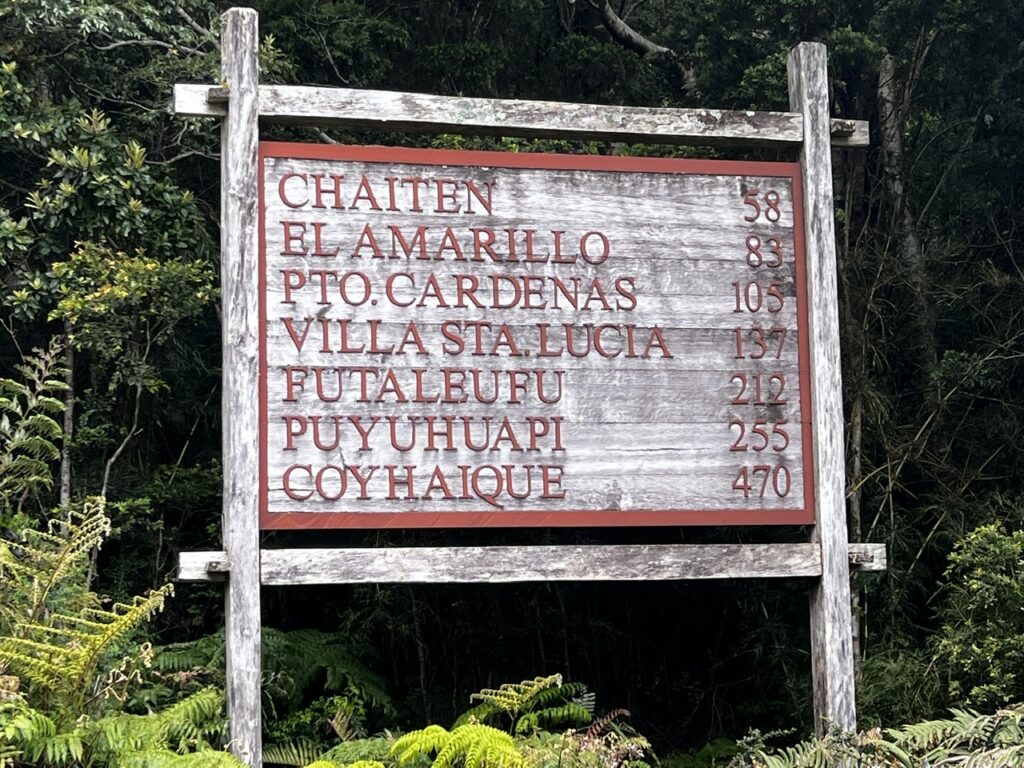
Our day started at Caleta Gonzalo, a small ferry port 58km north of Chaiten. Sign shows some of the stops on the route south
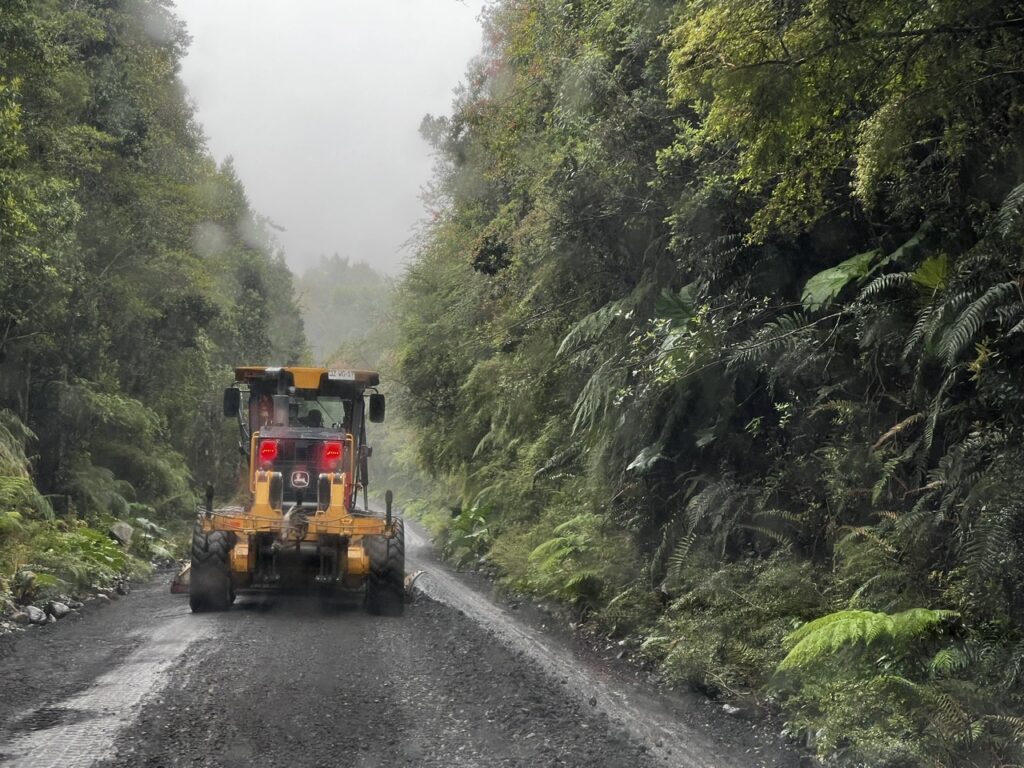
Noticed the first signs of what would be ongoing work on this road. Part gravel, part asphalt regardless it traverses difficult terrain and rock/mudslides are ever present risks – the road continues to be a work in progress.
Getting there was slow, lots of roadwork and mostly narrow gravel roads on this day
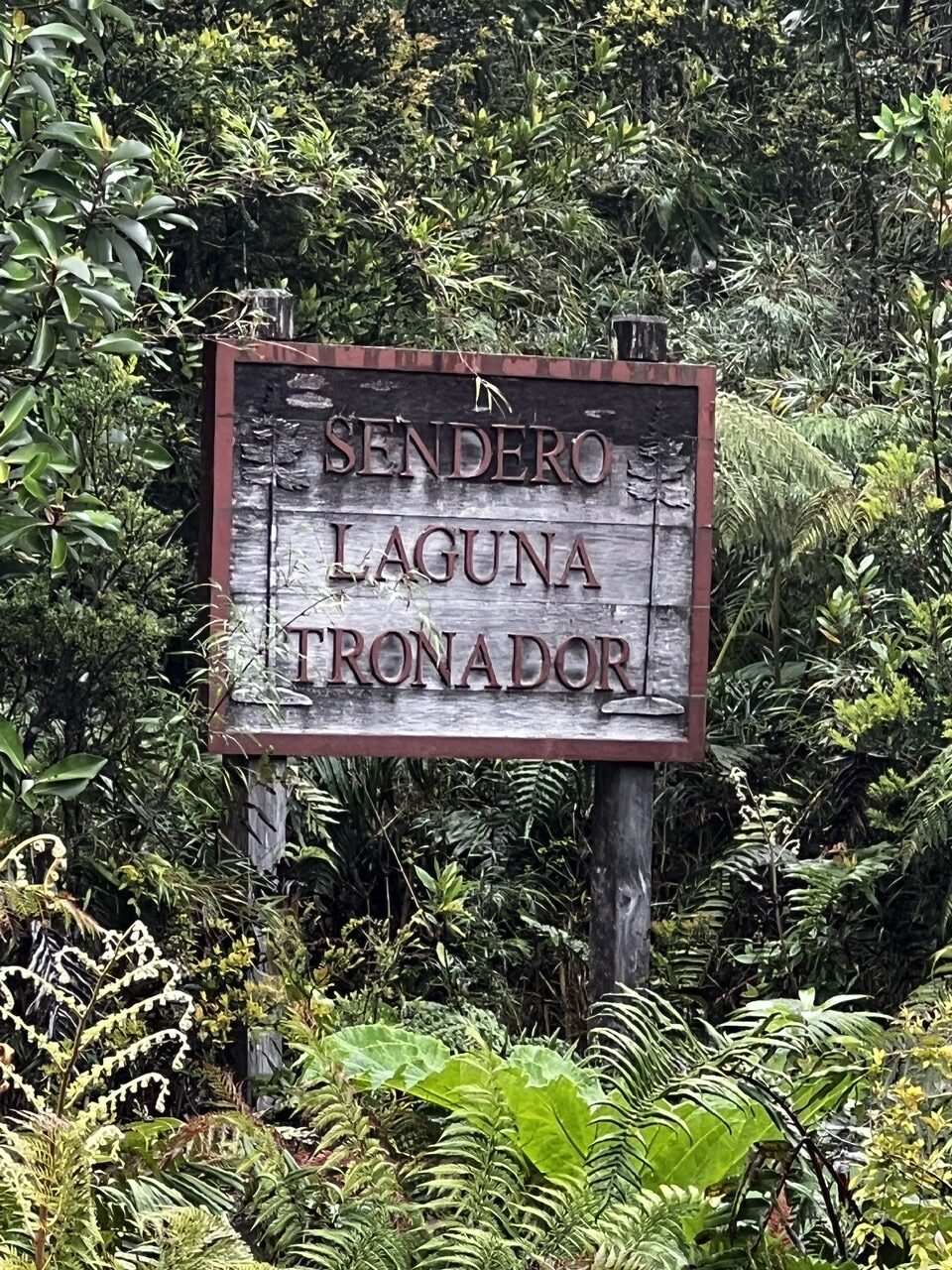
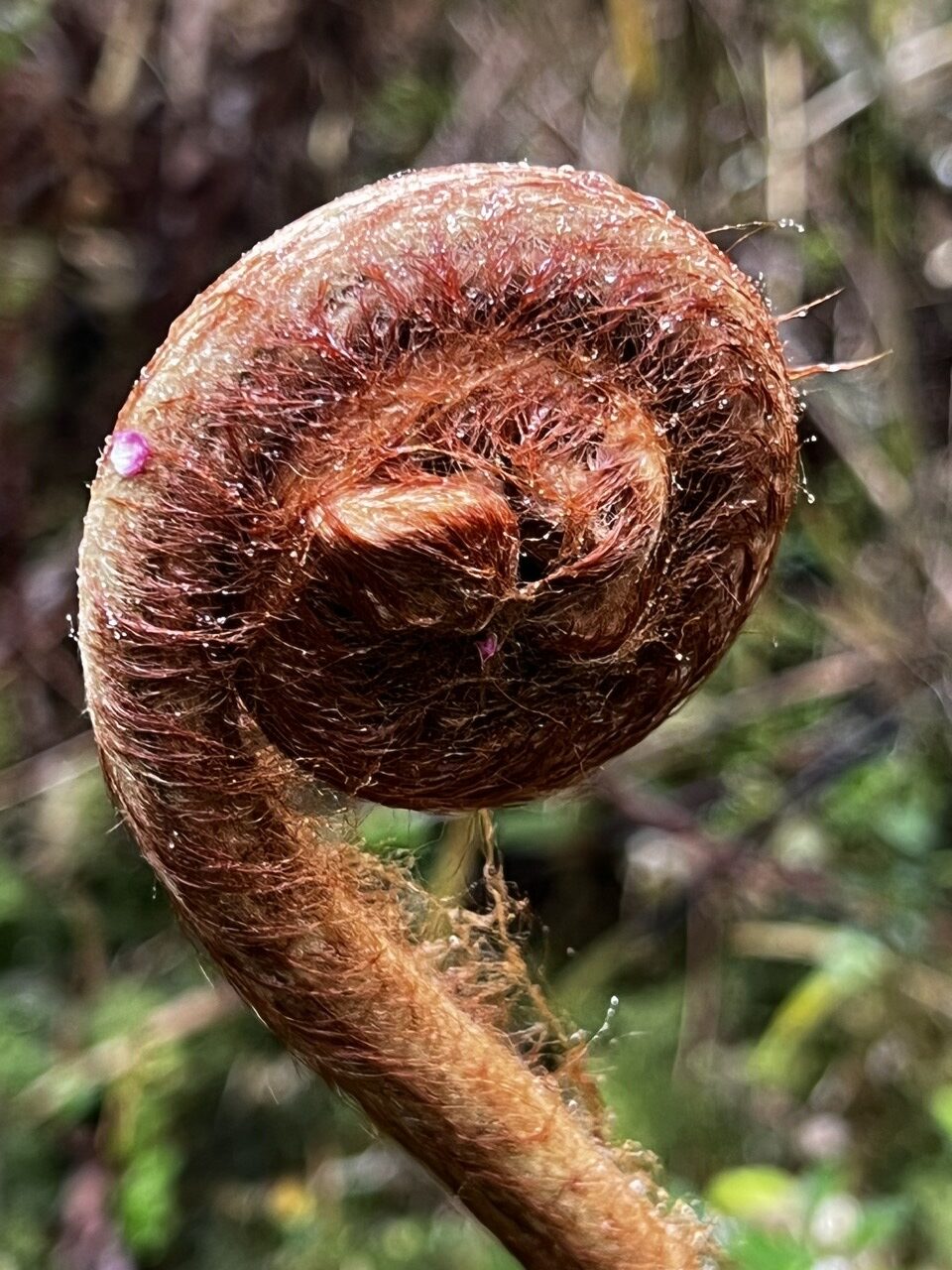
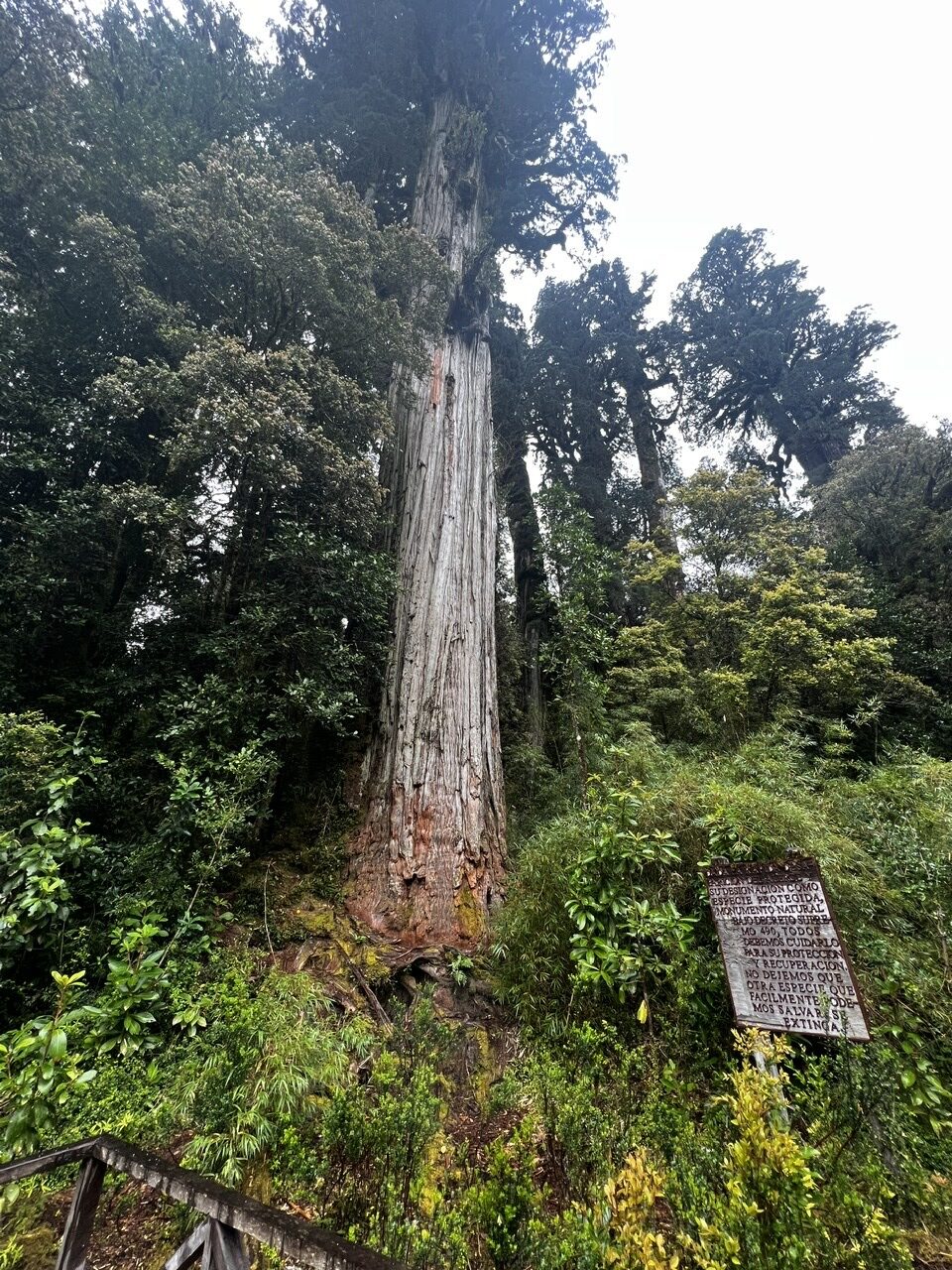
Andres’s recommendations both of the Sendero Laguna Tronador hike and the Sendero Cascadas Escondidas (waterfalls) hikes were well worthwhile and it was great to get out and stretch our legs on a couple of fairly short hikes. The giant alerce trees are indeed impressive ( related to North American sequoias, and can reach 4,000 years old ). We also came across a bunch of other weird and wonderful plants. Very reminiscent of Vancouver island and parks on the Oregon coast ( visited earlier on the PanAmericana).
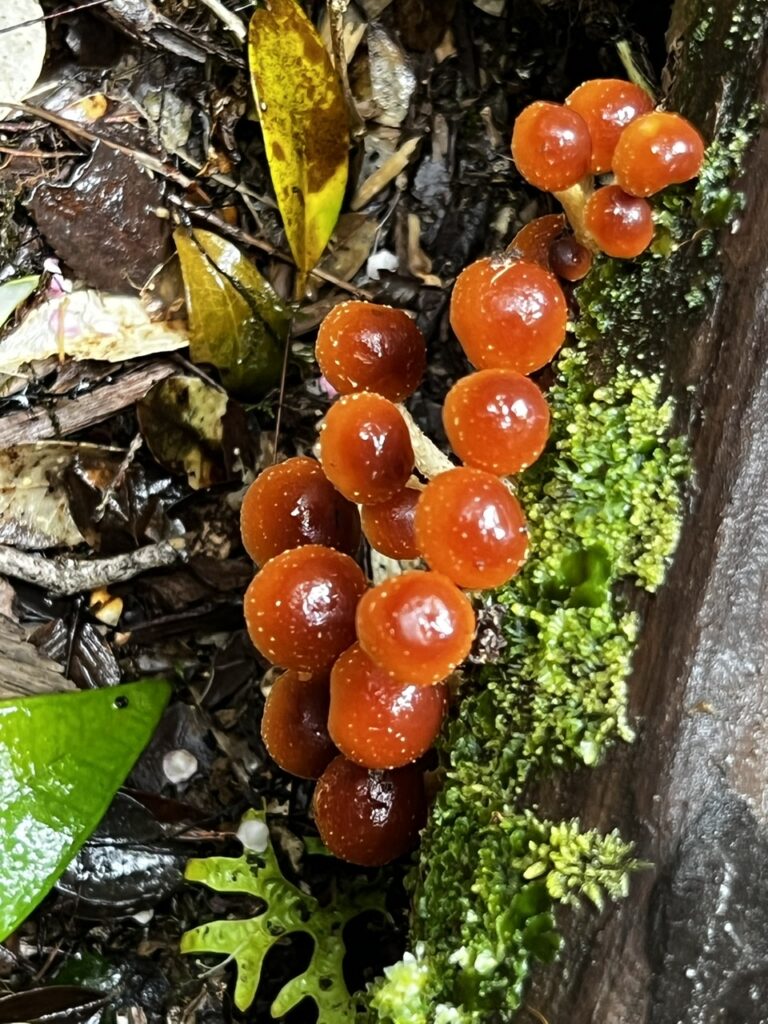
First hike, to check out the alerce treesThey are not mini tomatoes !….and along the way uncovered some weird ( to us ) plant life !Old growth alerce trees, some were massive
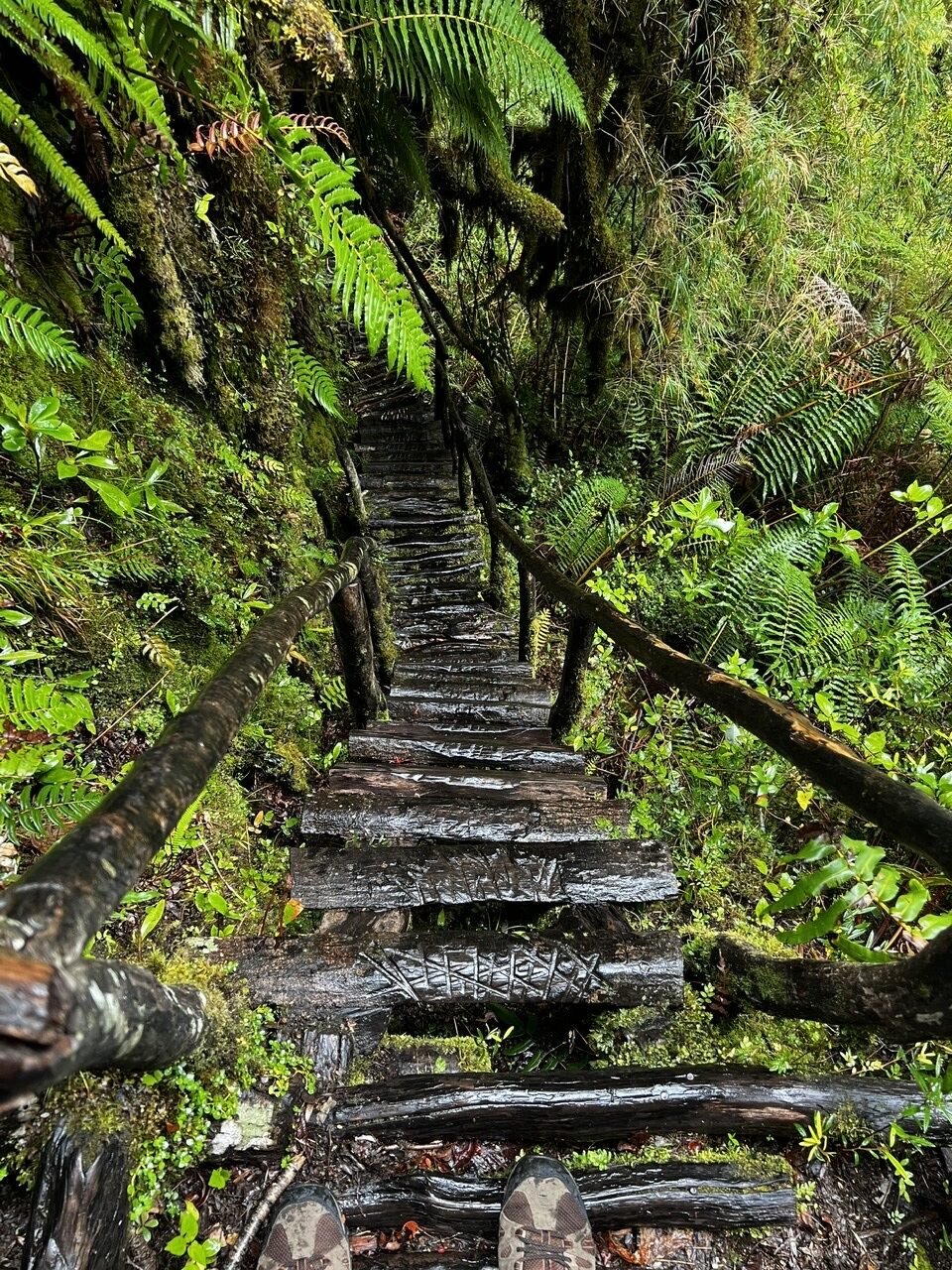
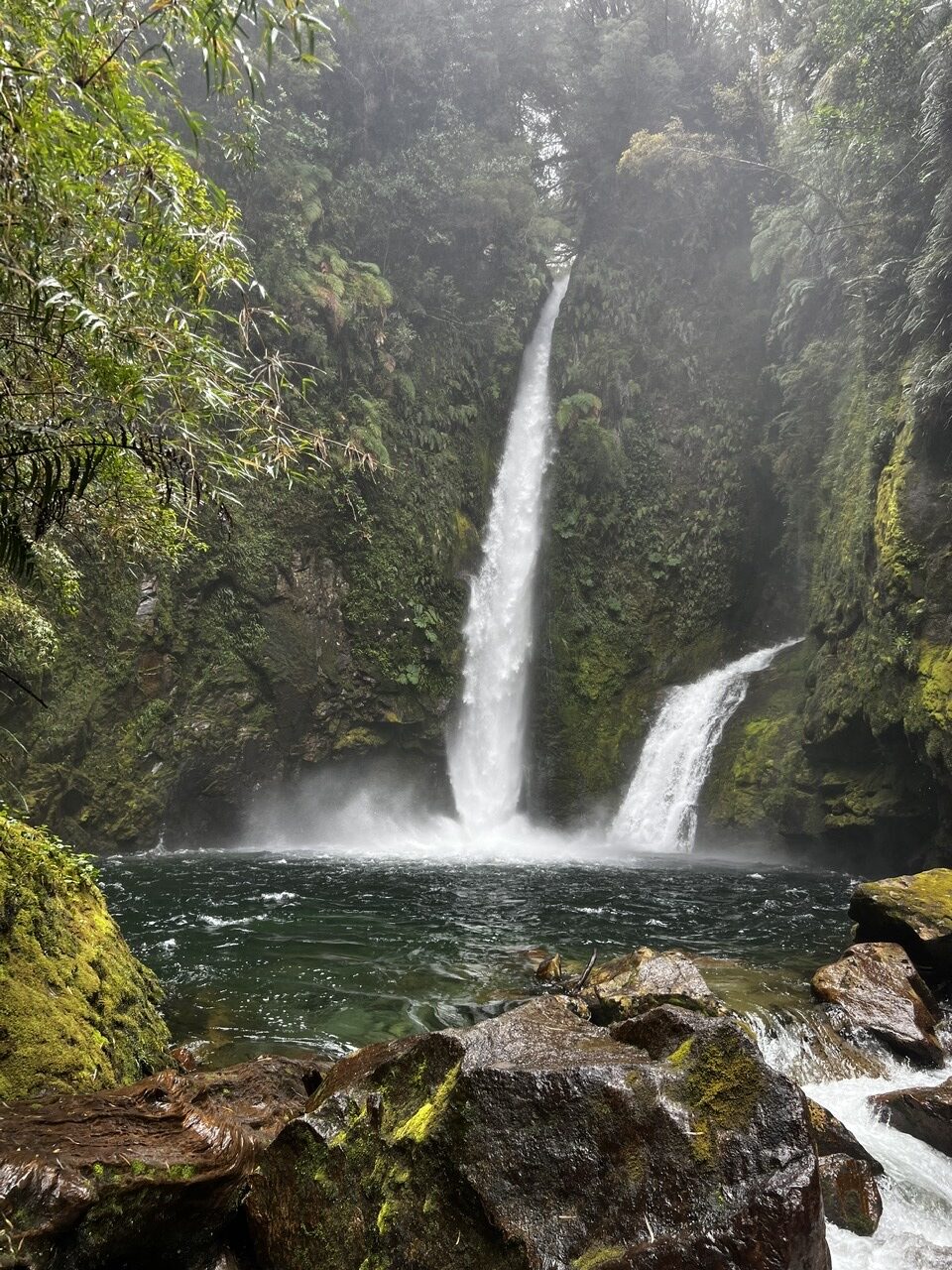
While very misty, it wasn’t exactly raining and we managed to see the two sites in pretty good conditions though in some cases rudimentary ( and almost vertical ) “ladders” had to be navigated to get to the falls; the destination justified the trek
A very slippery hike !The falls were impressiveSome smaller falls further south
Futaleufeu was an easy drive and with better weather predicted there we made for this quaint little town near the Argentine border. The vehicle needed an airing out in some hotter weather after days of mist and light rain – any regular campers will know the feeling! The Futaleufu excursion was not just for the weather but also to soak up what is one the Carretera’s most popular “detour” drives and to take the opportunity to speak to border agents about the status (now and in December ) of the crossings to Argentina. The earlier good news we had heard about ALL frontier posts being open as of December 1 appears to have been a miscommunication so we needed factual and accurate information straight from the horses mouth so to speak. Absent more border posts opening in the south we would not simply be doing the Carretera Austral southbound but in all likelihood northbound as well making for a very circuitous route to southern Chile and Argentina.
Scenery got more interesting after the Futaleufu turn-off Typical of the narrow one way bridges Visibility had improved enough to see the tops of the mountains
Futaleufu was predictably charming – an outdoorsy rafting/hiking/biking mecca, the town also had some great coffee shops and excellent food. Pizza de Fabio was highly recommended for his artisanal pizza and Fabio did not disappoint!
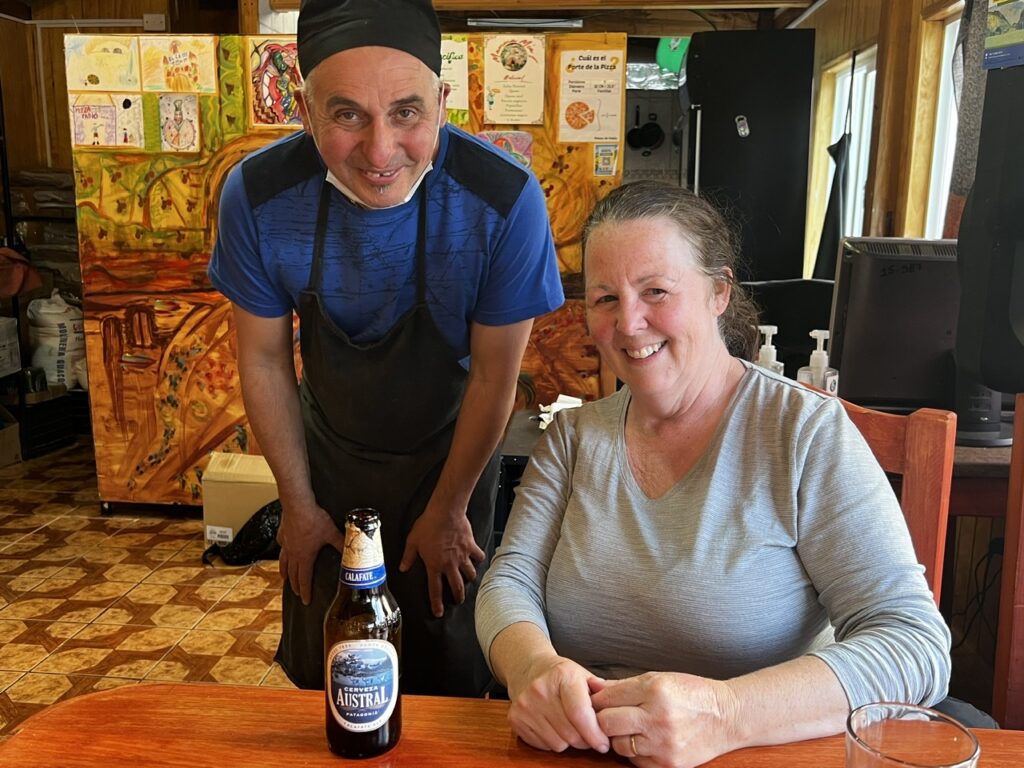
Lois with Fabio, owner of Pizza de Fabio. The Pizza Andina was delicious, washed down with ( what else ? ) an Austral beer !First stop next day – a coffee shop recommended for its cappuccinos ( Lois’s favorite )Took advantage of the wind and sunshine to air out our bedding . Things can quickly get damp in Patagonia regardless of the season.And there is that name again
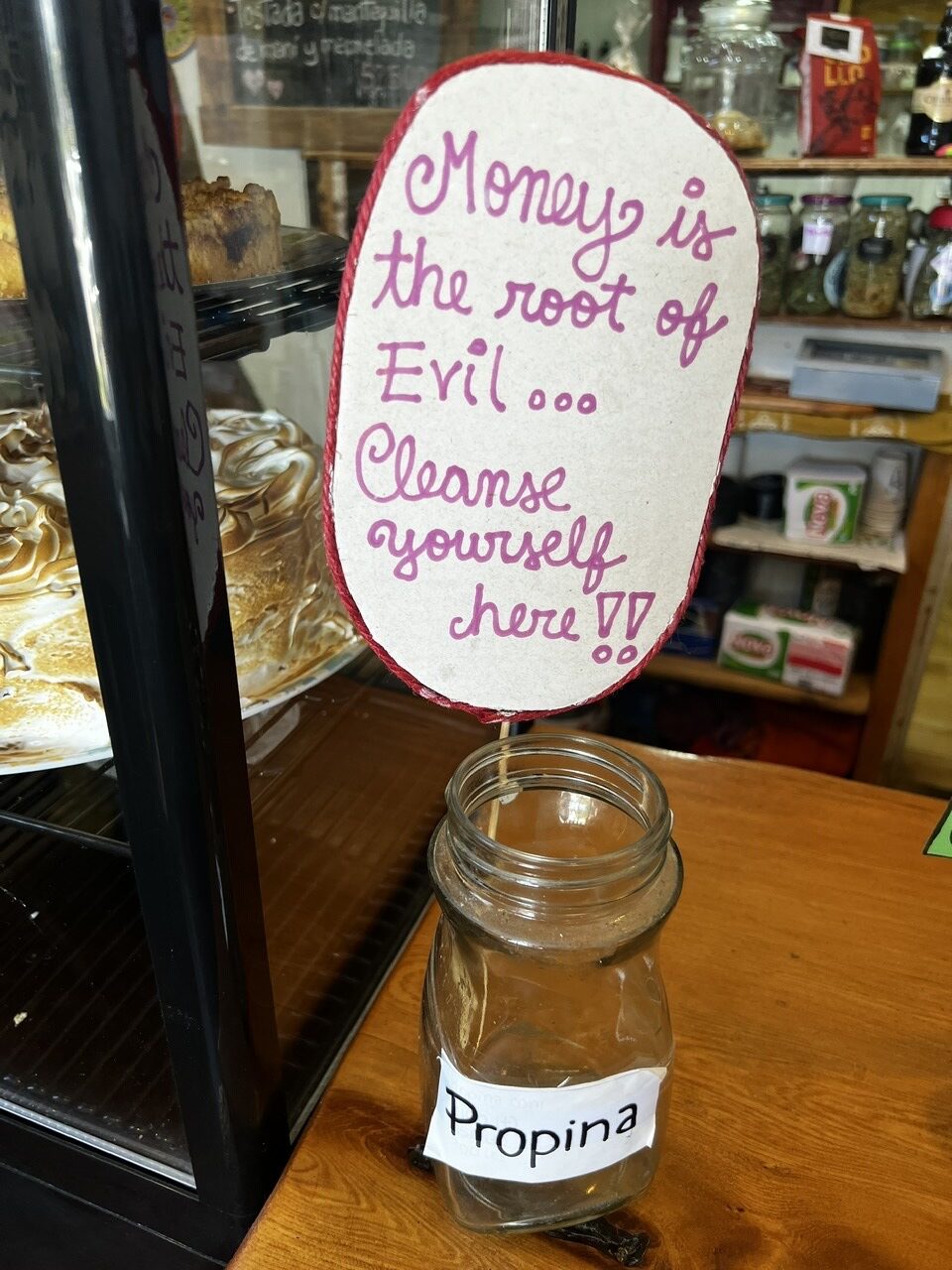
The Chileans have a great sense of humour – loved this sign in a shop we visited 😊
So we had the delicious cappuccino and then “cleansed” ourselves ! Hint: “propina” means tip !
Following our discussion with the Aduana ( border officers ) in Futaleufu there was cause for optimism that at least one Chilean/Argentine border in the south will open by January 1 (currently none are ). In the week ahead there will be time to work that into our travel plans such that we can, very hopefully, still make it all the way to our goal of reaching Tierra Del Fuego.
From Los Angeles ( Chile ) the Lakes District was only a few hours drive south. Long, straight, smooth highways almost all the way made for an effortless drive, first to Villarrica, and then on to Pucon. Two of the gems in the Chilean Lakes District these two towns attract Chileans in droves. We spent almost 5 days in the area and can see why it is so popular. Reminded us very much of Banff/Jasper….just had that kind of feel. Sampled some of the best coffees and sweets so far and had the usual amazing Chilean hospitality especially where we stayed.
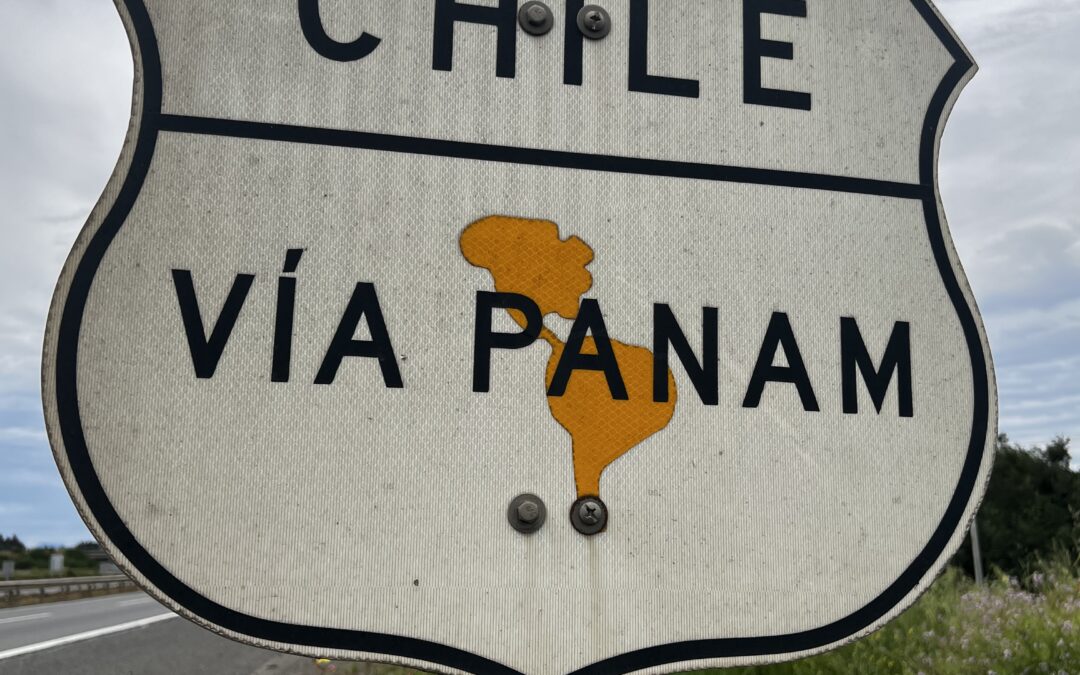
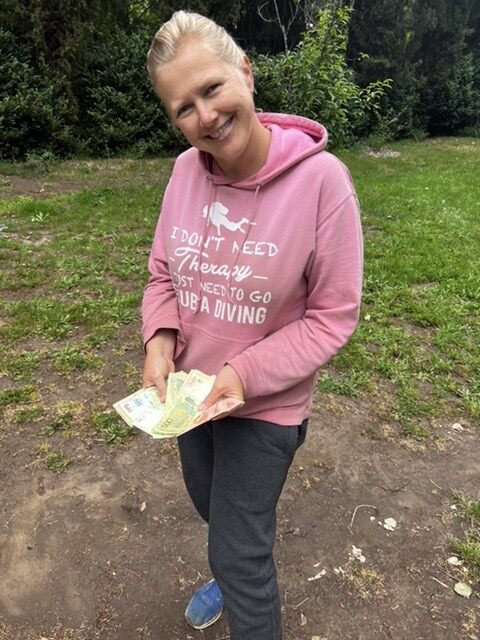
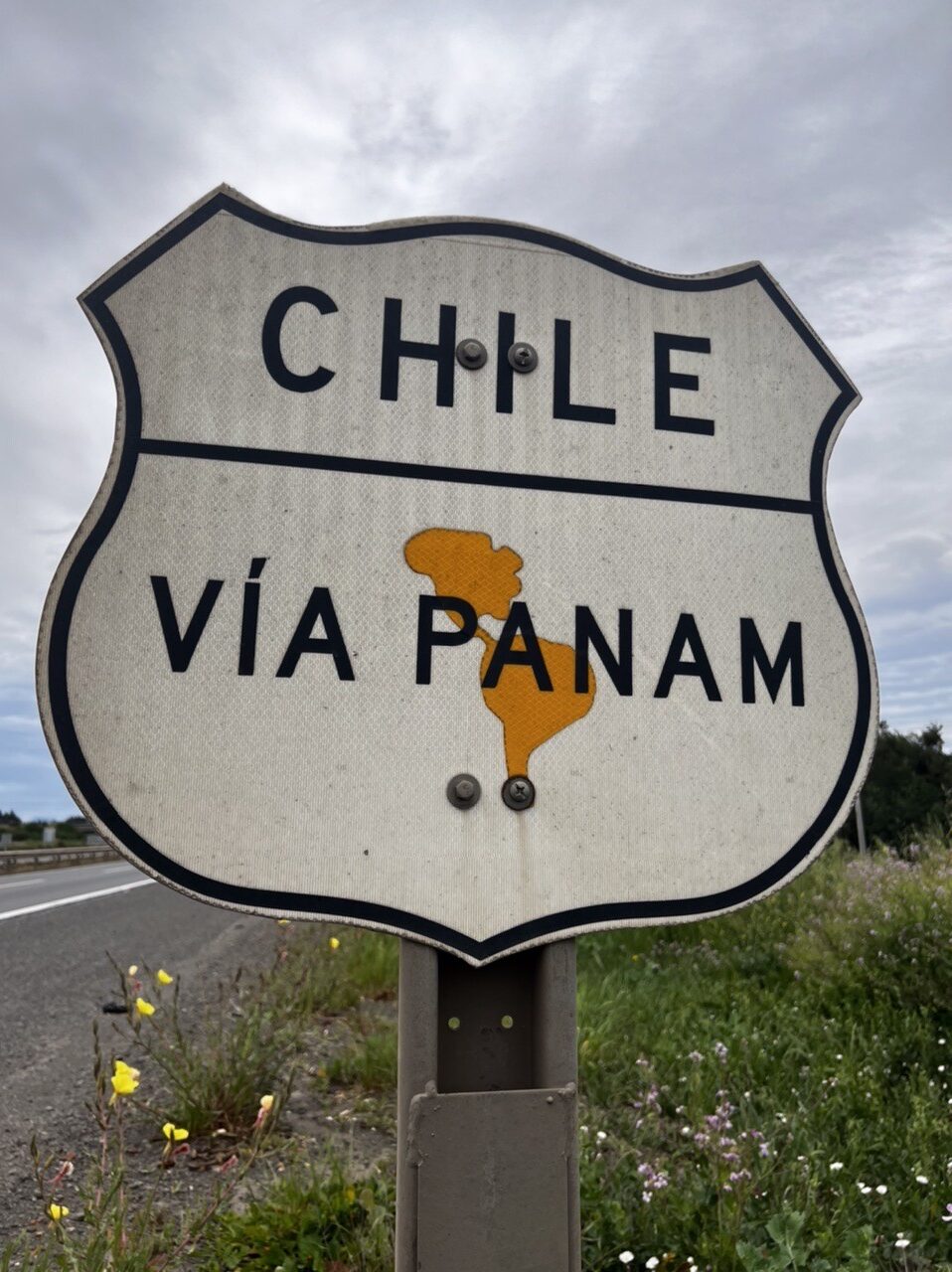
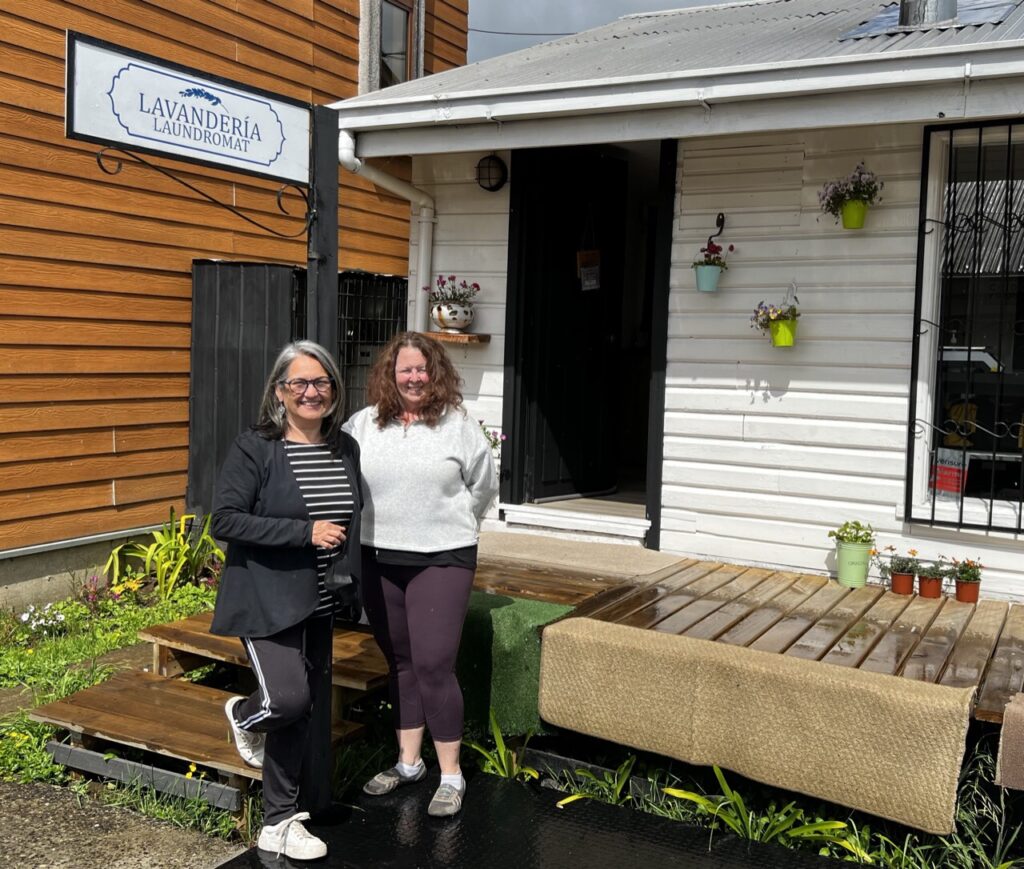
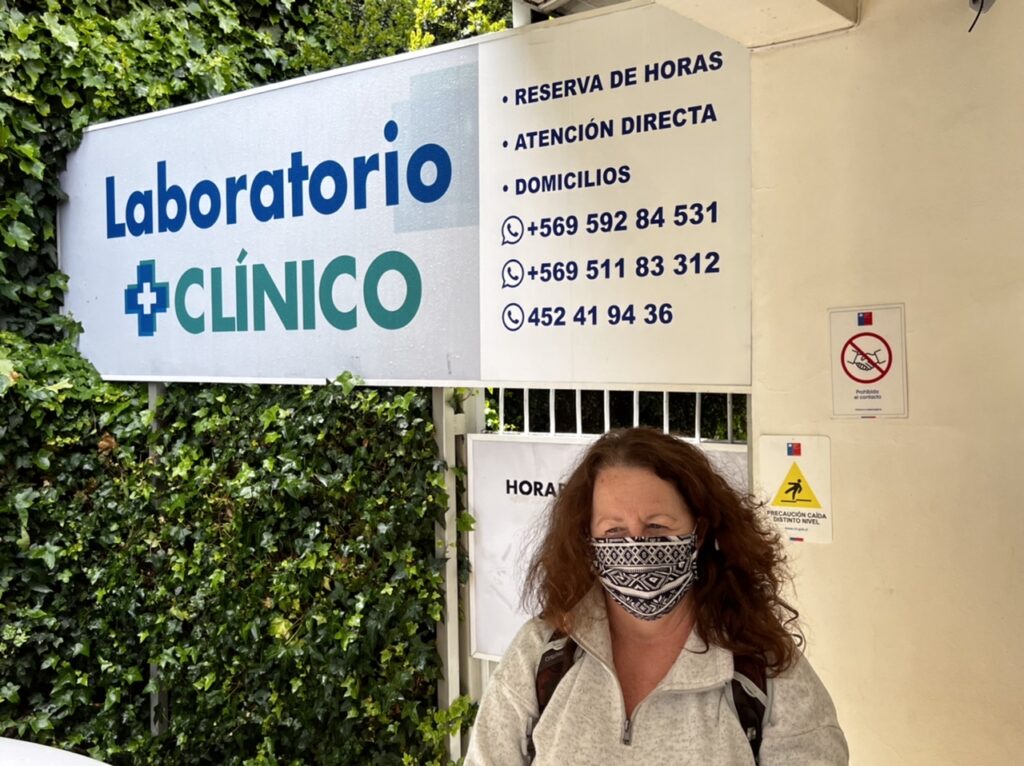
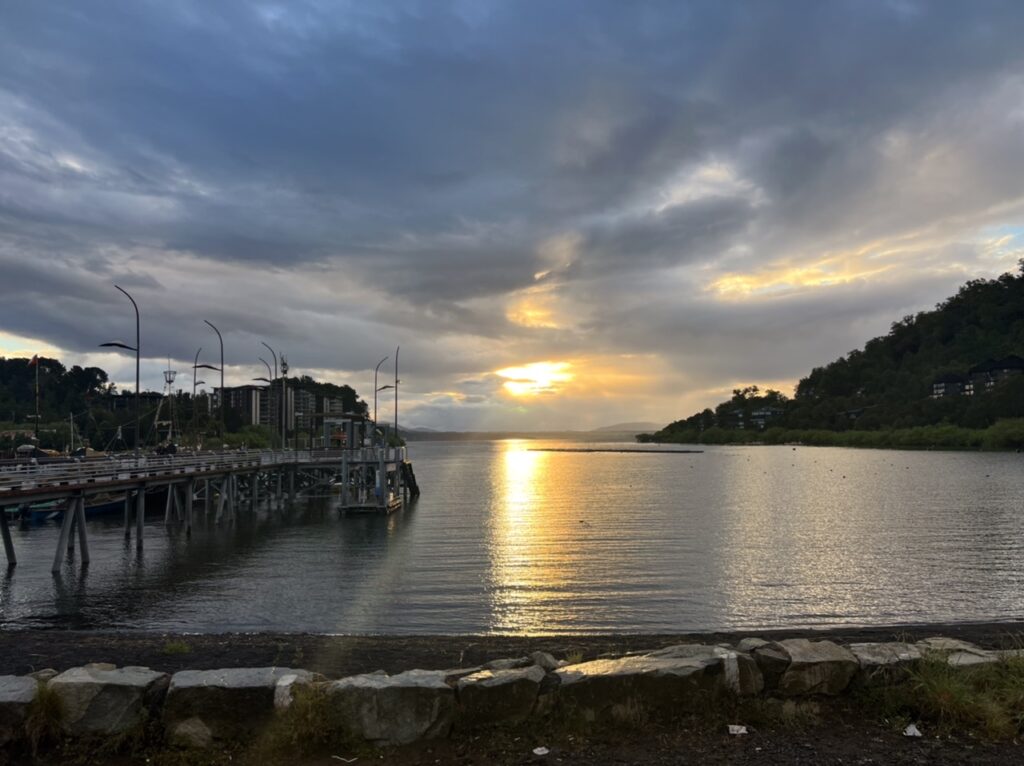
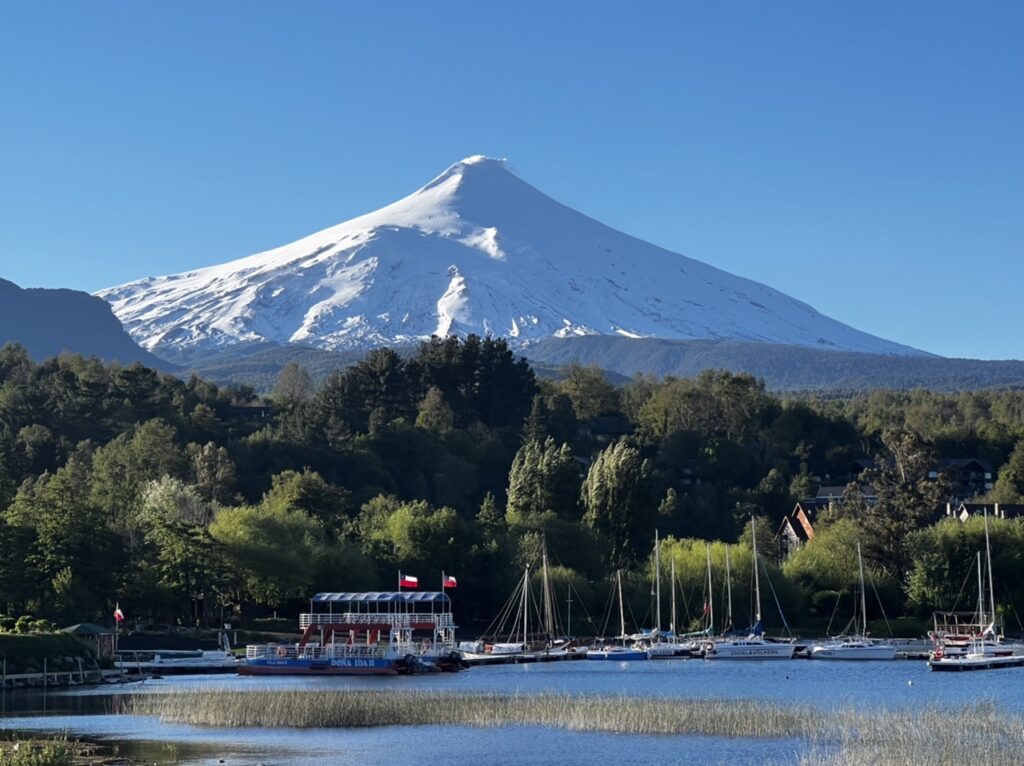
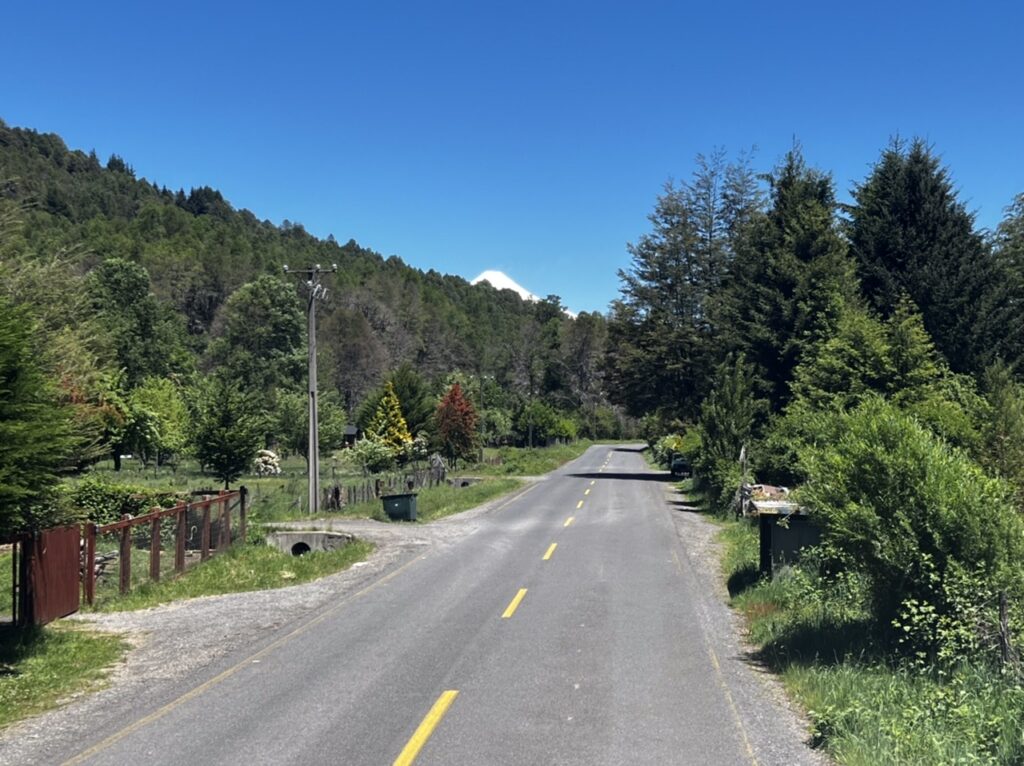
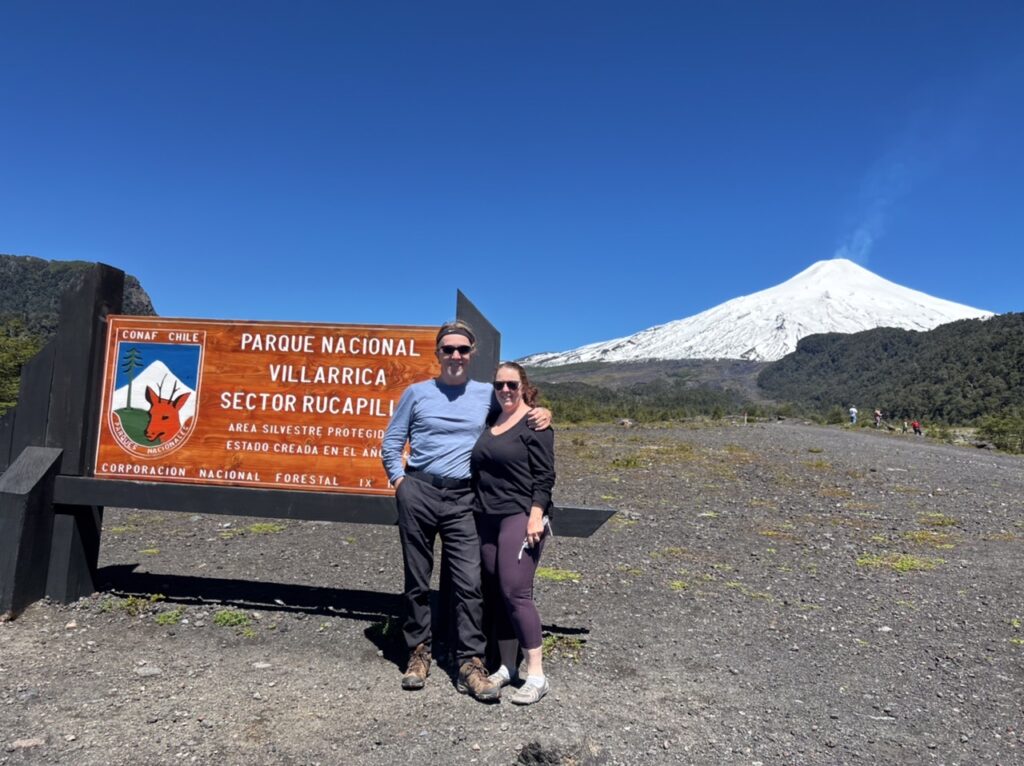
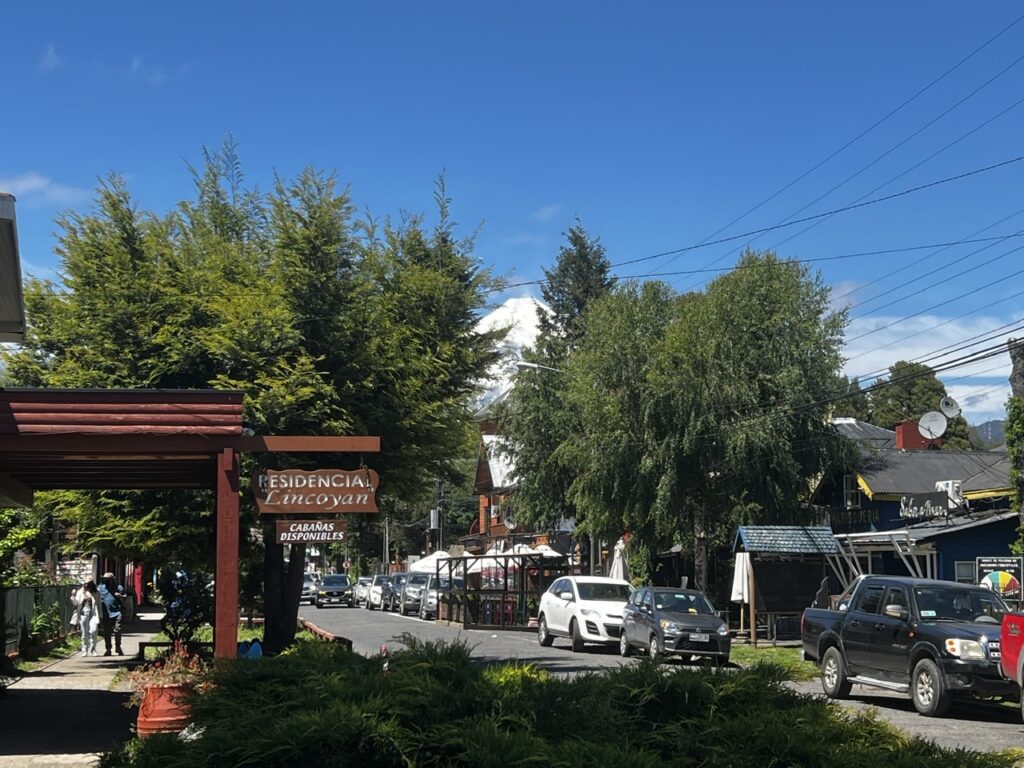
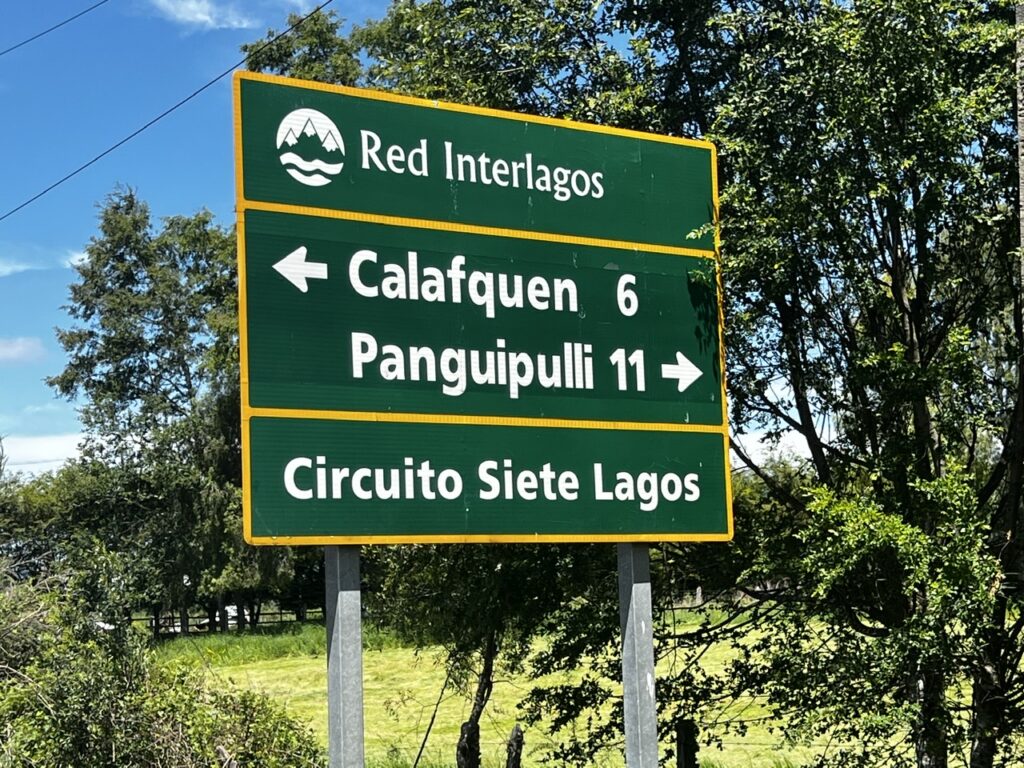
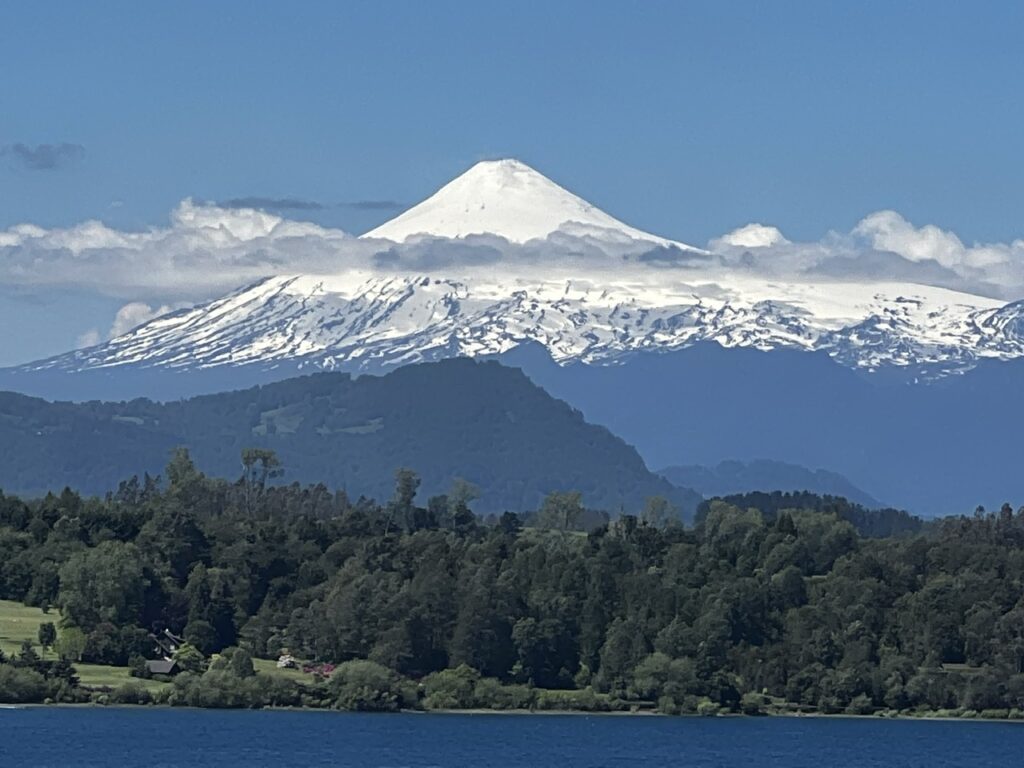
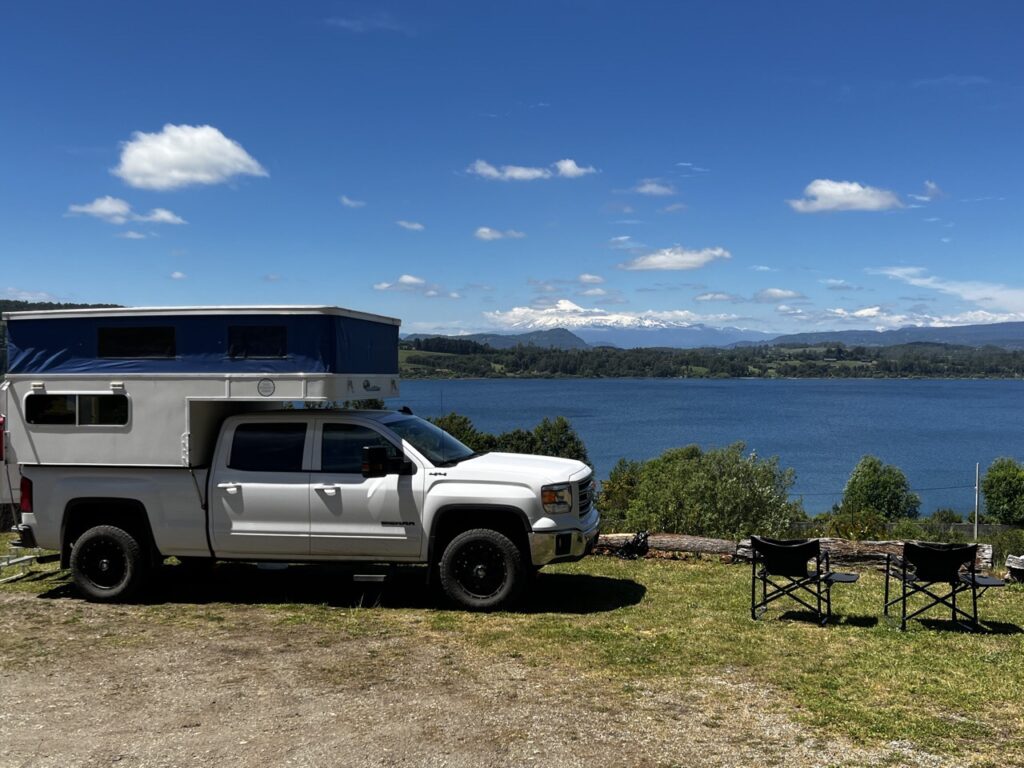
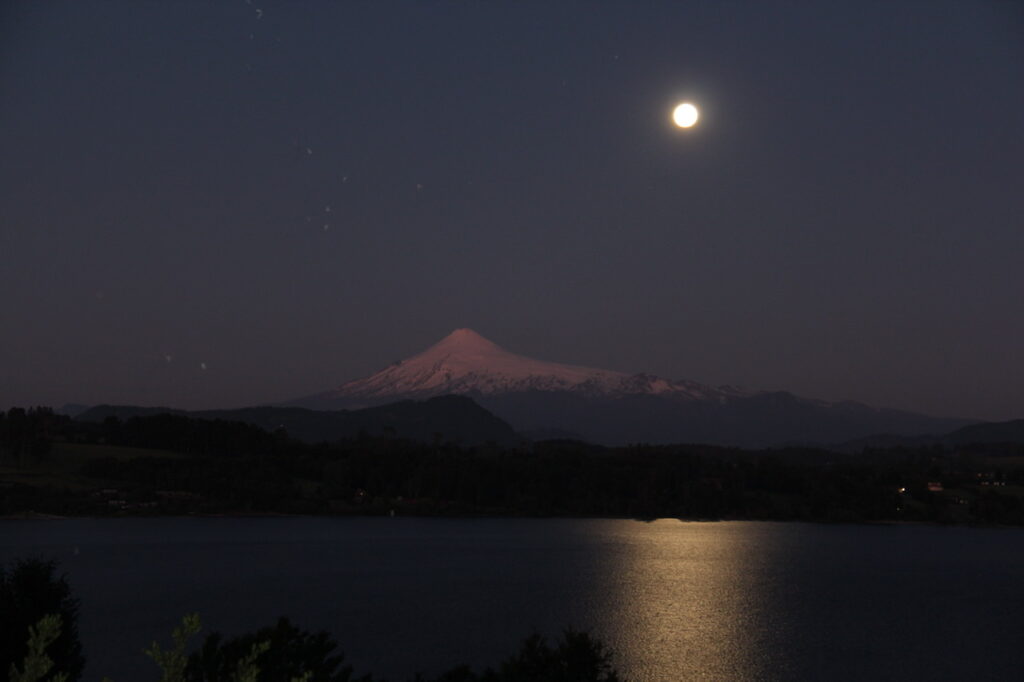
Prior to leaving Los Angeles ( Chile ) we took all Nienke’s Argentine pesos off her hands. Would come in handy if we crossed into Argentina at a remote locationPan American highway signs began to reappear in ChileFinally, 10 days into our time in Chile and no longer did we need to self report possible Covid symptoms !Rodrigo hosted us at his cabanas in Villarrica on our first night, he had studied in Winnipeg and warmly welcomed some impromptu Canadian guestsStreet scene in VillarricaStreet scene in Villarrica Patricia, who owned the laundromat in Villarrica was a godsend. Helped us through the Chilean health process. Another fluent English speaker, she and her family had lived in Canada in the 70’s after fleeing the Pinochet regimeWhile in Villarrica we needed to do a test to guarantee to the Chilean health authority that we really had been vaccinated. Required to extend our health pass to 90 daysSunset in Pucon where camped on the waterfront one nightView to Volcan Villarrica from the Pucon waterfrontOur camp “site” one night in Pucon. Overlanders had mentioned this little gem so we sought it out. A stunning view to wake up to but a disturbed night of sleep. We moved on…..Rural scene in the Lakes District. A snow-capped volcano around every corner it seemed Volcan Villarrica Street scene, Pucon ( parking was impossible ! )Great cafe/coffee shops in Pucon, we sampled a bunch. So tempting !The name “O’Higgins” appears all over Chile and he was a legendary historical figure ( with an Irish background ). Many streets and plazas bear his name.Andrea (with “Blackie” ) who hosted us for a few days in Pucon. Camping Copacabana, one of the best campsites we have been at.Street scene in PuconWe spent several days just roaming around the Lakes District, partially following the “7 Lakes Circuit”Volcan VillarricaStopped in at Panguipulli as we left the lakes area. A dynamic view from our hillside spot in the afternoon…..…and a stunning night view after dark on a beautifully moonlit night
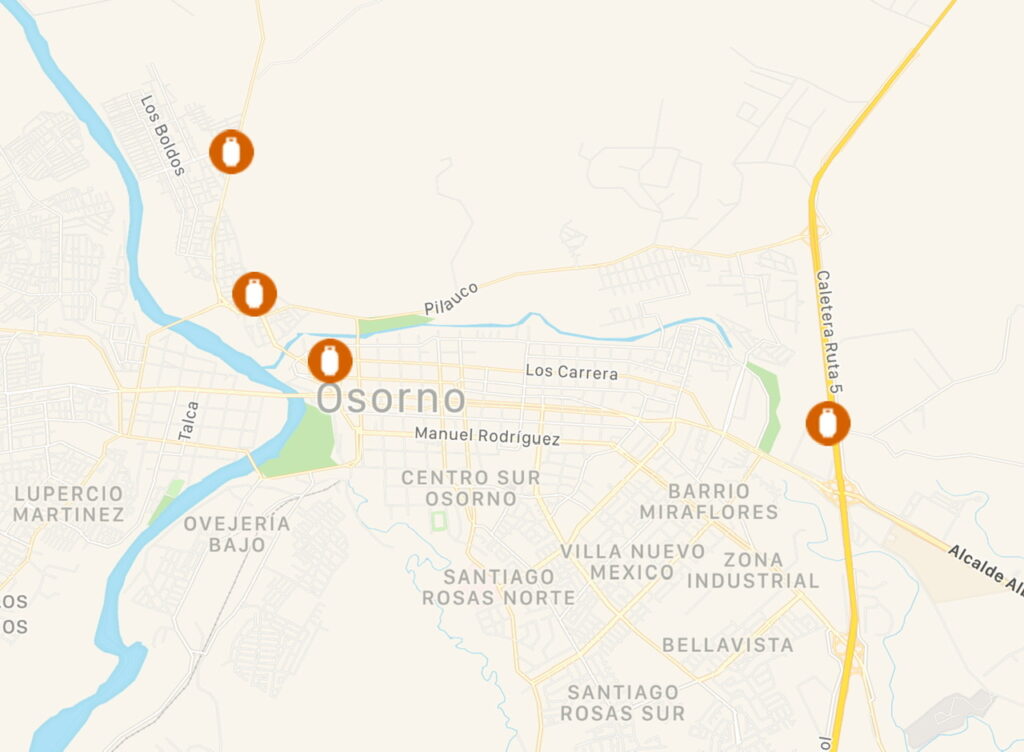
Our week closed with a drive on to Puerto Montt, a southern port city in Chile and the official beginning of the Carretera Austral. En route a pit stop was made in Osorno since our trusty iOverlander app had identified a propane depot that could apparently fill our North American tank ( and we running precariously low with some extended remote travelling ahead in potentially colder weather ). Osorno was, in all likelihood, our last kick at the can until we crossed the border into Argentina (probably well into December). Fortunately the gods were smiling on us……success with the first one we visited !
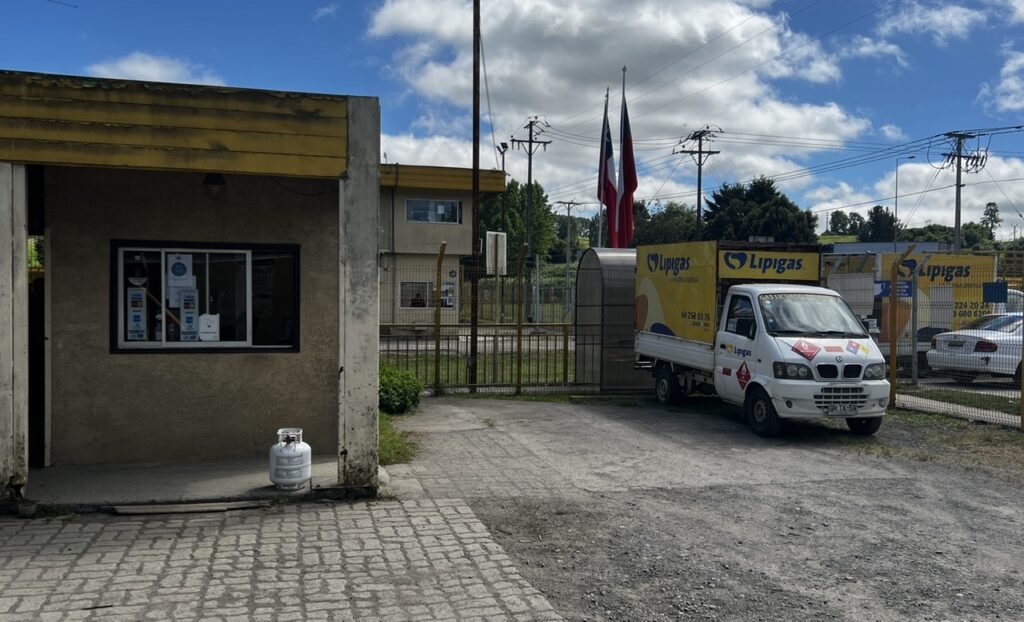
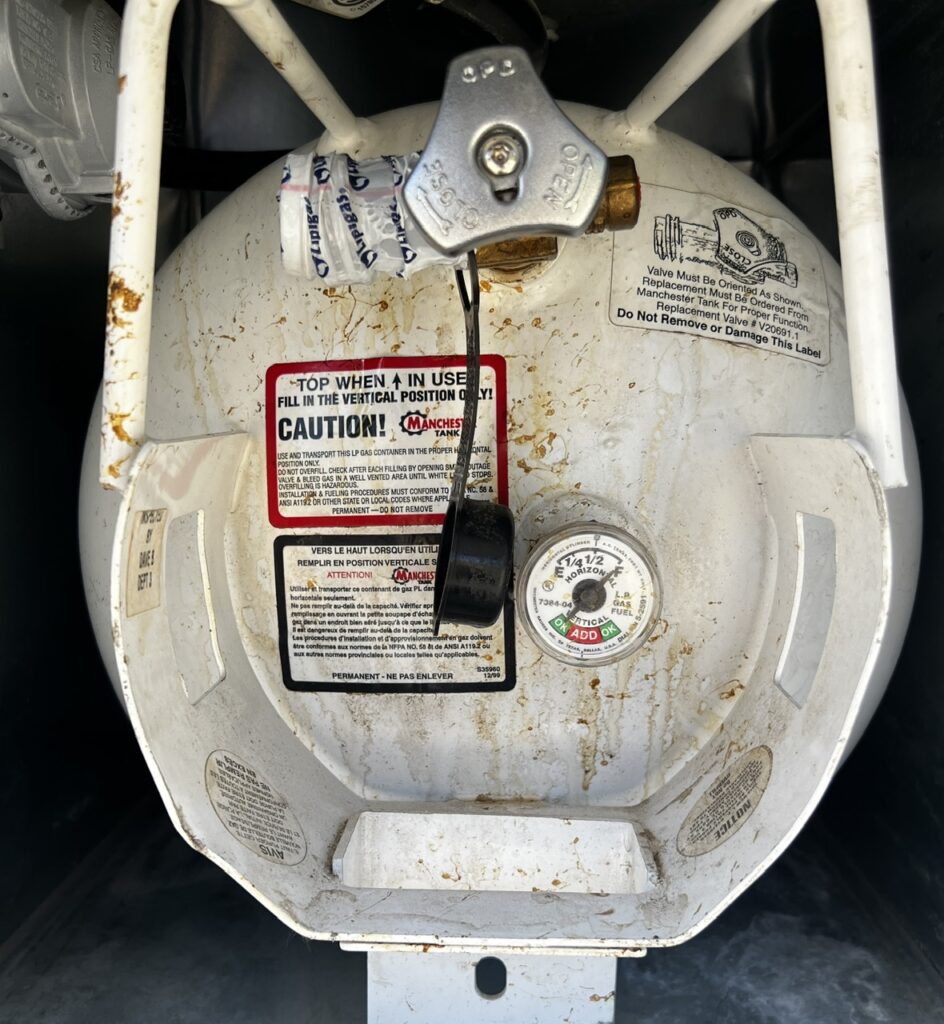
IOverlander listed 4 possible locations for propane, two of which had in the past filled North American tanks…..fingers crossed they would help us. We tried the one near the highway first.Happiness is….finding a propane depot that “might” fill your foreign tank. The different fittings in each country make it a real challenge on the PanAmericanaSheer delight is….actually getting it filled !
All going well, next week should have us on Chile’s famous Carretera Austral. We are scheduled to take the ferry from Quellon ( on the island of Chiloe ) to Chaiten where ( in practice ) this legendary road journey begins…….
Chile’s famous Ruta 7, or Carretera Austral ( Southern Highway )
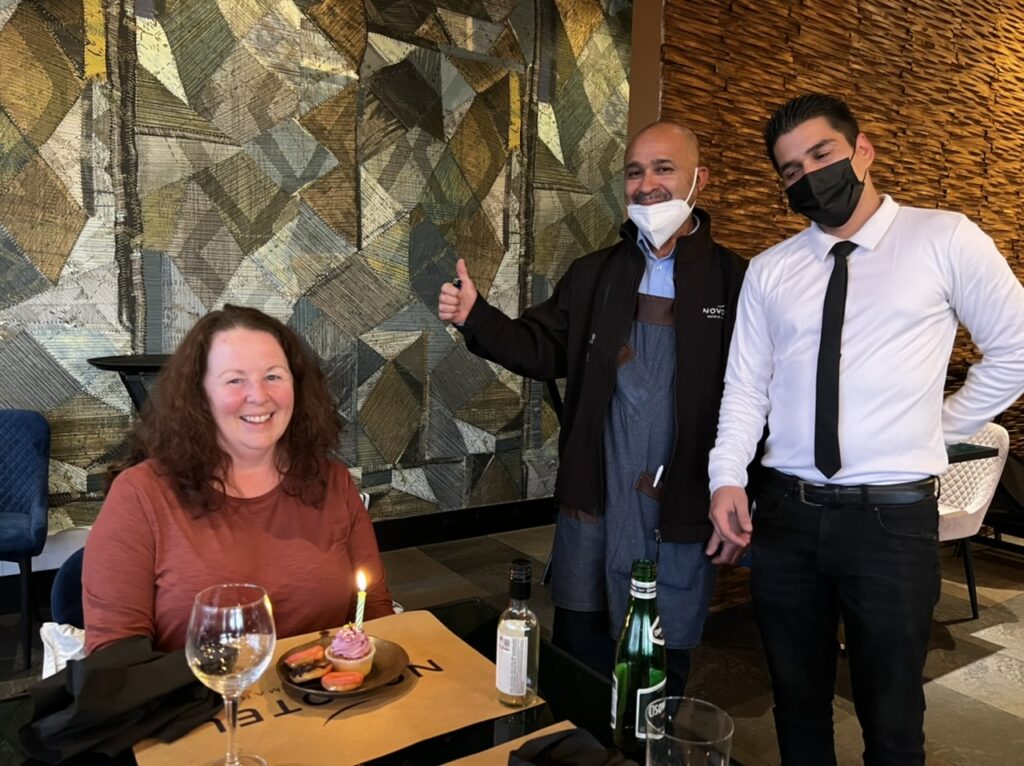
Vina Del Mar had been a great place to transition back in to Chilean life. Beautiful warm days, excellent shopping, and – I’d be remiss if I didn’t mention it – incredibly hospitable hotel staff. They simply could not do enough for us and all commented on how thrilled they were that tourism here was “coming back”. Enjoyed a special dinner on our last night as it was Lois’s birthday the next day – as soon as the waiters became aware of that some cupcakes and cookies were promptly delivered to us and the two of them serenaded Lois with a rousing “Happy Birthday to You !”
Lois getting a birthday treat
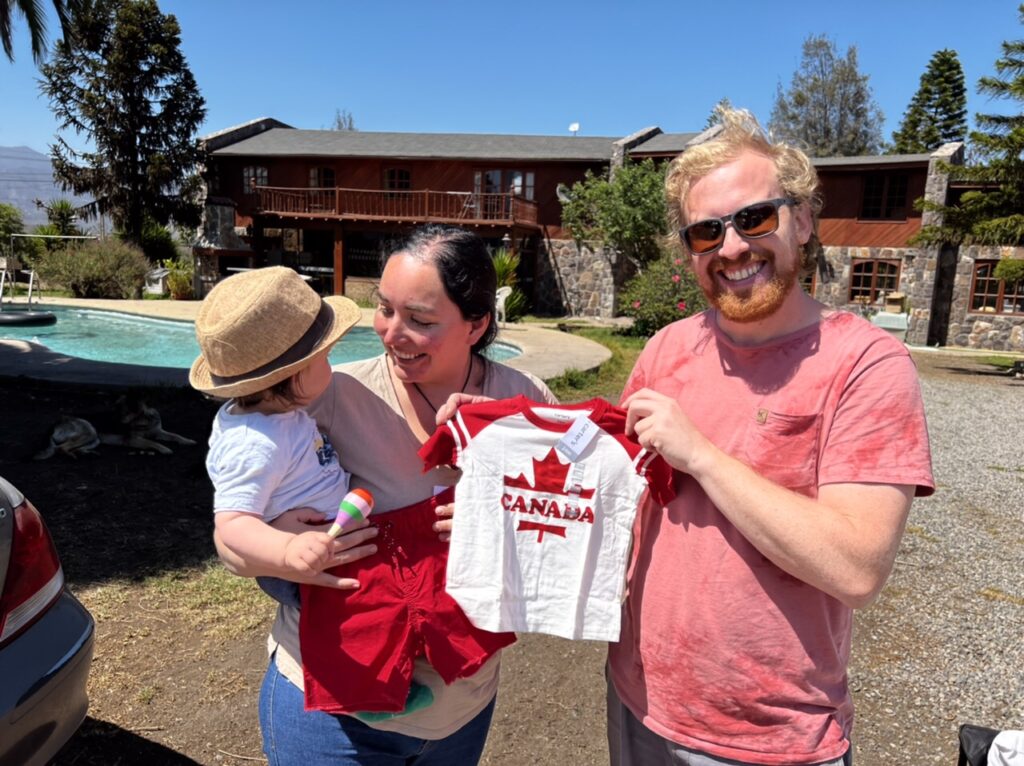
Our “man in Chile”, Juan Pablo, arrived Sunday morning and it was truly wonderful to connect with him again after last seeing him in late March, 2020. He had become a father, started a new business, and, as it turned out, did a fantastic job of taking care of our vehicle ( and almost 30 others ! ). Quillota was only an hour or so away so we took a slightly more scenic route up the coast. He had kindly washed the vehicle and it truly did look just as we’d left it. Some cleaning to do inside, lots of re-packing and ultimately a new battery ( we would replace it a day later – after 18 months a dead battery was to be expected ) but within a few hours we were ready to at least get moving. Juan Pablo would have none of it and insisted we stay for a full Chilean family lunch ( which starts late and runs almost into a North American dinner )…..course, after course, after course !!! Delicious, filling, and supplemented with interesting conversations with the whole extended family. Star of the show was of course their new baby boy, Andes ( yes, like the mountains ) who captivated us all. It was one of those get togethers you just did not want to leave. A global pandemic had brought us together as strangers and here we were about to leave but certainly now as good friends – COVID did give us some silver linings.
Juan Pablo, his wife Daniella and their son, Andes Preparing for a Chilean feast
The general direction now was simply…….south ! Santiago lay immediately ahead and having explored it fairly extensively on a previous visit the plan was simply to navigate around it. Chilean elections were just 2 weeks away and the city had seen protests and threats of road blocks so not something we wanted to get tangled up in. Our trusty iOverlander app ( absolutely THE most essential travel aid in the repertoire) helped us locate a small private campground near the coast on a route that would later take us through Chile’s Colchagua valley, one its most famous wine growing regions. Unsurprisingly we were the ONLY campground guests, a pattern that would repeat for the rest of the week.
Camping Las Cipreses, El TaboEl Tabo
From the rustic town of El Tabo, our route took us through the grimy port city of San Antonio ( only for the sake of procuring a new vehicle battery ) before getting dramatically more scenic on the approach to Santa Cruz. What did strike us was both the relative absence of campgrounds in this area, or, where they did exist, the fact that they were closed. COVID impact ? Too early in the season ? Either way, finding a spot to camp would be be a tad more challenging for the next couple of nights. In any event as most often seems to happen, a solution was found and we found ourselves ( again ) the only guests, this time in a private’ gated, “Tiny Cabins” development with total run of the place…!
Marco, replacing our dead battery in San Antonio
It only made sense to make full use of the facilities ( space, security and privacy ) to do a total re-clean, and re-pack of the vehicle merging all the things we’d left behind with an even bigger pile of the things we’d brought back, only to realize that some serious, shall we say, er, “consolidating” was in order.
Parked at Tiny Cabins, Santa CruzBattery was not the only thing we replaced. I carried a spare cabin air filter so changed that tooA most serendipitous discovery
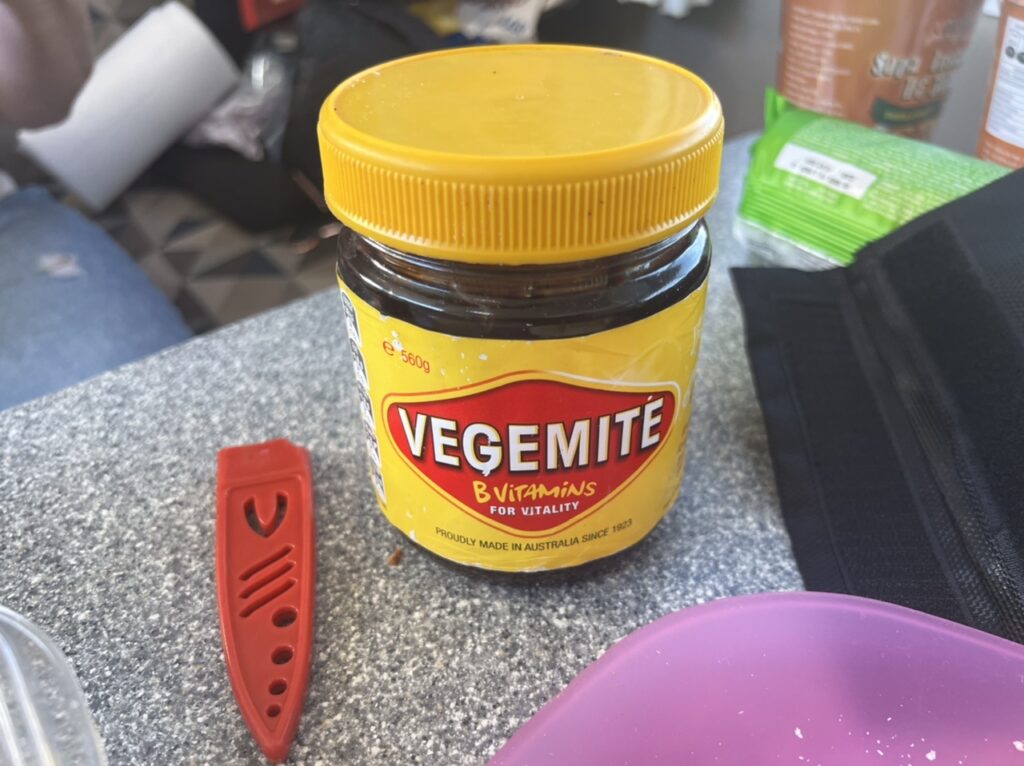
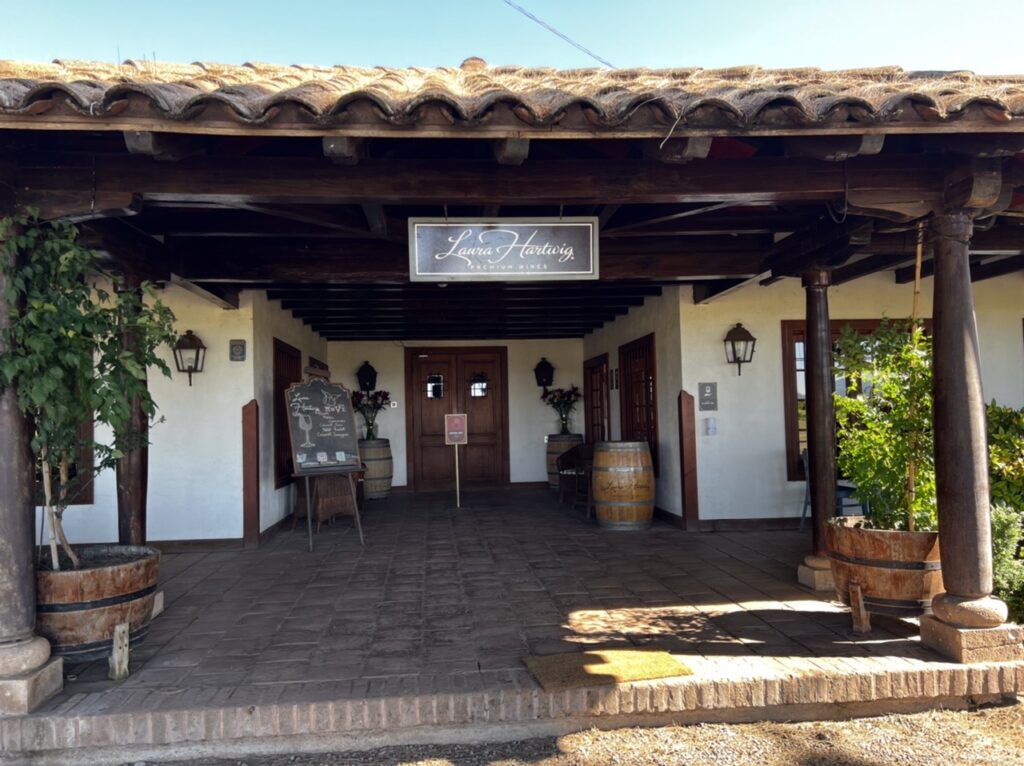
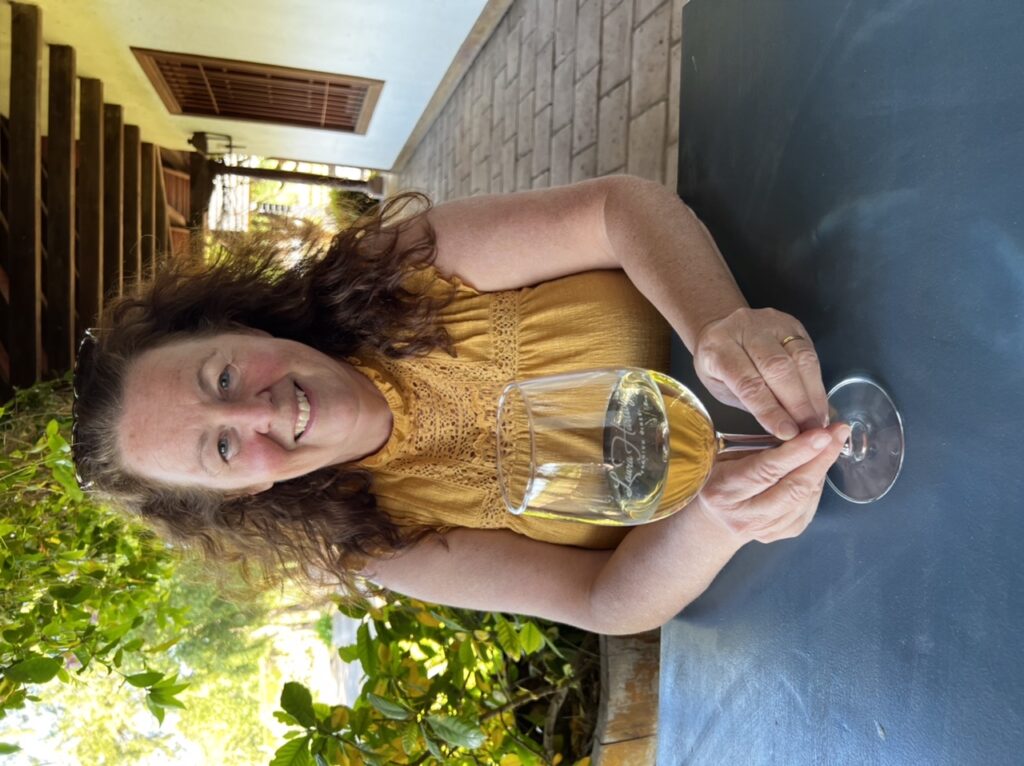
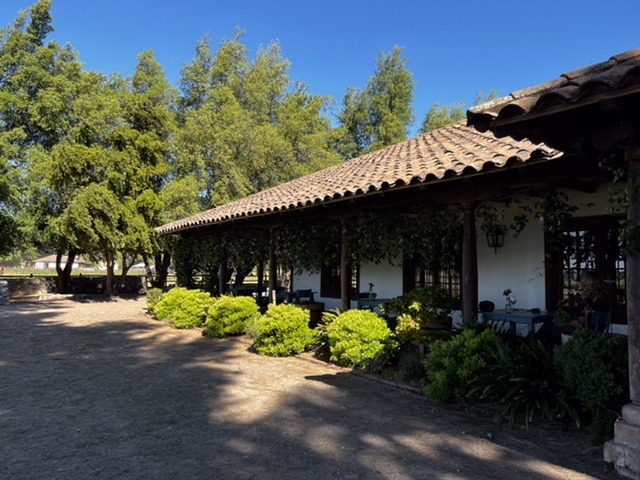
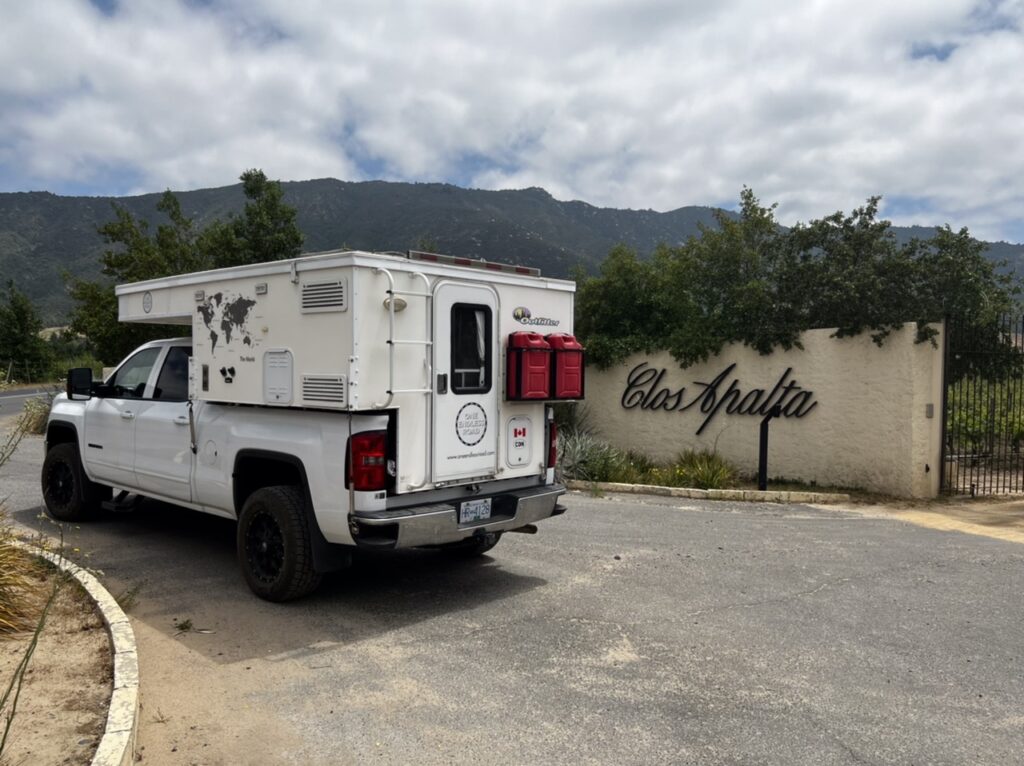
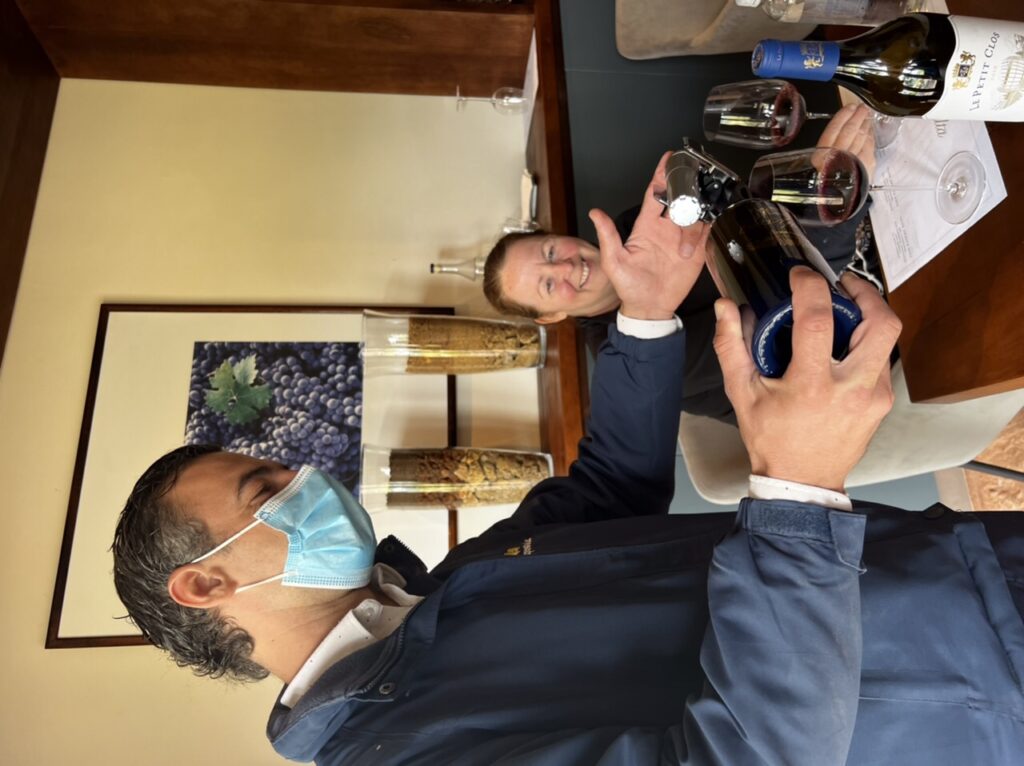
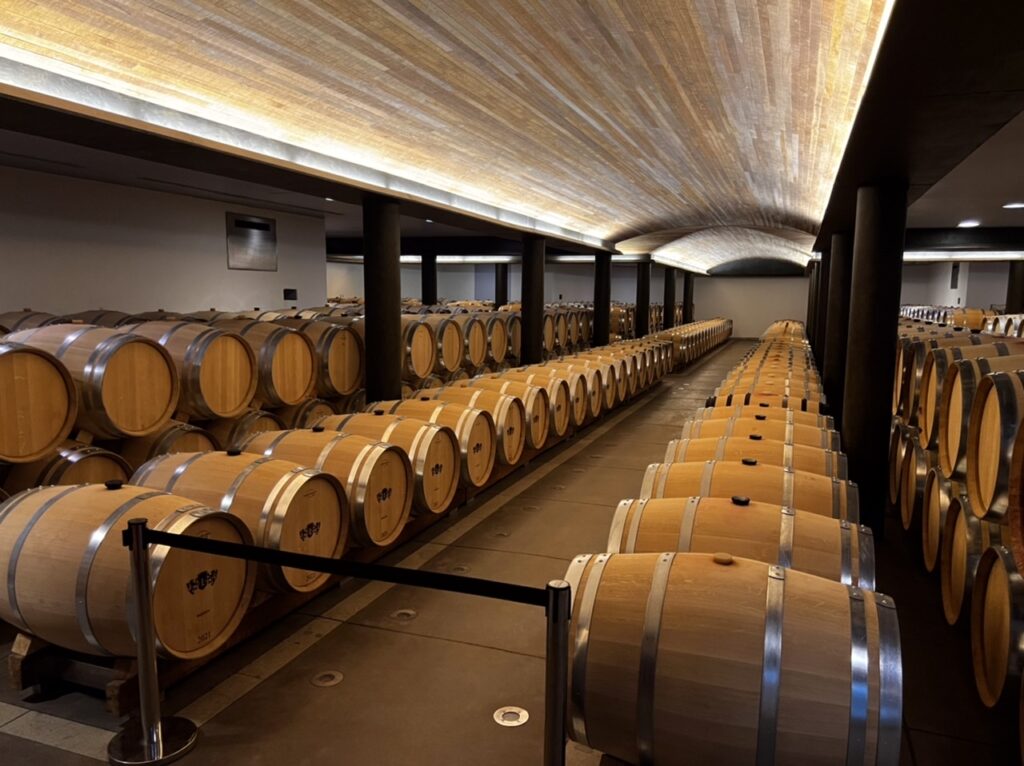
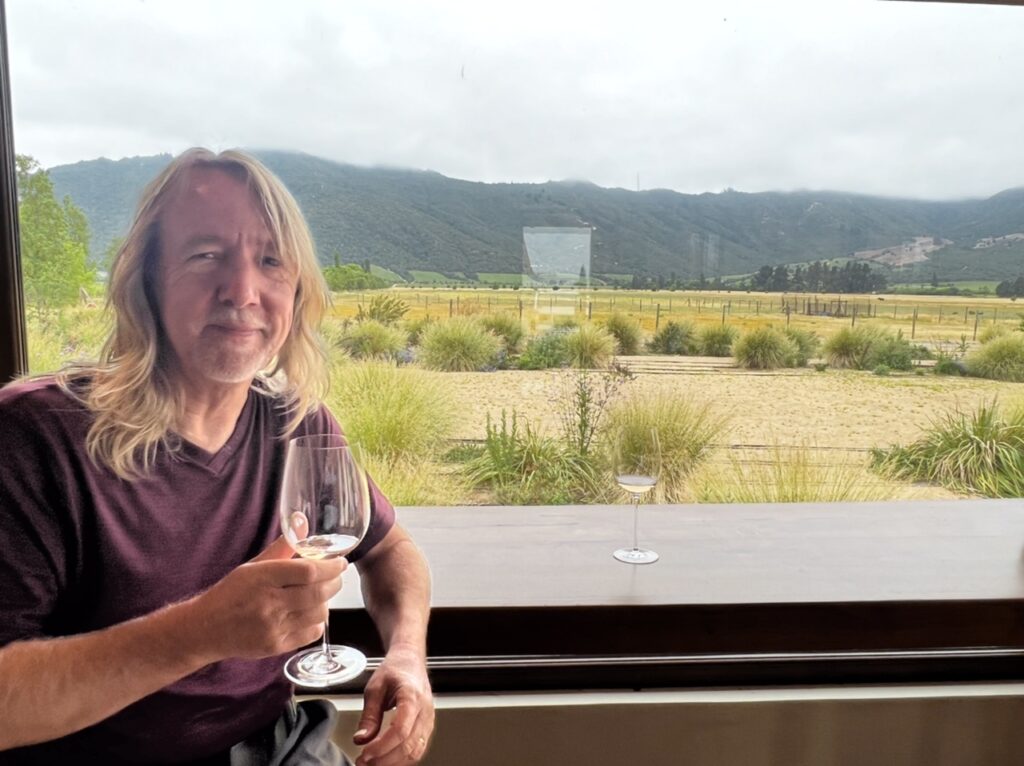
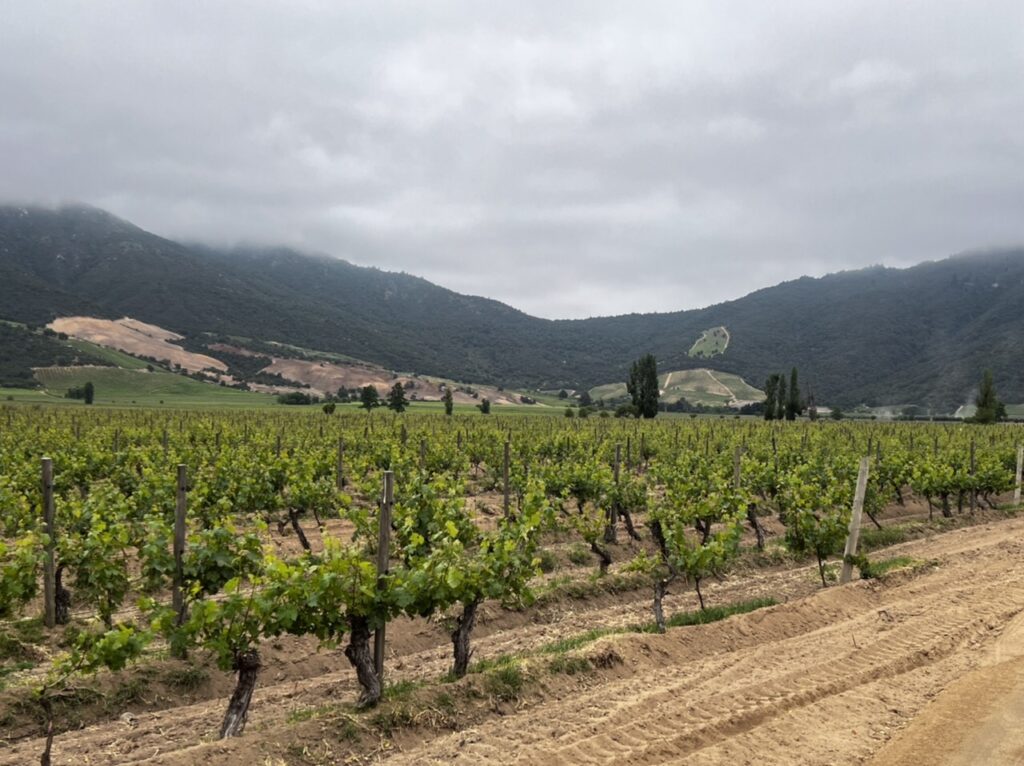
While Santa Cruz does not offer easy camping accommodation it does deliver great wineries, restaurants and a real “Napa Valley-like” ambience. Hugely popular with Chileans, it’s an easy place to just linger……so, linger we did for a couple of days, one touring the wineries of Laura Hartwig, then the amazing Clos Apalta, followed by a second day just unpacking , cleaning, the re-packing the camper – it had been so long since we left Chile that we had forgotten how much stuff we left in the camper. One little gem we ( well, “I”), did uncover in the process was an almost full jar of pure Australian gold……..Vegemite ! Absolute heaven, and enough to last me a good few months used sparingly ! Lois suggested it was the aroma of Vegemite ( she hates it ) that kept the mice out of the camper !
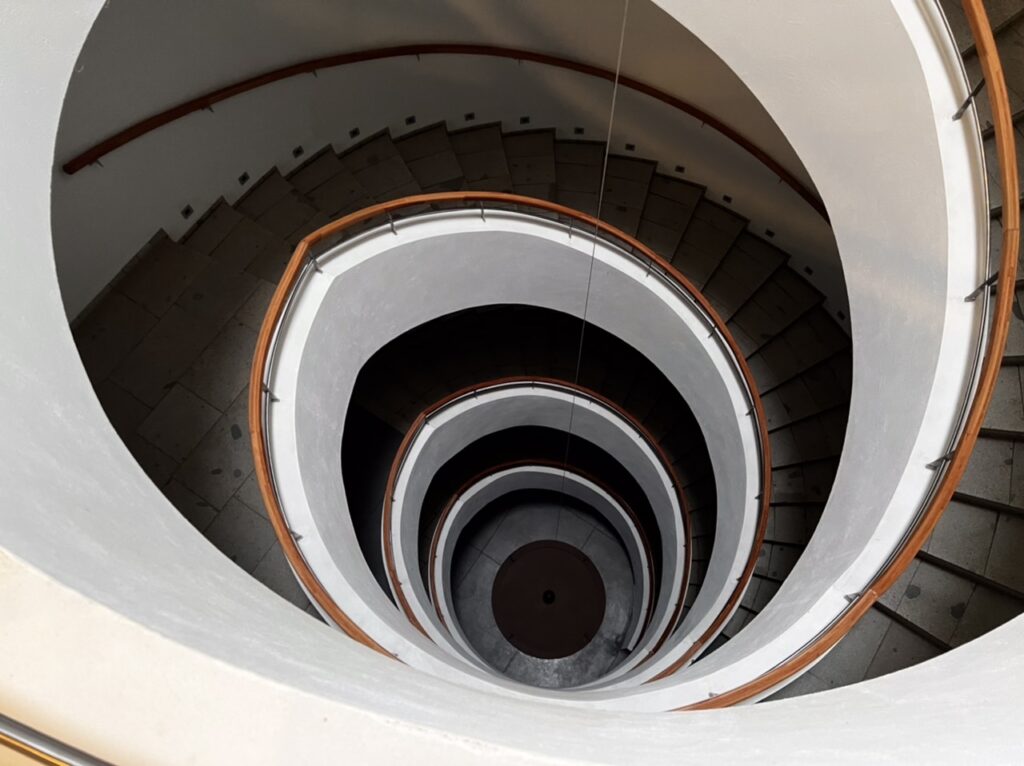
Laura Hartwig WineryLois sampling a Laura Hartwig wineLaura Hartwig WineryClos Apalta WineryLois sampling a Clos Apalta redClos Apalta cellar The staircase to the six level Clos Apalta underground cellar. It was dug out from stone over 6 years and is one of only a few such in the worldJeff, with a whiteThe vineyards
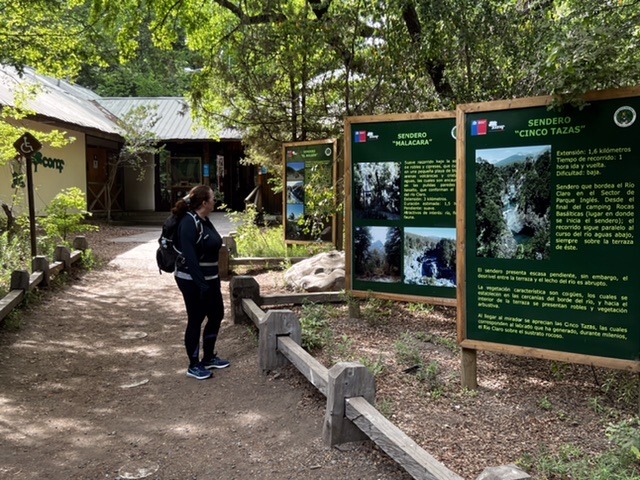
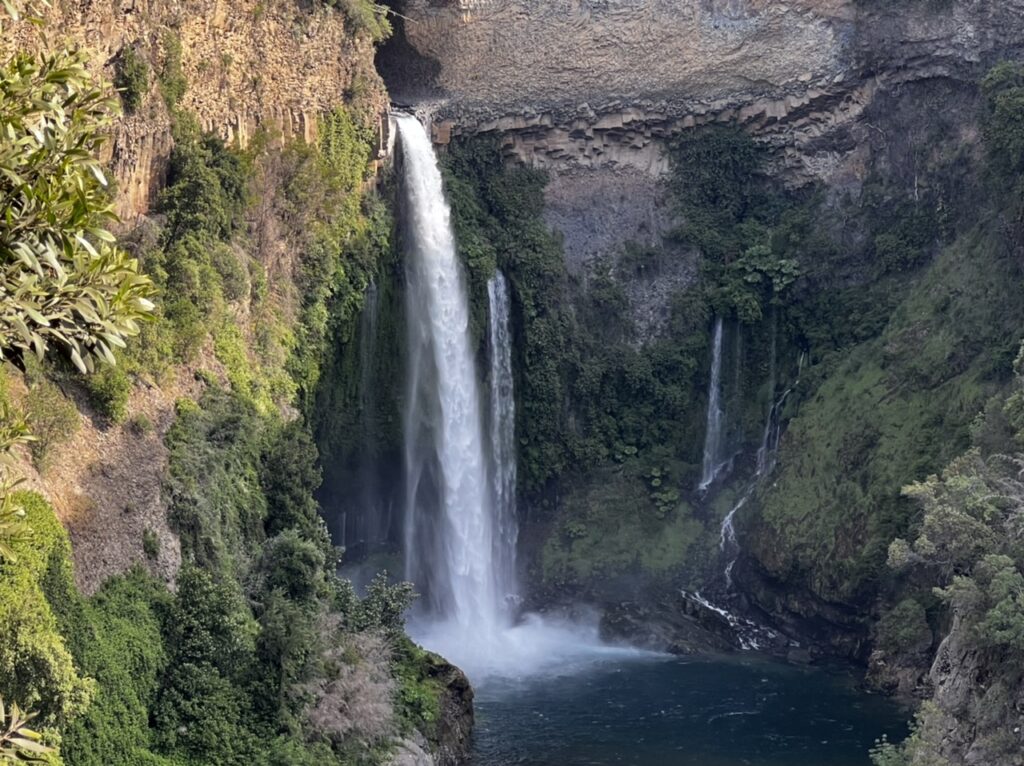
More than a couple of Chileans had recommended we visit Siete Tasas ( 7 Cups ) National Park and being that it was not a big detour on the way south we made our way there. Great place to stop for a couple of days, enjoyed a long-needed 8km hike and realized a second thing that also became immediately obvious – how absolutely out of shape we were ! Once again we were pretty much alone albeit in a beautiful setting right on the Rio Claro.
Lois at the Siete Tasas National Park entryWaterfall, Siete TasasCamping at Siete TasasRio Claro, right beside our siteThe Siete Tasas cascading “cups”
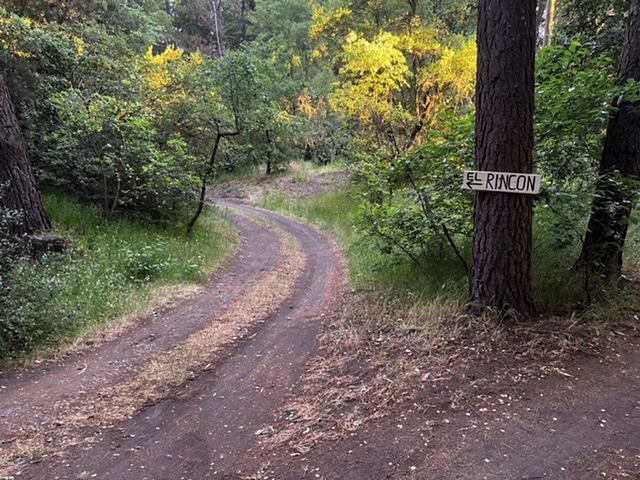
While the next stop on our route was Chile’s Lake District ( centred on Villarica and Pucon ), it was a bit of a stretch in one day so we broke the journey at a great Eco Camp ( El Rincon ) just north of Los Angeles ( Chile’s Los Angeles ! ) hosted by Don and Carla, two expat Americans who have created a little slice of heaven in the Chilean countryside. Great spot, great hosts and we finally met our first other foreign travellers ( a Dutch couple ), ironically however on their way home to Holland. Enjoyed a night together sharing drinks, and tales from the road. Bliss……….
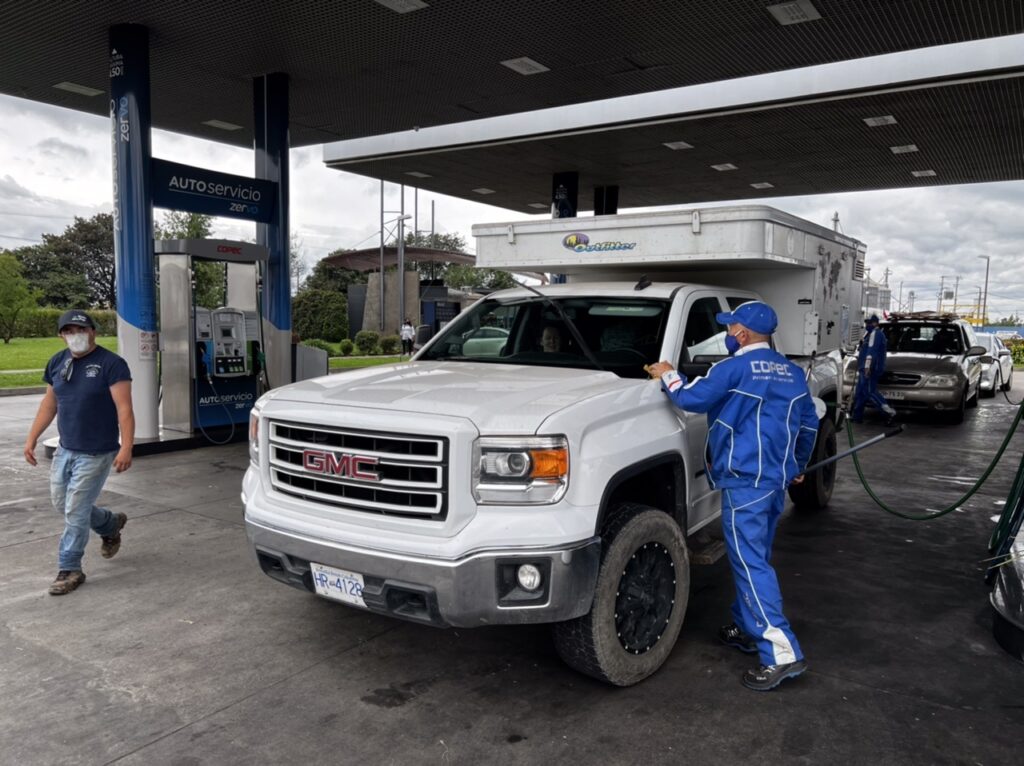
Road to El RinconCamping at El Rincon They still wash your windscreen and pump your gas here…….and wear a uniform !
The PanAm completed in April, 2022 and with the truck camper sold, we shipped our new Sprinter van to Australia in late 2022. We travelled there through all of 2023 and into 2024 before shipping it up to North East Asia where we travelled for 4 months between Korea and Japan, before shipping it back to North America. It’s our plan to continue exploring the world in 2025.