The incredibly lush, green scenery of Kyushu continued all the way north and east as we left Cape Sata in the far south. Reaching the east coast an unexpected surprise was passing the Japan Space Agency’s rocket centre at Uchinoura. It’s certainly no Cape Canaveral but since we were here (and visits were permitted) we decided to go in and take a peek. Unfortunately, just as we did, a huge waft of fog enveloped the mountain bringing visibility almost to zero. Rather a non-event ! What was not a non-event was the beauty of the east coast and specifically an area known as the Nichinan Kaigan coast which extends almost to Miyazaki. While perhaps somewhat generously compared to Italy’s Amalfi coast, it does share some of the same steep cliff drop offs, rocky outcrops and pristine sea views as its more famous Italian cousin. The rutted, horizontal rock formations near Aoshima are quite unique.
Uchinoura Space Centre – we got “fogged out” !Nichinan Kaigan coast.Rock formation known as the “Ogres Washboard”, near Aoshima.Ditto
Miyazaki is one of the nicer small Japanese cities and while not holding a lot of interest for the foreign visitor it’s well known in Japan as being pretty much the centre of early Japanese civilization and Miyazaki jingu shrine is the very place where Japan’s first emperor ( Jimmu ), dating back to 600BC, is enshrined. While famous Beppu ( known for its hot springs and thermal pools ) was the main attraction for us before leaving Kyushu, a slight detour west to unique Tackachiho Gorge made for a very worthwhile diversion – not just for the unique gorge itself but for the drive in which included some of Kyushu’s finest scenery ( and narrowest roads ! ). Hardy surprising I suppose, as it criss-crossed parts of Kyushu’s legendary Yamanami Highway.
Heiwa ( Peace ) Park, Miyazaki.Miyazaki Jingu shrine.Tackachiho GorgeTackachiho Gorge
Beppu never disappoints and on this occasion, in addition to visits to a number of its well known red and blue colored thermal springs we managed to find a little, out of the way, quiet outdoor onsen, of the type that can be harder to find. Not only were there pools of differing temperatures and supposed therapeutic qualities but this one included a soothing mud bath. Highly recommended should you get to Beppu !
West of Beppu and across Kyushu’s north lies much heavy industry and generally unappealing urban sprawl ( including Kokura, the city which was supposed to have been the 2nd A Bomb target – how lucky were they ? ) – good for a long “drive day” which got us across the huge Kanmon Bridge connecting Kyushu with Shimonoseki on Japan’s main island of Honshu.
Kanmon Bridge, Shimonoseki.
Here there was a decision to be made since our travels would now take us east across western Honshu. On the advice of the “Lonely Planet: Japan” author we opted for the more rural and scenic northern route across what is known as the Sanin Coast versus the more industrial and congested Inland Sea route ( parts of which we would explore later anyway ). An easy choice, really, since we had not explored this part of Japan at all previously. It turned out to be a great call since the route across the north over the next four or five days brought us ( mostly ) good weather, great coastal scenery, two historic towns ( Hagi and Tsuwono ), one of Japan’s best preserved castles in Matsue, a sand dune surprise in Tottori, and finally a look at one of Honshu’s most historic and unique fishing villages at Ine. A week overflowing with sights.
Toll booths and toll roads always seem to cause us an issue. Got on this one by accident !I lost the bet in Korea but won it in Japan. We met Mr and Mrs Kim from Korea who shipped their Jeep over to Japan for a month of travel. So we’ve now met one other foreign vehicle !At the Michi No Eki where we met the Kim’s, a car club was having a meet up – some nice machinery !I got to check out a Lamborghini Countach. Very low.Scene in Hagi.Noble’s house from 1850’s, Hagi.Ikebana display, Hagi.Sanin coast, near Matsue.Stunning coastal rock formation, near Matsue.Beautiful Inari shrine, Tsuwano.A street scene, Tsuwano. The canals each side are full of koi.Traditional sake store, Tsuwano.First glimpse, Matsue Castle.Full reveal. One of the few original castles surviving in Japan and dating back to 1611.Samurai house, Matsue.Sahara desert, or ? Tottori sand dunes, Tottori. Not something I EVER thought I‘d see in Japan !Traditional boathouses, Ine village.Boathouses, closer view.
From the Sanin coast we head inland to Japan’s cultural capital, Kyoto and explore Kyoto, Osaka, historic Nara and our old stomping ground of Kobe. Till next week……
Note: This week I decided to roll all the video clips into one 4 minute “reel”. Gives a bit more continuity and the clips pretty much follow the order of the pictures above. Enjoy….
One can’t leave Nagasaki without being profoundly impacted by what you’ve seen at its most famous museum. We certainly were. This week, though, we’d see an amazing museum which detailed another tragic chapter in the closing days of Japan’s WW2 experience – in our continuing trip around the beautiful southern Japanese island of Kyushu we would discover the beauty of Unzen ( a spa town on the Shimabara peninsula ), the castle city of Kumamoto, the volcanic craters of Mt. Aso, and a few truly unexpected gems in the Kagoshima region ( one, as mentioned above, that had a similar impact on us as the A Bomb museum in Nagasaki did – albeit from a completely different perspective). Despite a generally dismal week weather-wise it was one that we packed a lot into.
Recent route ( in blue).Unzen onsen…..the town is a mecca for them.
Directly north of Nagasaki lies a fertile volcanic area known as the Shimabara peninsula. Almost (but not quite) an island, this area presents a number of attractions but key for us was the spa/onsen town of Unzen. Unzen is generously endowed with some of Japan’s best spa’s – the scenery on the way up its tortuously windy access road is pretty impressive as well. Tested one of the local onsens and found it very soothing – no shortage of hot baths in this town. The ever friendly local tourist office referred us to a great little “hole in the wall” Japanese restaurant and again ( as in Fukuoka ) we were not disappointed – not a super busy night so ( as an added bonus ) the owners insisted on making us both a couple of traditional Japanese paper cuttings. Yet again, we’ve been dazzled by the incredible hospitality we’ve experienced on the road.
Hmmm. If the parking space is not too small there is another issue ( low branches )!Steaming hot “ofuro” bath.Personalized paper cuttings made for us by the restaurant owner.Thermal activity, Unzen.
After winding our way down to the coast, we took the 45 minute ferry from Tiara Port to Nagasu putting us on the Kumamoto side of the Kagoshima peninsula and an easy drive east to one of Japan’s more famous volcanoes, “Aso-San” ( Mt. Aso). Still active, and constantly spewing smoke, Aso attracts hikers from all over Japan and beyond. We were actually surprised at how many foreign visitors we saw while there. Sadly, dangerous recent thermal activity meant that Nakodate crater is no longer accessible to visitors 😔. While at Aso the sun shone brightly so we were keen to get in all the hiking and sights that we could – our first sunny day in a while.
Also has craters within craters. Incredibly green.Towns and farms exist inside what is the world’s largest caldera.Resting during a hike.
You know it’s getting hot and humid when you see palm trees line the roads – entering Kumamoto.
Pretty Kumamoto is only a stone’s throw from Aso and its historic castle is a major draw. Like many such castles in Japan it’s seen a lot of renovations but it is definitely one of the better ones. Kumamoto was also easy to navigate so we went right into the heart of the city with the van, taking in impressive Suizenji Koen ( Park ) as well. Parking was, thankfully, not an issue in Kumamoto !
Suizenji park, Kumamoto – the hill is meant to resemble Mt Fuji.Japanese garden, Kumamoto.Impressive Kumamoto castle.Ditto.
The Kagoshima area is not far south of Kumamoto and basically represents the southern extremity of “mainland”’ Japan. That, we knew. There were two major events in Japan’s ( relatively ) recent history in which Kagoshima played a pivotal role ( that we did not know about ), but both of which we would explore during our time there.
The first. I won’t get into the weeds here but Kagoshima ( and the local Satsuma clan ) was at the heart of many of the events surrounding the early and often tumultuous days of “Meiji” all of which is described in great detail at Kagoshima’s Museum of the Meiji Restoration . If you’ve seen Tom Cruise’s epic “The Last Samurai” it covers some of the political and military machinations during this tumultuous period in Japanese history, albeit with the usual Hollywood liberties taken. Fascinating stuff if you have any curiosity at all about Japan’s rapid rise into a powerful modern state once it opened up to the world in the mid 1800’s.
Saigo Takamori, samurai, nobleman, patriot, famous Kagoshima son.
As the Kagoshima area weather was not always cooperative we also loaded up on museum visits while there and based on a tip from another overlander we made the 1 hour trek out to the Chiran Peace Museum. Probably one of the most well presented and touching museums we’ve seen in a long time. Chiran, you see, tells the story of the “tokkotai” – a group better known outside Japan as “kamikaze” pilots. I’ll back it up a bit first. By March of 1945 the writing was on the wall for Japan in WW2. Okinawa was under Allied control and US ships were nearing the home islands ( Japan’s 4 main islands, of which Kyushu is the southernmost). Chiran is in the far south of Kyushu and, being the furthest forward operating base, was the airfield from which approximately half the young Kamikaze pilots departed to attack Allied ships, primarily around Okinawa. Over 1,000 in all.
Statue of a mother, looking up at her kamikaze son, flying off on what she knew was his final mission.
Hard, in today’s world, to understand why these young men were asked to make such a pointless sacrifice so late in a war which was, to all intents and purposes, already lost. While we never got the answer to that, we came away with immense respect for the courage of the young pilots, many of whom were not yet 20. The stories they wrote to their mothers on the night before their “final mission” had us both almost tearing up. I was left with this thought – it’s got to be unbelievably tough for any parent to send a son/daughter off to any conflict knowing they might not return. Imagine being the parent of a son asked to be a kamikaze pilot ? Definitely a one-way ticket. I’ll let the following pictures tell the story.
Kamikaze pilot ready for his final mission.Notes of support and encouragement were often written on a hino maru ( national flag ).This pilot – a boy of 18.Samples of clothing.Googles and cap.Remnants of a Japanese “Zero” fighter recovered from Kagoshima Bay in the 1980’s.“Triangle” huts, where pilots spent their last night together, shared stories, sake ( and, according to one letter, often some tears).Inside the triangle hut. Pictures of the pilots can be seen on the wall.Letter to parents by young pilot, “Masanobu”Page 2 of letter..The original Chiran base ( airfield) has long since been redeveloped but remnants remain in the town – here a water tank from the war period.
Following the incredibly sombre experience in Chiran some relaxation was in order – what better place than nearby Ibusuki, home of the famous Japanese hot sand bath . A wonderful experience where you lay on a bed of hot sand ( heated from hot springs below the sand ) and staff cover you in more hot sand up to your neck in which you then relax for 15-20 minutes. Invigorating..! The experience is completed with some further relaxation in a hot onsen afterwards. Bliss.
Hot sand bath, Ibusuki. Photos not allowed – this one from the hotel itself.While parked up in Ibusuki a very friendly Japanese fellow in an extremely “lifted” Mitsubishi Delica van insisted on photographing his vehicle together with ours. Despite his van’s lift kit he could not believe how “takai” ( high ) our van was in comparison. Conical Mt. Kaimon, near Ibusuki at the very bottom of Kyushu. Typically the last Japanese landmark the kamikaze pilots saw as they flew south to certain death in Okinawa.
A short ferry ride across the mouth of Kagoshima Bay took us to the south eastern side of Kagoshima-ken ( state ), close to the southern-most extremity of mainland Japan. Not just an “extremity” box to tick but it’s a particularly scenic drive to Cape Sata that attracts drivers and riders from all over Japan. We’d earlier reached Kyushu’s western edge (near Sasebo) so made the trek on to Cape Sata, Not only was the drive ( and hike at the end of it ) worthwhile, but it also afforded us a chance to camp at the first “formal” Japanese campsite we’d come across. Not exactly like home, but pretty close and ticked all the key boxes : flat, with potable water, and impeccable amenities. We hope to find more of these!
View of our van we don’t often see – on the ferry to Capa Sata.
Hiked out to the Cape Sata observatory- time for a selfie.Cape Sata – end of the road in southern Japan Bikers LOVE the road to Cape Sata. It’s all about the curves.
Being at the very bottom of Kyushu now, the obvious next direction is north, following a general route along the east coast of Kyushu- but, we’ll save that for the next blog 😊.
Funnily enough, we got our first impression ( or should I say, first “reminder” ) while still on the ship from Busan. The ship is Japanese ( but managed together with a Korean company ) so it has more of a Japanese “flavour” one might say – tatami rooms that could sleep up to 10 people, its own “sento” ( hot bath ) and, something else we have only ever seen in Japan – beer sold from vending machines ( common not just on the ship but all over Japan ) ! Most people reading this blog live in North American or Australia – in any of those countries it would be emptied by under age kids in short order ! The Japanese, though, are known for following rules – even adolescents, it seems.
Japan is the only country we have been to where beer ( and other alcohol ) is sold in vending machines.Our happy moment – finally leaving the Port of Fukuoka.The day was not perfectly clear on arrival in Fukuoka but was much better than the air quality we experienced in Busan.
After an extraordinarily long first day dealing with customs, carnet and insurance issues, it was exciting to finally drive out of the ferry terminal, with our van, ready to explore Japan. Fukuoka itself, a nice enough mid-sized Japanese city, does not have a ton of sights of interest but certainly enough to fill a day so we started our Japan sightseeing right there. On top of the interesting sights, a real delight was stumbling upon one of the city’s older, and very popular, yakitori restaurants; enjoyed the best wasabi-flavored chicken skewers ever, washed down with a generous serving of sake to celebrate our safe arrival in the country. Definitely a memorable moment, made more enjoyable by the company of some super friendly and helpful locals.
Downtown Fukuoka is a reasonably nice Japanese city, super clean, and very easy to get around.Ohiri Park Japanese garden, Fukuoka.Remains of Fukuoka castle. Mist show, Japanese garden, Fukuoka.
The flowers were beautiful. Azaleas in a Fukuoka garden.Loved this yakitori restaurant..!The sake came in a glass, placed in a box. They filled the sake to overflowing so that it almost filled the box. Once you finish the glass one empties to rest of the sake from the box into the glass. Perhaps it’s a Kyushu thing !
From Fukuoka, the plan was generally to travel southwest in the direction of Nagasaki. Where possible, toll roads were avoided ( not hard to do ) giving us a great perspective on life in rural Kyushu; small towns, farms, fishing villages and the odd larger centre filled our first few days. Some great beach camping, scenic coastal drives and our first Michi-no-Eki ( literally “road side station” ) experience were highlights. We have nothing quite like a Michi-no-Eki; think of a farmers market, running every day from 9-5, with plenty of parking, impeccably clean toilet facilities and perhaps a small store. Place it on a main road so that passing travellers have a place to pull over, rest ( for a few hours, or even overnight ) and sample regional specialties that are for sale. These have only been around for 20 years but are now all over Japan…..well over 1,000 of them in fact, and they make great places to park up for the night as many Japanese (and others) do. It’s been a hugely successful idea- we are already fans.
Lois in a michi-no-eki near Nagasaki.Beach camping, just south of Fukuoka.Terraced rice fields, rural Kyushu.
Travel on Japanese back roads is slow, with much of it done between 40 and 60km/h but being in no hurry that gave us the opportunity to better appreciate the whole experience. Given that distances are not great, and the roads are usually windy in mostly mountainous conditions, the slow speed is not an issue- but I would not want to be driving across Canada at that speed. For most of our first few days the weather was either overcast or drizzling – unfortunate ( and unseasonal we were assured ) but it’s what we had so it limited some of our outdoor options.
By the time we reached Nagasaki, things had improved somewhat and we had reasonably clear days there. The A-Bomb museum and nearby Memorial to the Victims were priorities and both truly conveyed the horrors of war, especially nuclear war, well. Hard not to get emotional when looking at some of the displays – it was not lost on either of us that, given the Japanese people’s general longevity, and the fact that it occurred only 78 years ago, there would still be a significant number of survivors alive in the city with clear memories of it.
The impressive Memorial to Victims, right beside the A Bomb Museum, Nagasaki.Replica of the actual bomb that was dropped, known as “Fat Man”.Downtown traffic, Nagasaki.
In addition to the slightly kitschy “Megane Bridge” there were a few other sights we’d hoped to see in the city but had to abort those plans when we realized two things: a) Nagasaki’s streets are really narrow ( even for Japan ) and challenged our ability even just to turn in some cases, and b) while there were parking places which we would have happily paid for, they were all way too small for our 7m long van ! Worse, many parking spaces, (even those in open air locations) have height considerations which treat our van as a (perish the thought)….bus !!! Japanese parking lots consider our van to be enormous and where we have been able to park ( based on either length or height ) we have been hit with “bus” size parking fees ( almost 5 times what a car pays ) in some cases. Not something we can’t work around but definitely a consideration that will require a little more “strategizing” as we visit some of the larger cities ( in rural parts, no issue ).
“Megane” ( spectacles ) Bridge, Nagasaki.
Parked here, back in Fukuoka and assumed we’d pay the ( posted ) car rate of ¥700 ( $6 Cdn ). Did not notice the vertical bars (with hidden cameras) that measured our height and stung us for the “bus” rate of ¥3,000 as we departed. Height as a cost criteria – in an open air lot ? Ouch. We’re learning fast.First week in Japan.
Before I wrap up this week’s blog with a look at some facets of the country that are, well, uniquely Japanese ( enjoy ), an interesting little side note on Nagasaki and that fateful event on August 9th, 1945: it was not the intended destination for the 2nd A bomb. It was actually destined for Kokura, further north. The plane with the bomb actually flew to Kokura, circled several times and then aborted the target due to persistent cloud cover. The plane banked and headed south to Nagasaki, where, initially anyway, there was also cloud cover. They decided to wait there a bit longer – just before they would have had to turn for home, the cloud cover broke and the world’s second atomic bomb was released….the rest, as they say, is history.
You Know You’re In Japan When:
…..the taxi diver is wearing white gloves ( and always opens the rear curbside door for you from inside the car ) !….the apples are blemish free, individually wrapped in clear film, and THEN wrapped again in protective foam mesh ! Always. And everywhere.….ditto for avocados ! ….in many fuel stations there is no “bowser” as such. Hoses are pulled down from ceiling pods in stations like this. In the big cities, it’s all about space !…..and finally, in Japan even a visit to a simple public toilet is high tech. This one is typical – seat heats up as you open the door, it automatically flushes as you stand up ( but the blue button on the wall allows for a manual flush). The other 5 controls on the wall ? Two controls for the bidet, one other for the bidet water stream strength, another for sound volume control ( the sound of running water is heard while you do your business ), and a manual “stop” control. The small, wall mounted seat in front of the toilet is to place an infant ( should you be carrying one ) ! They’ve got it all covered here…….
What follows here is a review of the process of shipping our Mercedes Sprinter van from Australia to Korea ( February 2024 ) and then on from Korea to Japan ( April 2024 ). A warning – our regular blog readers will find minimal information of any interest in this edition ( unless the excruciating minutiae of shipping a vehicle captivates you ! ) – the detail is provided for those who may be looking to do something similar with a vehicle, either from Australia to Korea or onwards from Korea to Japan. A little payback ( or paying it forward ) for the many who helped guide us in this process in the past.
Dropping the van at the Port of Melbourne for shipment to Korea.
After spending all of 2023 and the early part of 2024 travelling around Australia in our Sprinter campervan, we shipped the van via RoRo from Melbourne to Pyeongtaek, Korea. We shipped via a Wallenius Wilhelmsen car carrier that stopped in Fremantle, Singapore, Laem Chabang ( Bangkok ) and Kunsan en route and took almost 30 days. After almost 4 weeks travelling with the van in Korea, we took the Camellia Line ferry from the port of Busan ( Korea ) to Fukuoka ( Japan ). We hope that the details below will offer some valuable insights ( we’ve included pricing and contact info ) to overlanders ( or anyone else ) contemplating shipping to or from these ports. I know I echo the thoughts of every overlander in saying that THE most stressful part of life on the road is dealing with shipping, especially collecting your vehicle, and specifically off a RoRo ship. Fortunately, this time ours is a good news story.
Not our specific ship but the same shippingcompany and same type of ship.
Australia to Korea
We used Anthony Paratore of Bullock’s Freightmaster in Fremantle. Anthony was timely, competitive and very reassuring throughout. Highly recommended. We shipped RoRo, on a Wallenius car carrier from Melbourne to Pyeongtaek in Korea ( about 30 days ). We took marine insurance through Stewart Insurance Group ( Michael/Anastasia ) who were also excellent and prompt. Quote was based on our vehicle’s value so no point quoting insurance premiums here. They were very competitive and used Zurich, a major global player. Drop off at the Port of Melbourne was fast and easy, we paid about $150AUD for the required port escort and were in and out in about 45 minutes.
Anthony referred us to YCL Logistics ( in Seoul ) to handle to collection process in Korea. They were professional, prompt with communication and gave us white glove treatment all the way. Not cheap, but very much full service ( pick up from hotel, driven 2 hours to Pyeongtaek for vehicle collection etc, etc ). Our experience was complicated by the fact that Wallenius changed our port of delivery from Masan to Pyeongtaek and this added some time and expense to the process. No one’s fault, *&$# happens ! Kunsan, Incheon and Masan are far more commonly used and would have saved us some money certainly.
This is now our 4th international shipment ( 1 x container, 3 x RoRo ) and while the broad process is identical there are unique aspects of each that merit attention. In respect of Korea I should add this; while I can’t say it with absolute certainty I’m quite sure the majority who visit with their own vehicles come by ferry from one of Japan ( several port options ), Russia ( Vladivostok ) or China ( Dalian/Tianjin ). It seems that in the case of ferry arrivals ( vs RoRo carriers or container ships ) the port procedures and customs clearance processes are far simpler ( and hence far cheaper ). Our experience was on a RoRo carrier, from Melbourne ( Australia ) so the clearance procedures were quite a bit more involved and hence more expensive (we also got “white glove” treatment – just the way our Korean contacts worked which undoubtedly added to our costs ). I’m sure it could be done for less if one handled some of the process oneself ( as we’ve done ourselves in other ports ).
Costs:
We had exceptional service from Anthony Paratore at Bullocks in Fremantle and would highly recommend him. For a 42cbm vehicle we paid $4,970 AUD ( approx. $US 3,230 ) from Australia to Korea – this included shipping freight and all port charges in Australia except the port escort in Melbourne ( approx. $150 AUD). Vehicle insurance is extra and no point in me quoting it here because it’s based largely on vehicle value so will vary enormously. Michael at Stewart’s in Melbourne was very competitive with a policy from Zurich Marine – and super fast.
At the Korean end YCL also served us very well. Super people with multiple English speaking contacts ( JB, Emily and James ) and very “full service” but as a result they are not cheap. We paid $US 1,100 to pick up our van in Pyeongtaek when all various charges were added. Two things ( no one’s fault ) compounded the costs. Firstly, Korean Customs at Pyongtaek do not often handle individual vehicles (we were told ) and simply were not sure of some of the processes. They had to consult with the folks at Incheon and Masan in order to complete our clearance. At one point they even suggested that it may be required to bond our vehicle, place it on a flatbed truck and drive it to Busan since that is the port we intended to exit from and according to their understanding, we should enter and exit through the same port ! Our agent talked them out of that nonsense. Had the ship stuck to its original discharge destination I have no doubt the process would have cost less. According to our shipping agent, Incheon was the best port to enter Korea through if one had a choice ( we didn’t ! ).
JB Chang of YCL and I receiving our vehicle in Pyeongtaek. No damage, no theft !
That all said, the pick up process at Pyongtaek was incredibly easy and very fast. About 45 minutes. Only in Brunswick, Georgia ( in the US ) have we seen a vehicle released faster and with less fuss – about 30 minutes ( a striking contrast to our experience trying to clear the vehicle out of Melbourne when it first went to Australia !!). No one looked at the vehicle with us, no one checked that we had insurance (we did have it) – some basic ID checks, hi-viz vest and hard hat worn, proof of fees paid and we were on our way. All done digitally, practically no paper. So simple.
What Went Well:
Well, the most important thing of course – we got our vehicle in perfect condition with no damage and (critically) NO THEFT ! I went to extreme lengths to ensure that everything of value that was left in the van was secured in the garage compartment under our bed and that it was able to be locked separately from the rest of the van. Unless customs wanted to check it when it arrived in Korea ( which I could facilitate ) there was no way port staff or ship-board crew could access our stuff. No one ( from the port staff ) accompanied us to the van when we collected it ( just my agent and I ). Fortunately no one in Melbourne made us unlock that area of the vehicle when we dropped it there ( in some ports they do ). This was a huge relief based on two significant thefts on past RoRo transits.
Vehicles coming and going at Pyeongtaek port.
What Did Not:
While originally routed from Melbourne to Masan ( in the south of South Korea ), once at sea the shipping line changed our unloading port to Pyeongtaek ( nearer to Seoul ). This caused hassles and costs for our agents, and we were stuck dealing with a port not familiar with what we were doing.
Summary:
We felt the shipping cost to Korea was excellent value given typical shipping costs these days. We felt the clearing costs in Korea ( on our particular shipment ) were higher than normal ( partly for reasons noted above ). It cost more than twice as much to clear our van in Korea than it cost to clear our vehicle in Brunswick, Georgia just 2 years earlier. I would have expected costs in the US to be higher than Korea; not so ! I would not assume these costs we paid to be normal, however, and am sure it could be done for well under $1,000 at other Korean ports. We know of people that paid considerably less than us.
Korea To Japan
We chose the Camellia Line ferry to transport our van from Busan ( Korea ) to Fukuoka ( Japan ). I cannot speak highly enough about this company. They did an excellent job from start to finish and we would recommend them highly. We booked it all via email through YJ Choi of the Busan office ( yjchoi@koreaferry.kr ). The ferry was on time ( arrived early in fact ) and they were super well organized from A to Z. Staff at the office spoke English, as did their port staff and staff on the ship. We were personally escorted to the ship with our van, through customs in Korea and again in Japan. They explained exactly what documents we needed ( passport, Carnet, Int’l Drivers Licence, and vehicle registration documents). They took care of issuing the basic Third Party Insurance needed to get road-ready in Japan and directed us to the JAF ( Japan Autombile Federation ) office in Fukuoka for Carnet validation.
Arrived at Busan Port International Terminal. A huge but extremely well organized place. Getting there from our campsite was challenging, the only time we ( briefly ) got lost in Korea.
About to leave Busan, 10pm at night.
Costs:
There was lots of room, ours was the ONLY private van/car on the ferry.They allowed me to inspect the lashing process and made sure I was happy it was tight. Have never had that before !Because we were shipping a vehicle the ferry company more or less gave us a personal assistant from start to finish. We were the only private vehicle on the ferry, along with a young Korean guy who had a motorbike.
Costs:
We paid 726,000 Korean won ( $537 USD ) to ship our 3.5 tonne, 42cbm van along with driver, passenger and a 2 berth deluxe private cabin with its own shower and toilet ( 536,000 for the van and driver, 90,000 for the passenger, and 100,000 for the cabin ). In Japan we paid approx. ¥32,700 ($212 USD) in charges – ¥5,000 port fees, ¥3,000 Carnet validation at JAF, ¥16,000 Surety Deposit at Japan Customs and ¥7,700 mandatory Third Party Insurance for the van. Camellia Line had a good reputation, was used by others we knew of and sails on the shortest route from Korea to Japan. I believe the Pukwan ferry carries vehicles as well but sails to Osaka ( further, and more expensive ). For those interested there are also ferries from Korea to Russia ( Vladivostok) and Korea to China ( Dalian ) although the Russian one may not be running at present.
On board the “New Camellia”.
What went well:
Everything, until we got to Fukuoka where the delays at Japan Customs cost us many hours of wasted time. It was a very long day ! Throughout the delays in Japan the Camellia staff were excellent. They could not apologize enough. The actual customs inspection in Japan was cursory- they barely looked inside and never even opened the rear doors. They seemed more interested in our trip around Australia and Korea than anything else ! On that note, the customs inspection in Korea was very basic as well. Super fast and easy.
It took a long time to do the paperwork at JAF where the Carnet was validated on behalf of Japan Customs and necessitated us commuting half way across Fukuoka. Not a slick process.
What did not:
It was a long wait at the terminal in Fukuoka for the Carnet to be processed.and documents signed. And then more signed, and then more when I asked that Lois be allowed to drive the car as well. Supposedly, if arriving in Japan by ferry, one is not “required” to have a Carnet but that was never presented to us an option – they asked us right from the beginning about the Carnet so we never explored the TIP option. I will ask more about that and update this section if I find out further information on it, it may have been an easier way to go.
Not the QE2, but hey, it’s an overnight ferry ! The cabin was large, comfortable, on the top deck, had a huge window with private toilet/shower.
Celebration time ! Paperwork all done in Fukuoka and we could ( finally ) drive away ! Here with Camellia staff member and agents for Japan Customs.
Summary:
We would highly recommend this route to Japan. Comfortable ferry, smooth crossing, well priced and very well organized. We had briefly considered shipping directly from Australia to Japan but decided to include Korea on the route for a few reasons; there was much of it we had never seen before, what we had seen had changed a lot in 40 years, and finally, we knew that the ferry crossing from Korea to Japan was quick, easy and ended up being even less expensive than we thought. It’s also a less popular destination for overland travellers which provided a more unique experience. For only an additional $US700 or so it was a very small price to pay to include both countries on our itinerary, and we are very glad we did.
What Next :
We are now in Japan and excited to begin exploring the “Land of the Rising Sun”. We will shortly start making plans to confirm space on a ship out of Japan for later this ( northern ) summer. Details on that once we have them.
An old overlanding trick we learned long ago was to start thinking about your exit from a country shortly after you arrive. That may seem a tad hasty, but it really isn’t, especially when your only route out is by sea and there is just one ferry line that takes vehicles to your destination. Such was our predicament in South Korea.
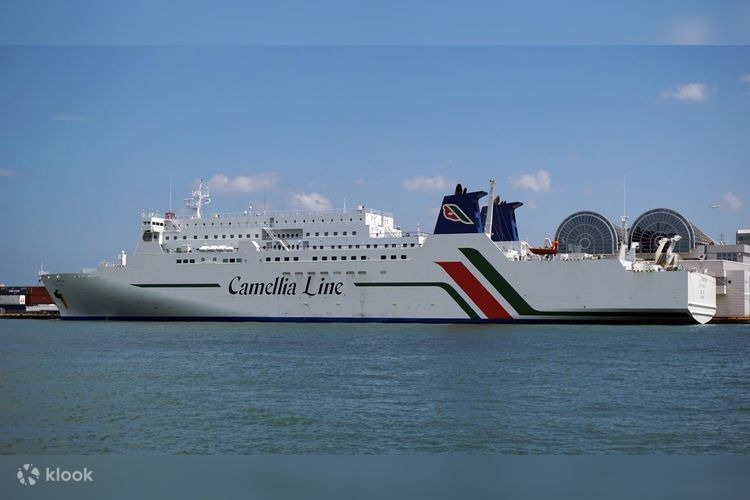
Camelia Line ferry, Busan ( Korea ) to Fukuoka ( Japan ). Courtesy, Klook.
With that in mind we reached out to the Camellia Line once we knew we had our van on the ground here. Lucky we did- turns out that the week we hoped to ship on to Japan was the ship’s annual “maintenance” week ( hence no sailings ). We’d thus need to bring said departure date forward a few days or push it back over a week, so we opted for the former, giving us a bit less than a month here, rather than a bit more. Still enough time but we’d have to ditch plans for Jeju-do ( a popular island in the far south of Korea ), plans that were not in any case firm and would have necessitated yet another long return ferry ride. Being a bit “shipped out” at this stage we were quite happy to limit our travels to mainland South Korea.
Adjusting for the earlier ferry date, our remaining time here would allow for a swing south to Gyeongju, out west to Gayasan National Park, down south to Namhae and east on to Tongyeong before wrapping up in Busan from which we were now booked to sail on to Kyushu, Japan. All places highly recommended by the Koreans we’d met and which, judging by the visits of overlanders ahead of us, had been popular with them as well.
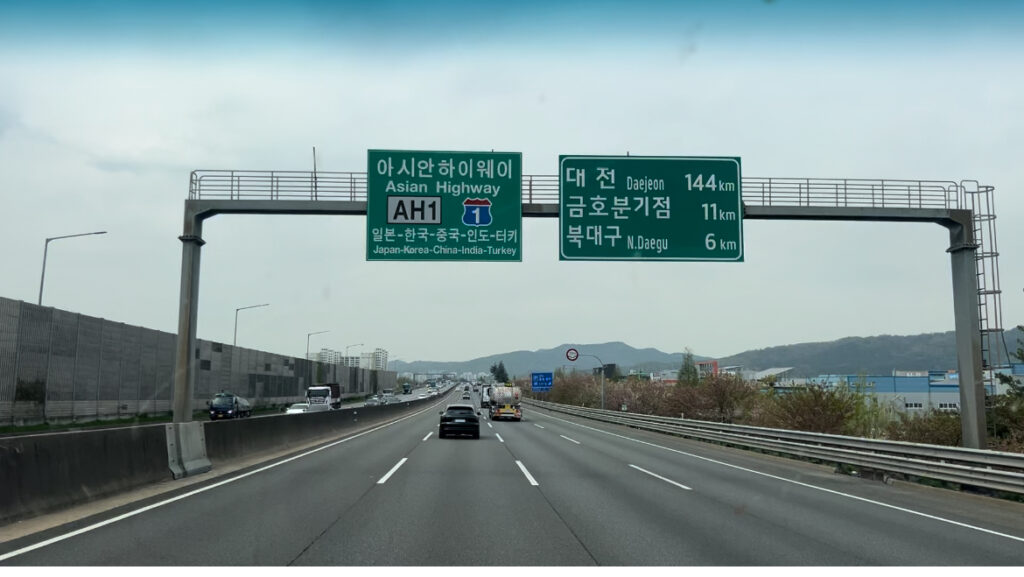
Early in the week we passed this sign on the expressway – had no idea we were travelling on part of a 20,000+ km highway that stretched from Japan to Korea to China to India and on to Turkey. Such is the Asian Highway, the AH1.
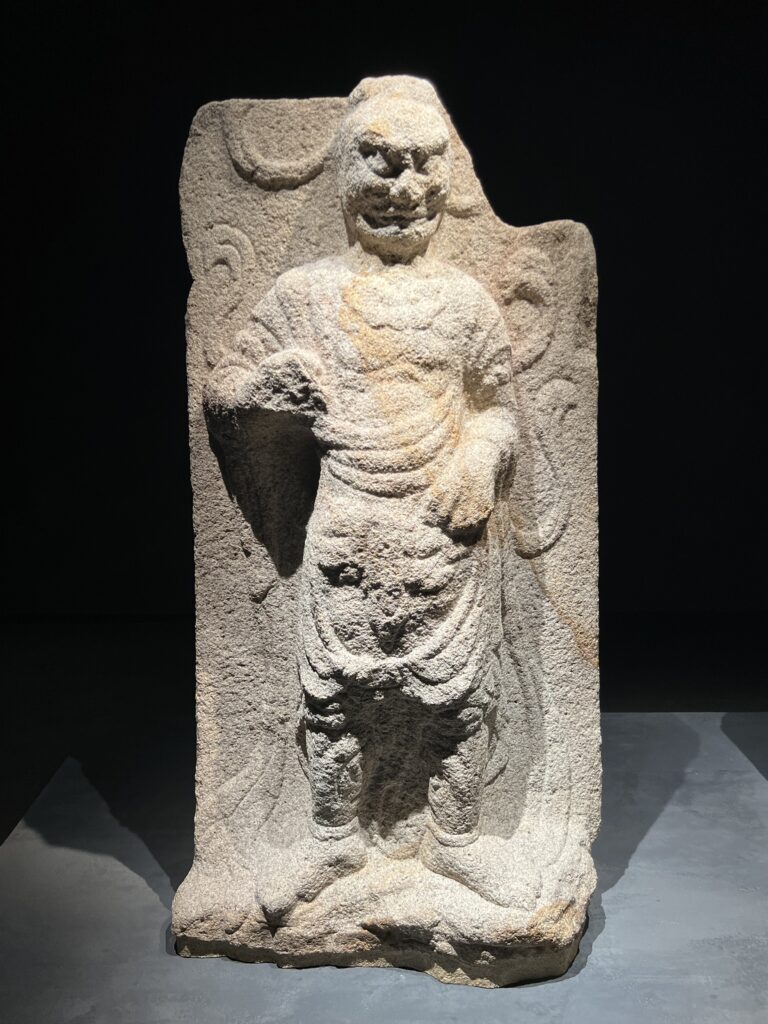
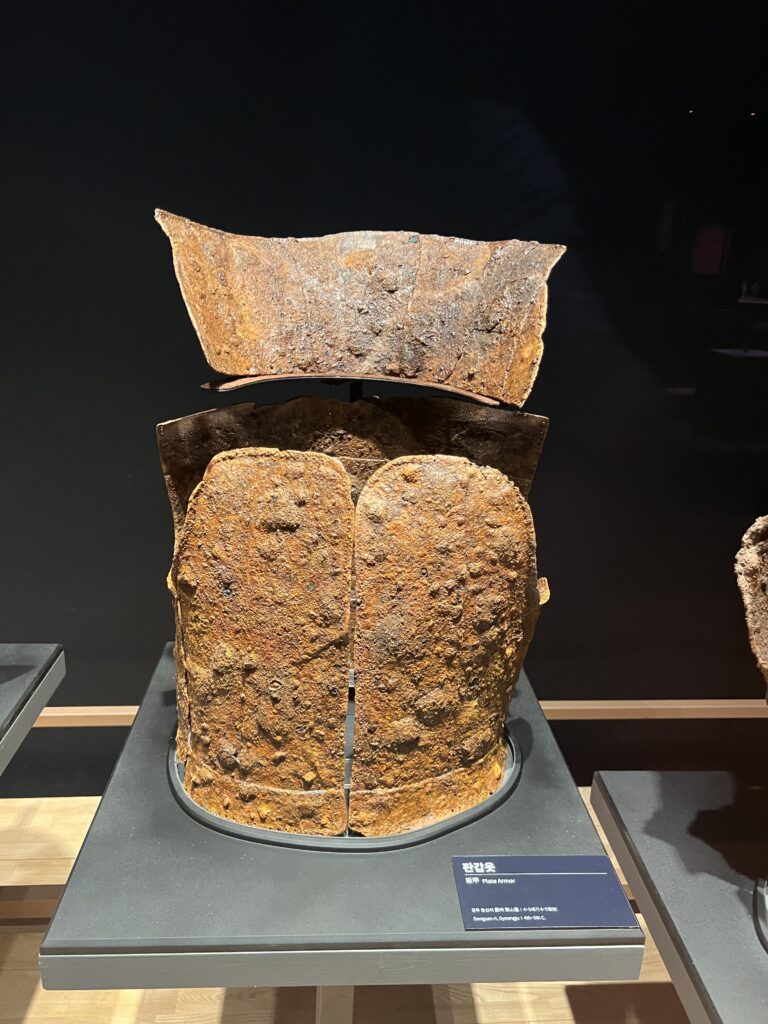
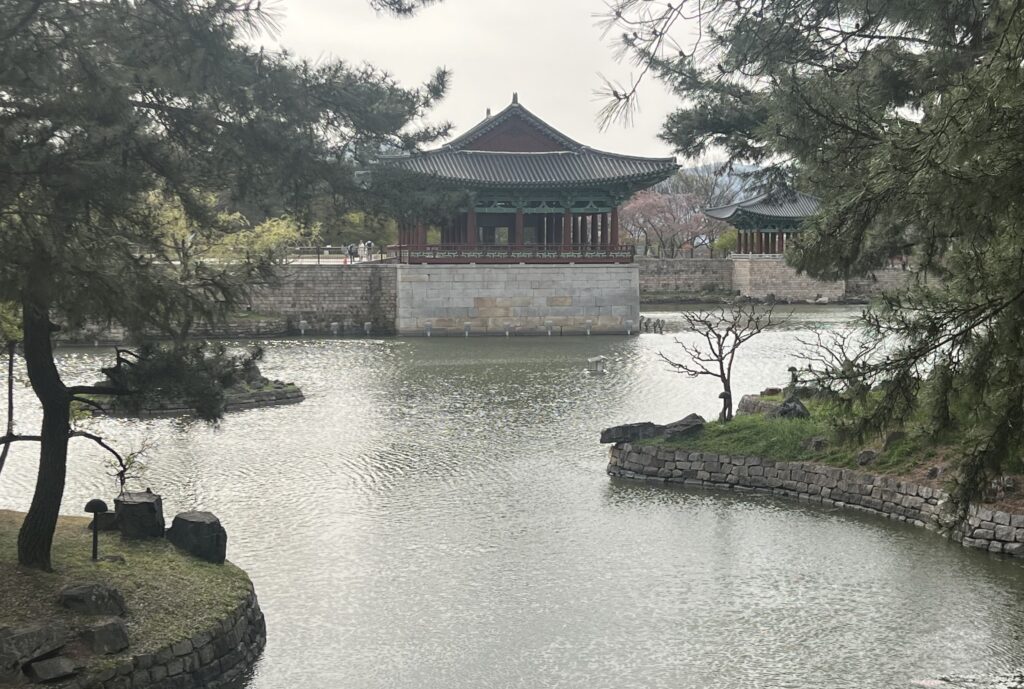
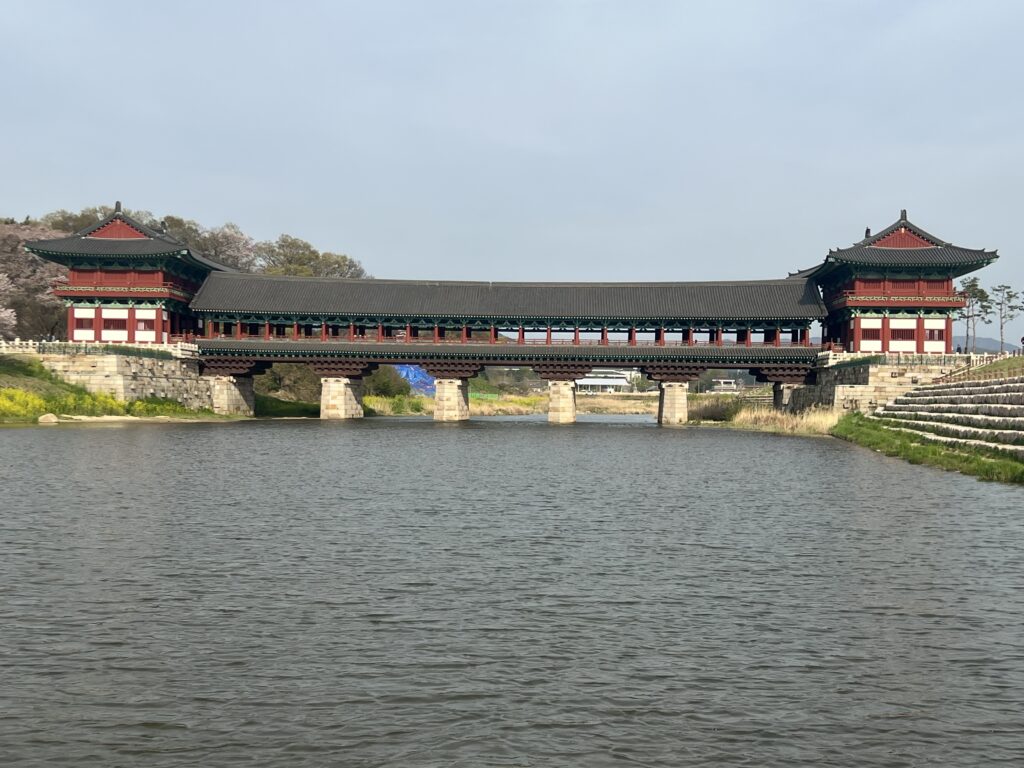
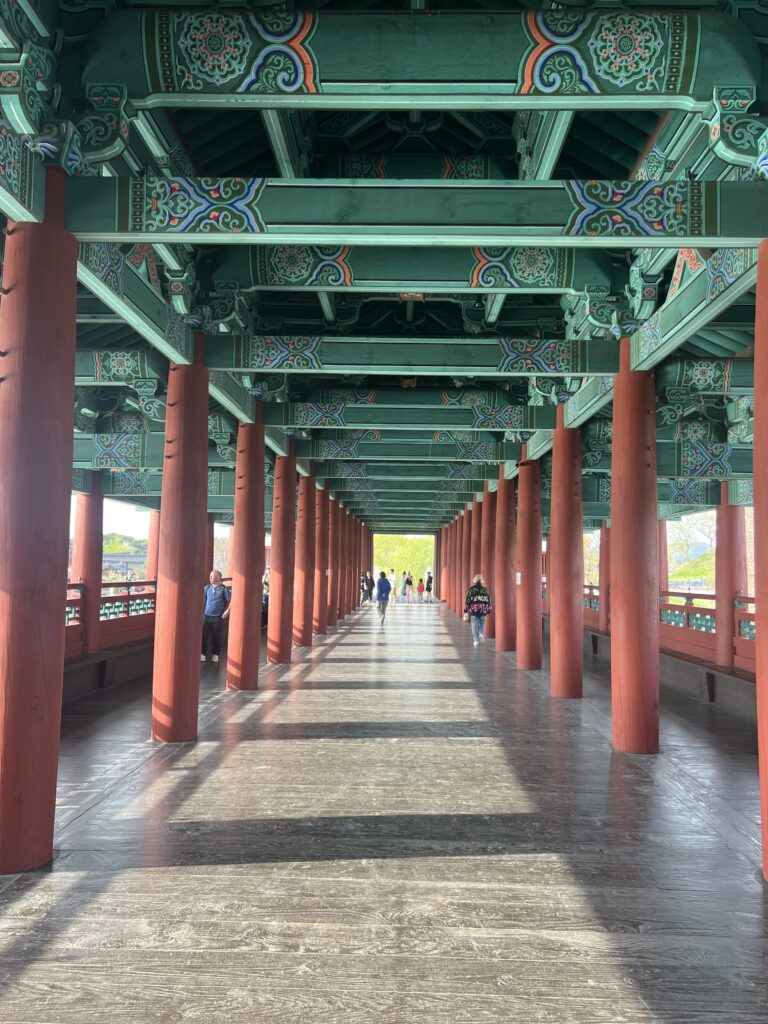
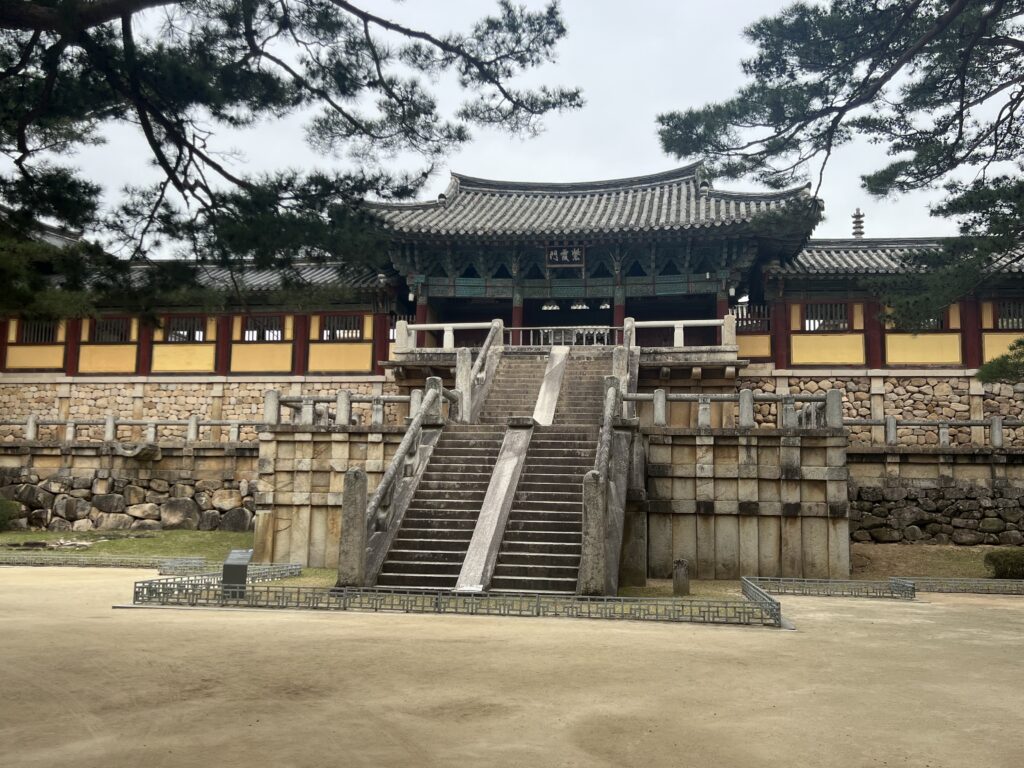
If Kyoto is the cultural heart of Japan, Gyeongju is its Korean twin. A smaller, easily navigable city, it has more temples, palaces, burial grounds and other historic sites than the average visitor is ever likely to see ( including us ) so we leaned on “Dr. Google” to give us its top 3 or 4. Excellent choices, all, and our time was well spent between the magnificent Gyeongju National Museum, Bulguksa Temple, Donggung Palace and Woljeonggyeo Bridge. If you’ve a real passion for Korean history, this is the place to spend time- so much of Korea’s dynastic history was centred in this part of the county and remnants are everywhere. Our pick was the National Museum, so informative, and the displays and organization overall were just first class.
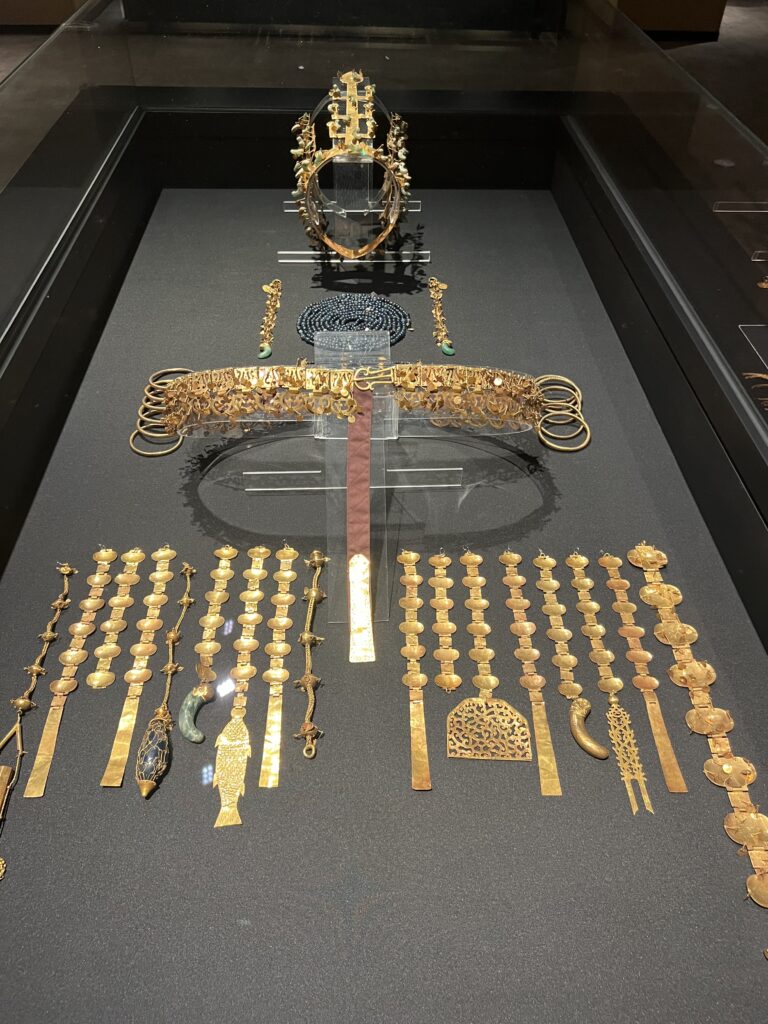
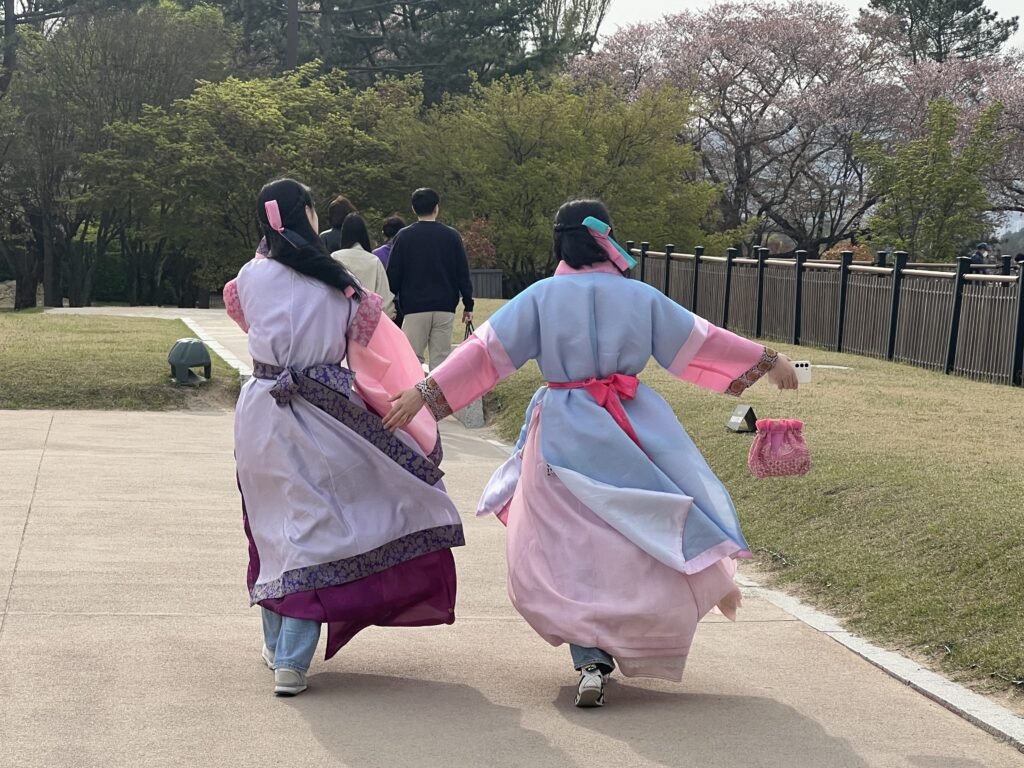
Ornate gold, Gyeongju National Museum.Stone carving, Gyeongju National Museum.Armour plate from a warrior, Gyeongju National Museum.Donggung Palace viewed across Wolji PondWe were ( pleasantly ) surprised how often we saw young Korean girls at tourist sites wearing the traditional costume. We noticed it in Seoul, Seoraksan and again in Gyeongju.Woljeonggyeo Bridge.Ditto.Bulguksa Temple.
From Gyeongju the next move was west, via Daeju ( another massive Korean city ) to Gayasan National Park. It’s famous fo a couple of well known hikes and the historic Heinsa Temple. Enjoyed the temple but got mixed directions on the hikes – ended up on the wrong trail and walked far further than we had to for a less impressive experience. We figured the exercise never hurts !
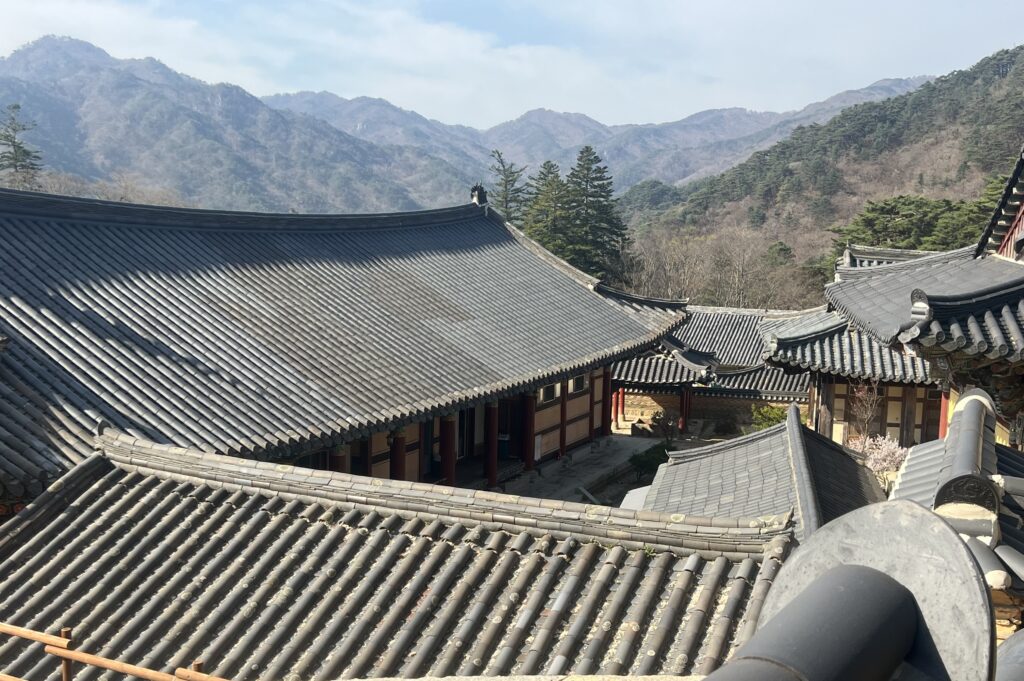
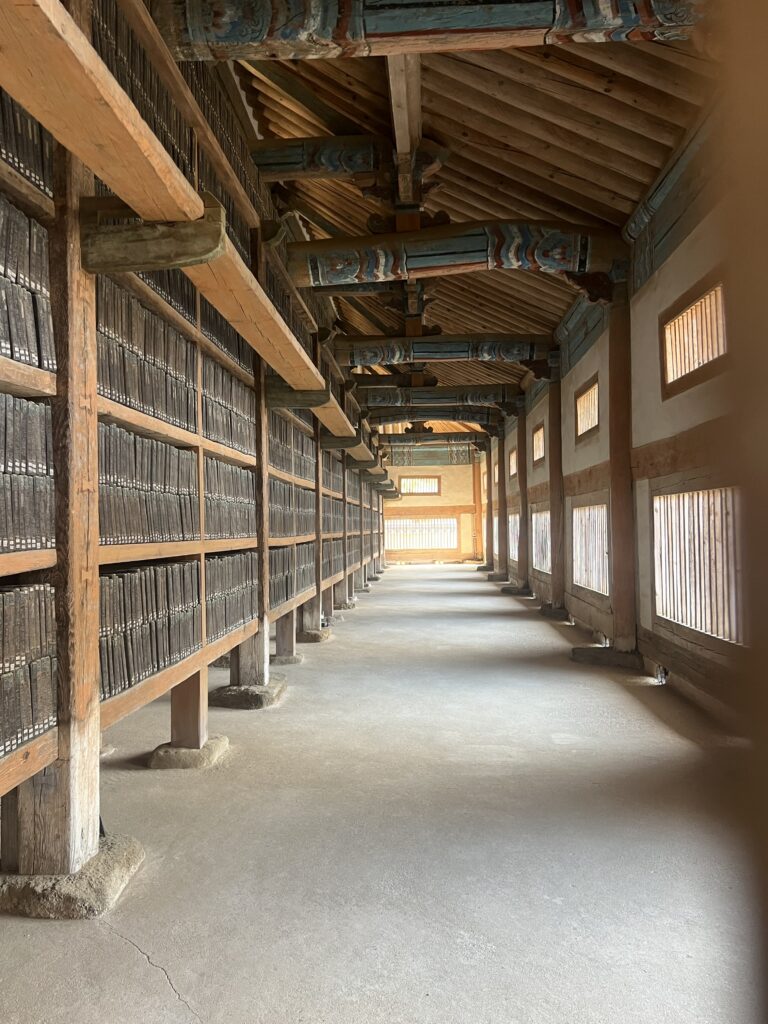
Beautiful drive into Gayasan.Namsan Jeilbong peak. Gayasan NP ( at least this peak ) was a bit disappointing simply because there was so little foliage on the trees at this time. We’d see more stunning vistas elsewhere.On the hike to Namsan Jeilbong peak ( Gayasan NP ).Pathway to Heinsa Temple, Gayasan NP.Heinsa Temple.Heinsa Temple.Heinsa Temple, inside, home to the Tripitaka Koreana , the most complete collection of Buddhist texts, engraved on 80,000 woodblocks between 1237 and 1248.
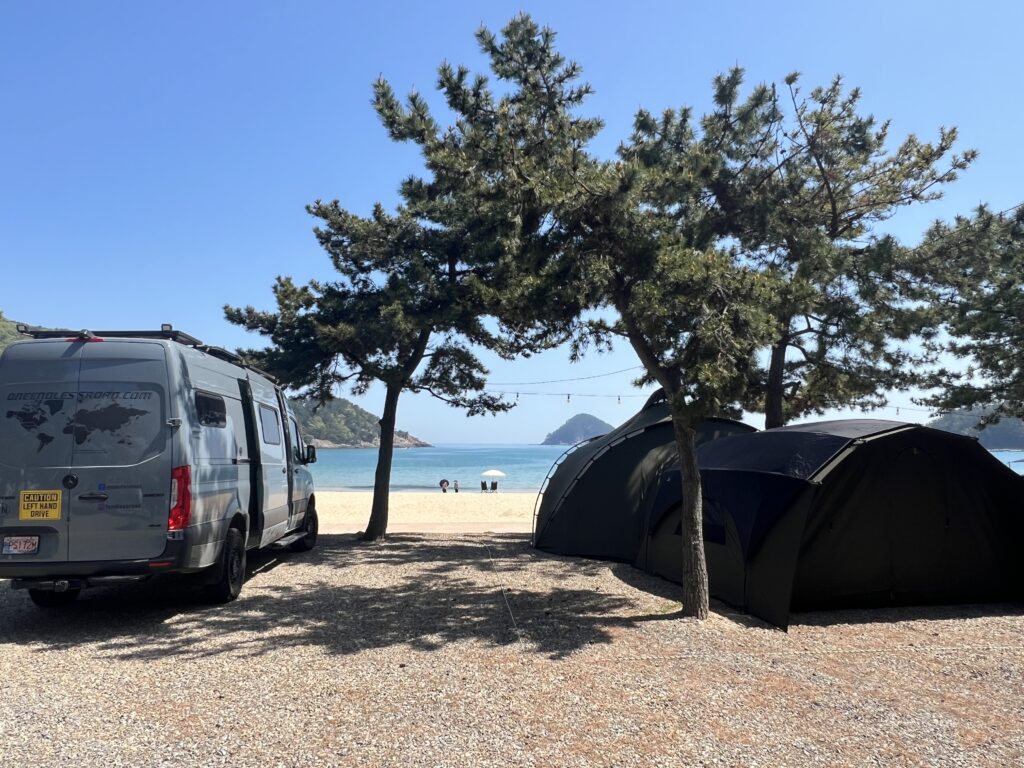
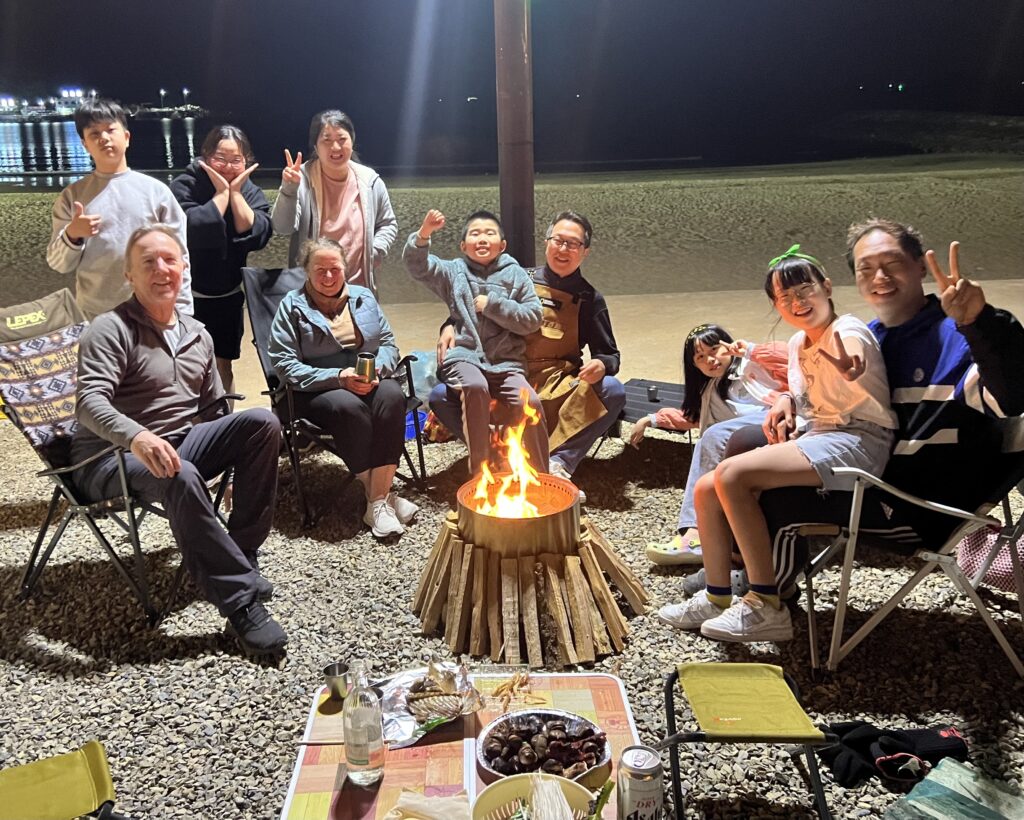
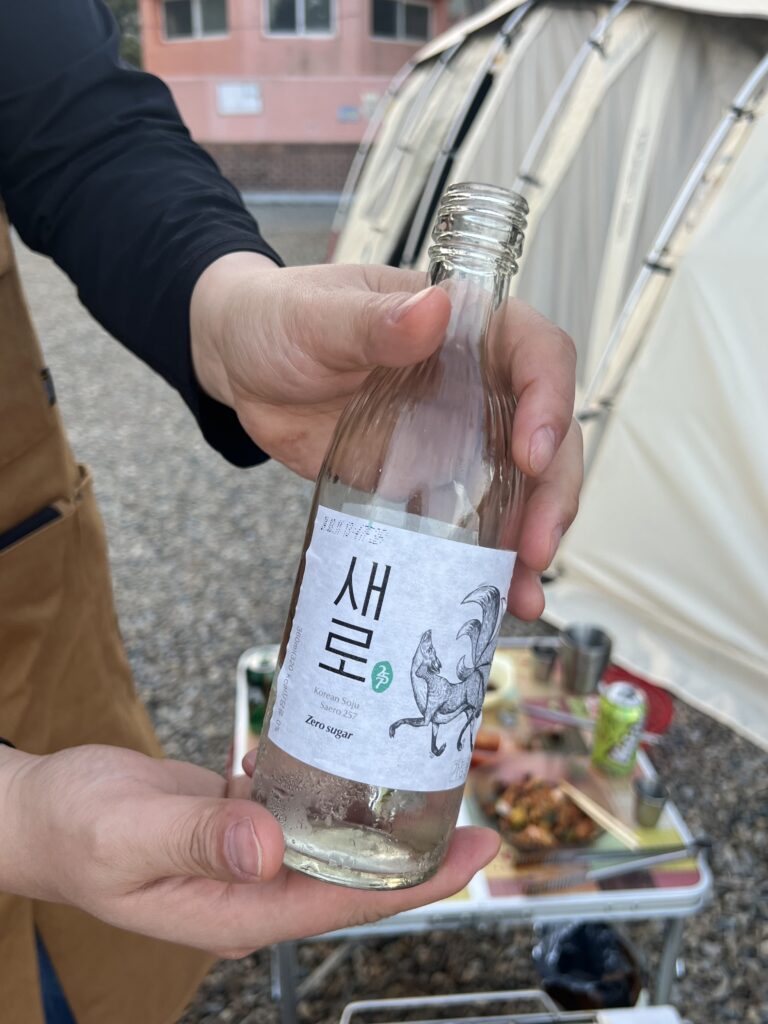
Our next move was more or less directly south to the island of Namhae – decidedly greener, warmer and in general, prettier than the landscapes we’d seen so far. We managed to score an amazing campsite right on the water at Sangju Beach which, in one fell swoop, redeemed our hitherto disappointing view of Korea’s camping offerings. Fantastic to meet some great locals who insisted on sharing some Korean BBQ food with us and introduced us the Soju, Korea’s national drink – not bad!
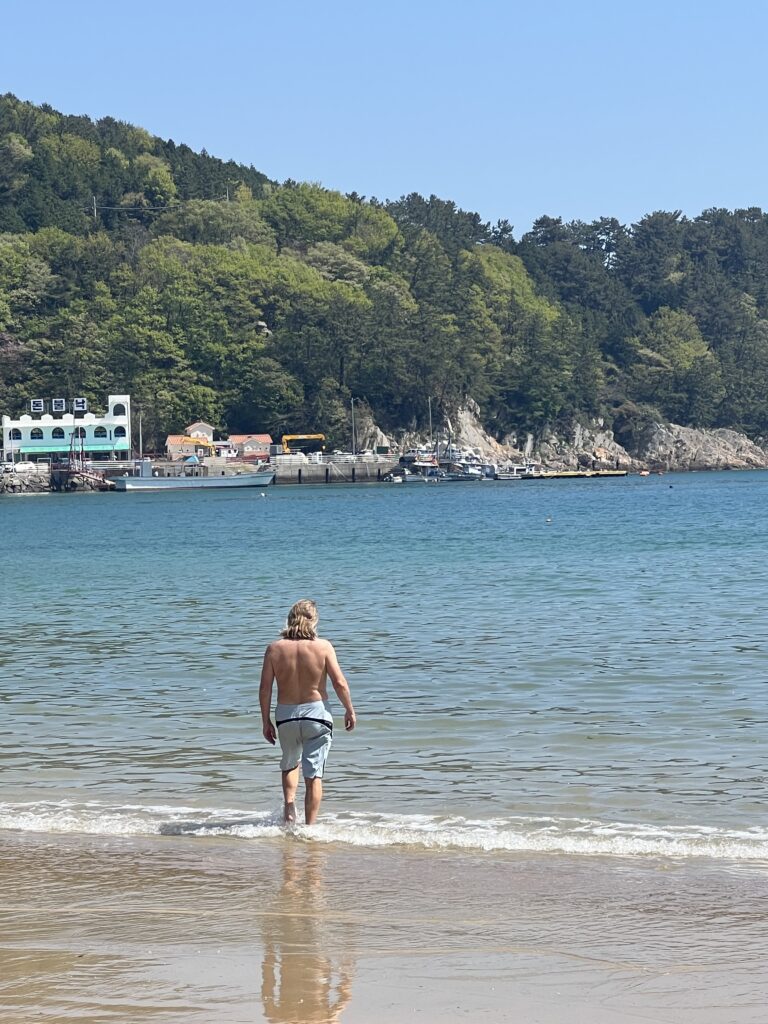
Best camping in Korea so far – Sangju Silver Sand beach. We were definitely “wowed” !It was more reminiscent of Thailand than Korea. Water not quite as warm, mind you…!A great evening was shared with our Korean camping neighbours………..who introduced us to “soju” ! Amazing hospitality.
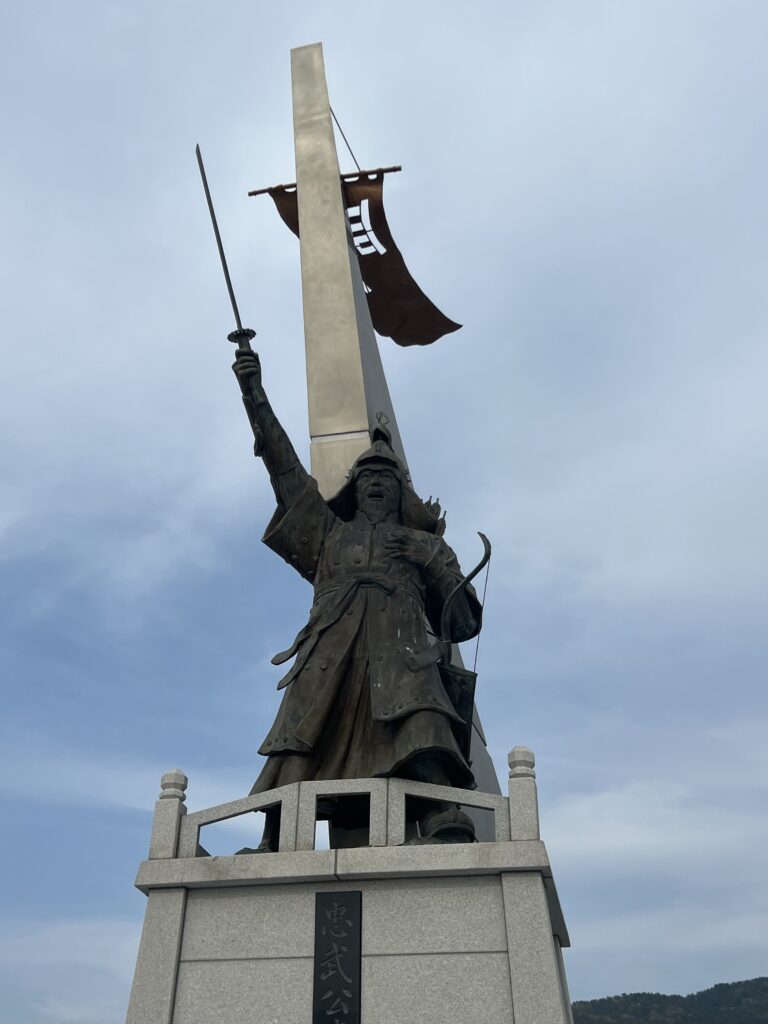
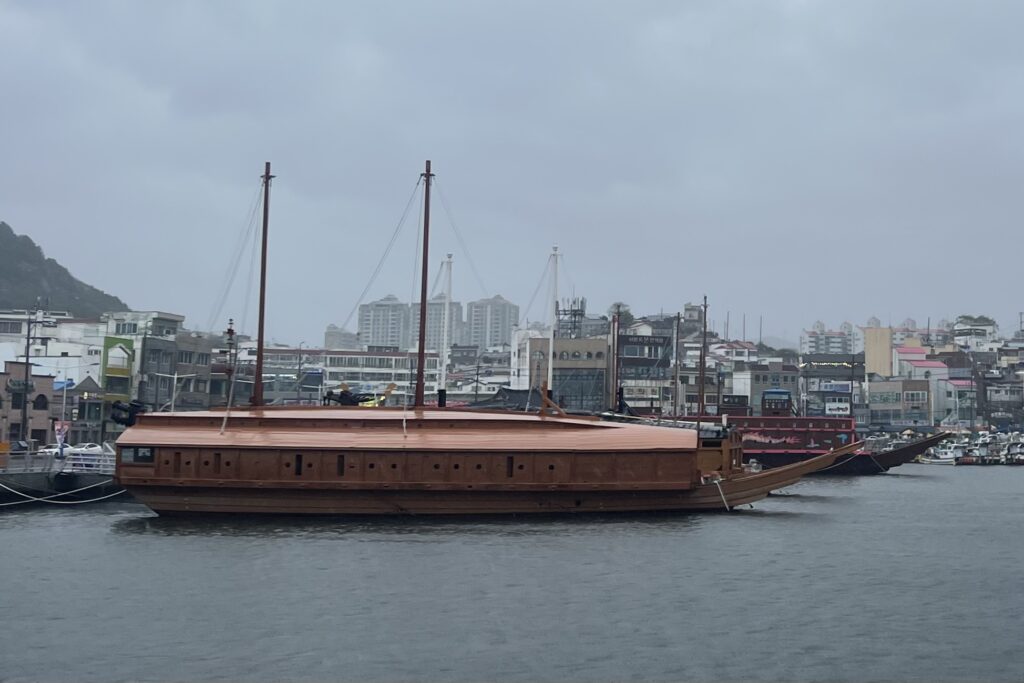
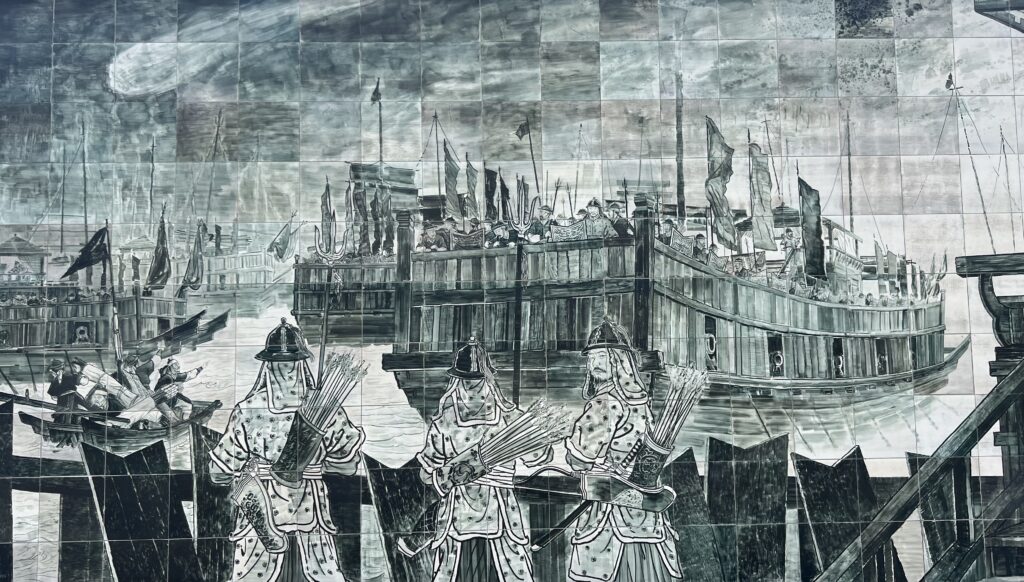
In addition to great beaches and some of the prettiest views we’ve seen in the country, Namhae is home to the Admiral Yi Sun Shi museum and we thoroughly enjoyed our visit, honoring Korea’s most famous naval hero ( globally ranked up there with Nelson and others ) – 23 battles and no losses, an incredible record. One of his great tactics was to use so-called “turtle ships” to defeat the numerically superior Japanese forces who threatened Korea at the close of the 16th century. Turtle ship replicas and Yi memorials are common in the southern islands, the very area in fact, where many battles were fought 400 or so years ago.
Legendary Admiral Yi, Namhae.A replica 16th century Korean “turtle ship”, Tongyeong harbour.Wall mural, Admiral Yi museum, Namhae.
Traveling the scenic coastal roads around the islands of Namhae, Tongyeong and Geoje would consume most of our remaining time in Korea, a very relaxing way to wrap up our time here. As has been the norm everywhere in this country the Korean people have been unreservedly warm, friendly and helpful – without exception they have been impressed to see foreign travellers exploring their country in some depth ( and, truly incredulous that we brought our own vehicle ! ).
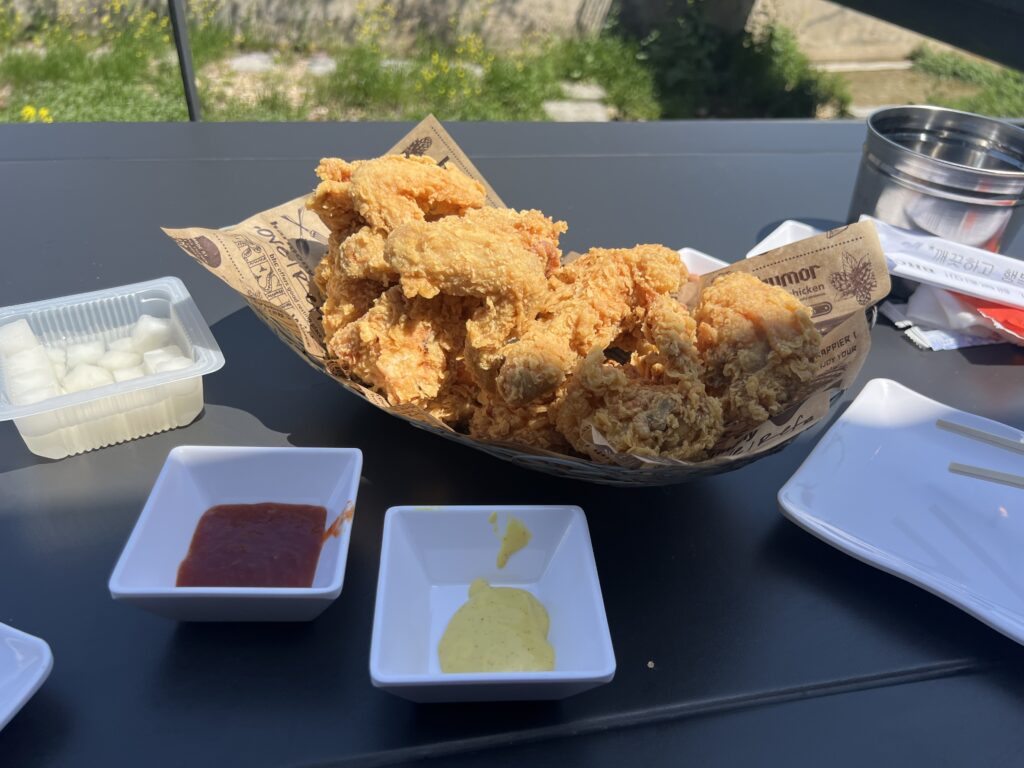
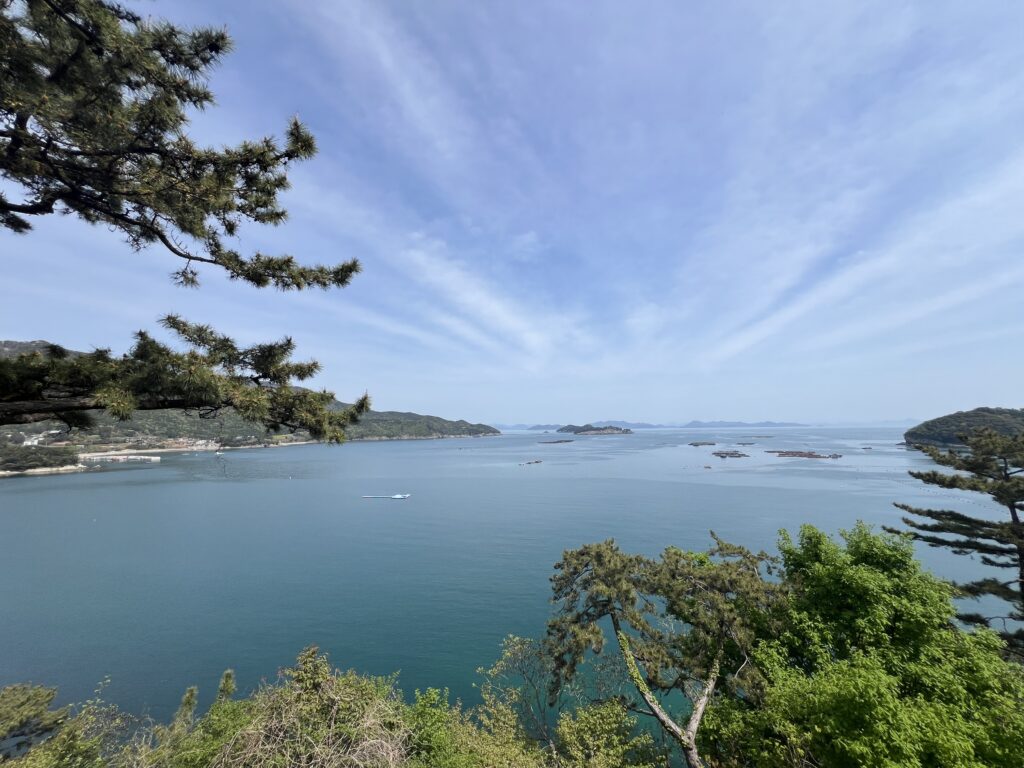
Koreans do their own version of fried chicken ( hugely popular here ) and we were constantly asked if we’d tried it. In Namhae we did – it is absolutely delicious, best we’ve ever had !Typical coastal scenery around Namhae and Tongyeong. A really beautiful part of South Korea, which we spent days just exploring.
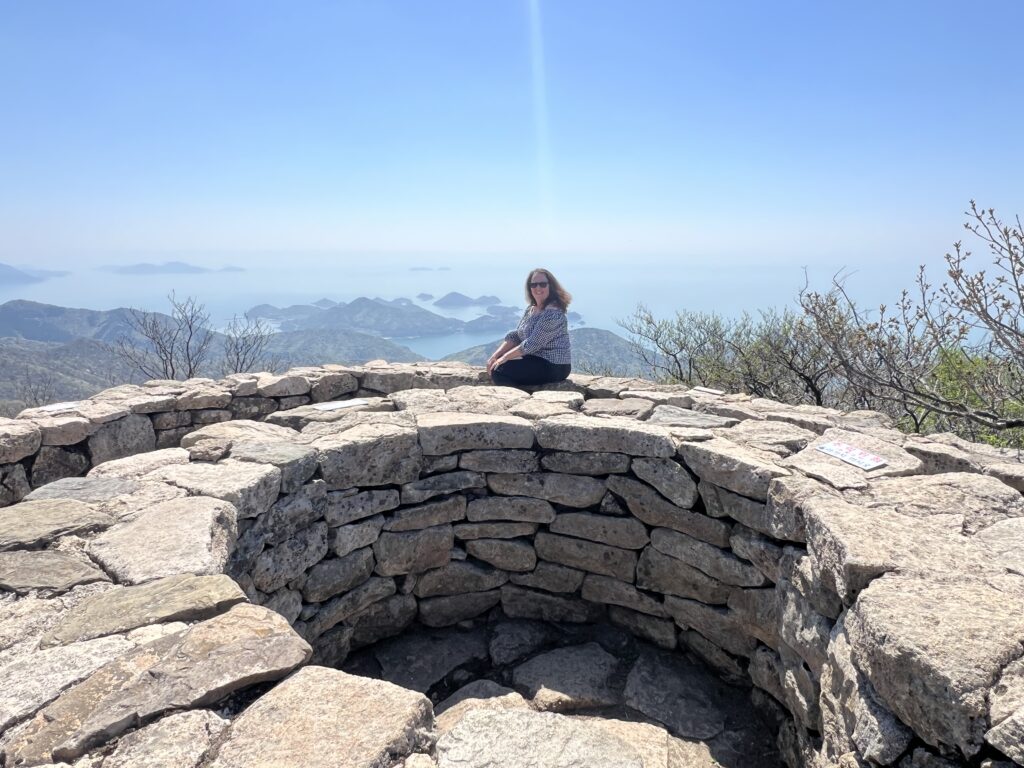
Hallyeohaesang NP, Namhae. A very steep climb near the top but the views made it worthwhile. Beacons like this, atop high peaks, were part of a smoke and fire signal communication system to warn of enemy invasions.
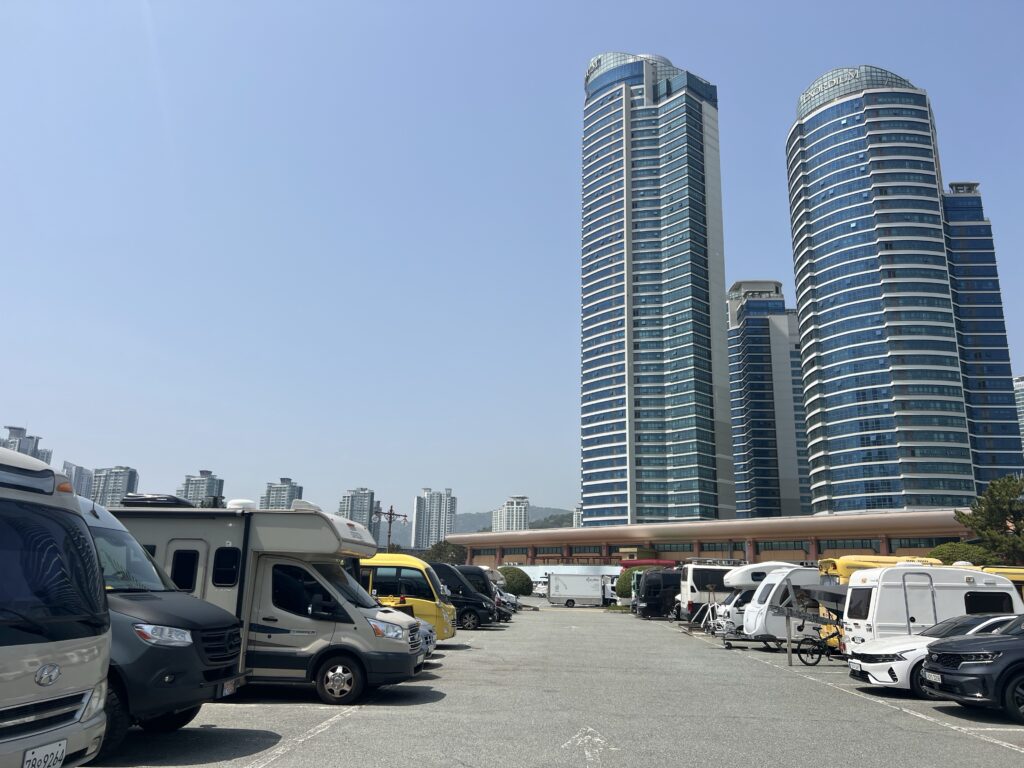
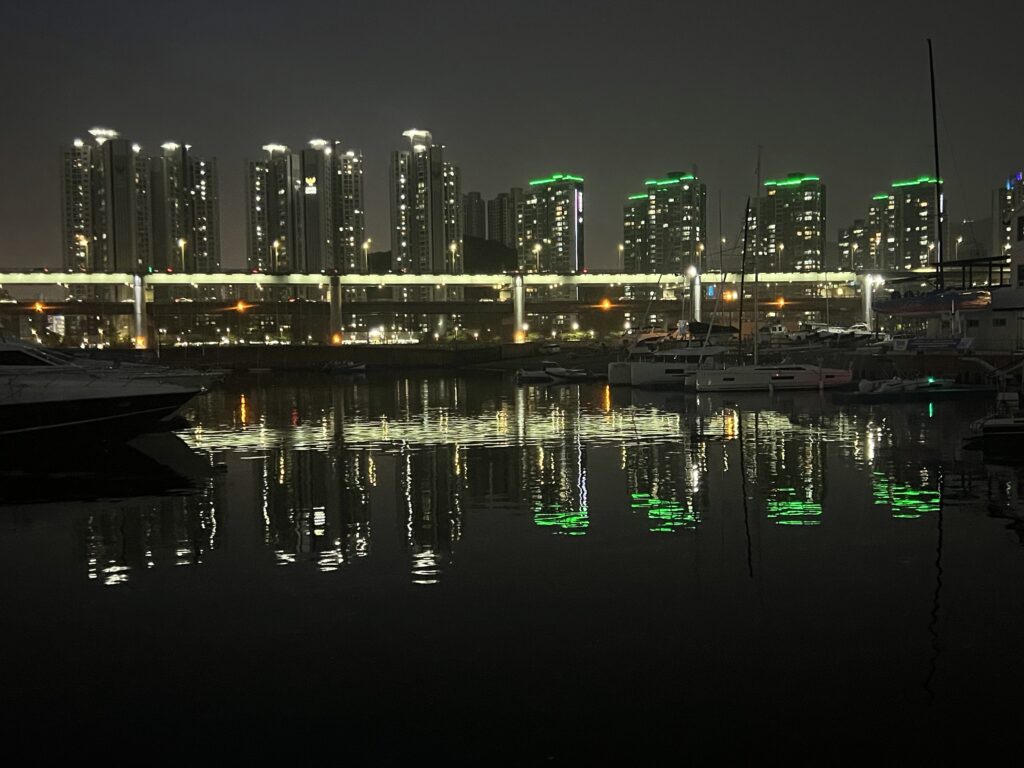
From Namhae and Tongyeong the outlying islands are all connected by bridges ( and then quite a long undersea tunnel ) back to the mainland again, just west of Busan. Busan, Korea’s second biggest city and a major port, stretches more or less lengthways across the south coast. It’s a thriving, bustling place and the many offshore highways ( nowhere to build more highways on the coastline ) afford great views of the city and and its mountain backdrop. We’d heard in advance that, rare among big cities, it had an an incredible spot to park up for the two nights we’d be there – the Busan Yacht Club. A truly amazing spot, central, in a very upscale neighbourhood with all amenities nearby. Predictably it is packed with campers ! If one needed any proof that Korean’s have taken to camping, or RV’ing in a big way, this was it. Our time in Busan was mostly organizational, arranging the shipping out, scoping out access to the International Ferry Terminal ( unfortunately right downtown ) but also managed some exploring and last minute shopping ( there is plenty of choice ! ).
Finally made it to Busan. A massive city, the drive in was, er, shall we say, interesting ! Parked up at everyone’s favorite, the Busan Yacht Club. They seem to allow lots of campers in here – it was full to overflowing. Rare to get a place like this in the heart of a big city – and on the waterfront.
View from Busan Yacht Club at night.
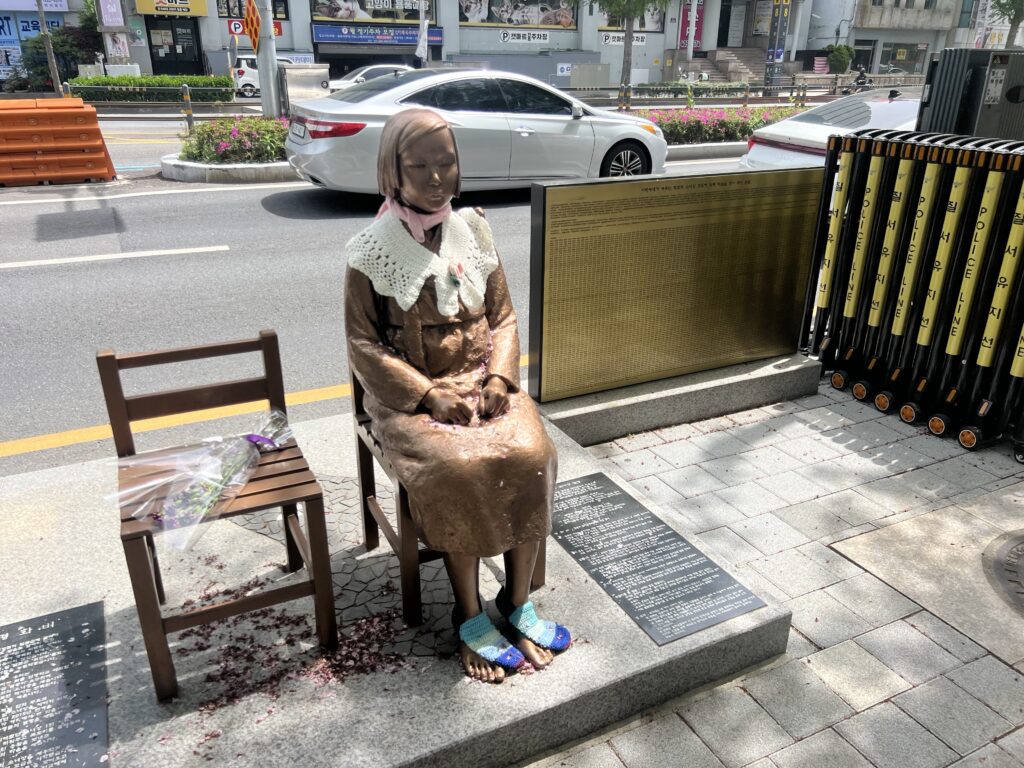
I’ll close this week’s blog on a little historical footnote. As we were walking along a downtown Busan street to the subway, we passed a huge walled complex with a police presence out front – we were unsure of what it was initially. I then noticed the bronze statue of a young Korean girl sitting, just staring ahead with an empty chair beside her. I then recognized what it represented and where we were ( we’d not gone looking for this ). She was the symbol of thousands of young girls ( and older women ) taken away from their homes and used as “Comfort Women” by the Japanese Army during WW2. It’s been a hugely contentious issue between Japan and Korea for decades, the Koreans feeling that the Japanese government has not properly acknowledged what happened, nor atoned for its war-time actions. A number of former comfort women survive to this day, and for many years have sought to bring visibility to the issue. That building the statue sits in front of ? The Japanese Consulate in Busan.
Comfort Women monument, Busan.
By the time this blog goes out we’ll be in Japan so I have added a separate “shipping” edition this week as previously promised – all nitty, gritty detailed shipping stuff so not a relevant read to most. Oh, and for those interested, Lois won the bet – in almost 4 weeks there we saw tons of RV’s and campers but not one single other overland traveller who shipped their rig in, ( darn ! ).
While very excited to be returning to the Land of the Rising Sun, we leave Korea with real sadness and a huge appreciation for the places we visited, the amazing people we encountered and a real “Wow” of total respect for the incredible economic miracle Korean’s have performed in developing this amazing country into what it is today. We hope, one day, to visit again.
Korea: Random Observations:
Each week as we roam around, we encounter situations, places and practices that we find interesting and which really shine a light on the people and culture of a country. As we leave Korea, I’d thought I’d share some here:
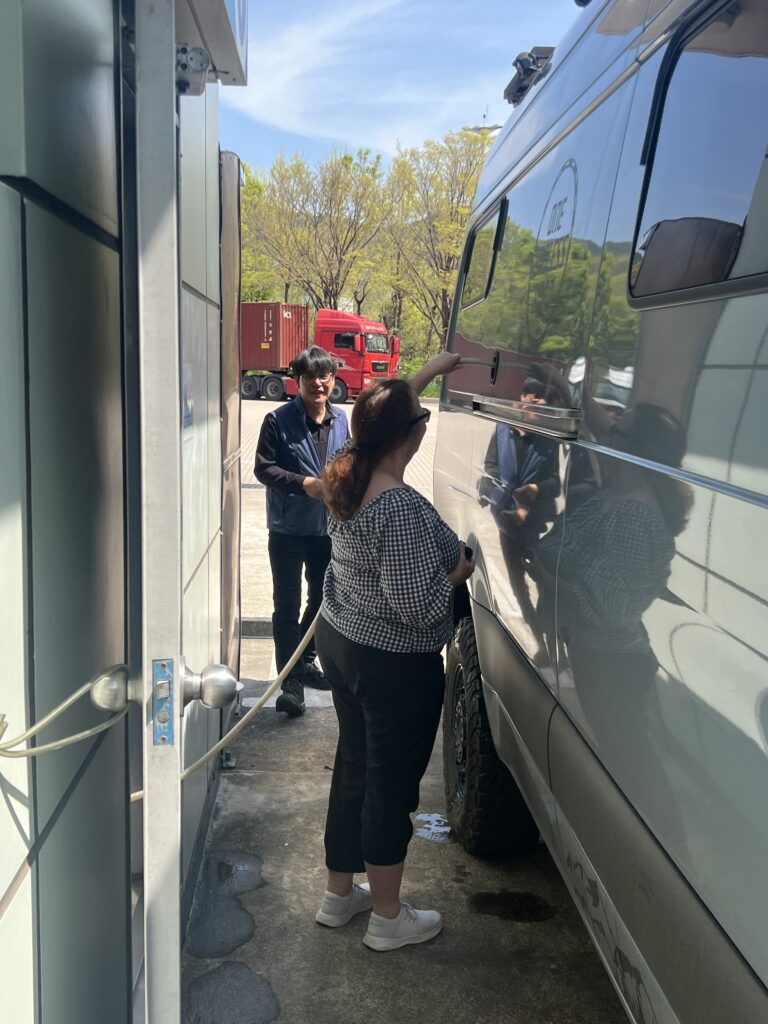
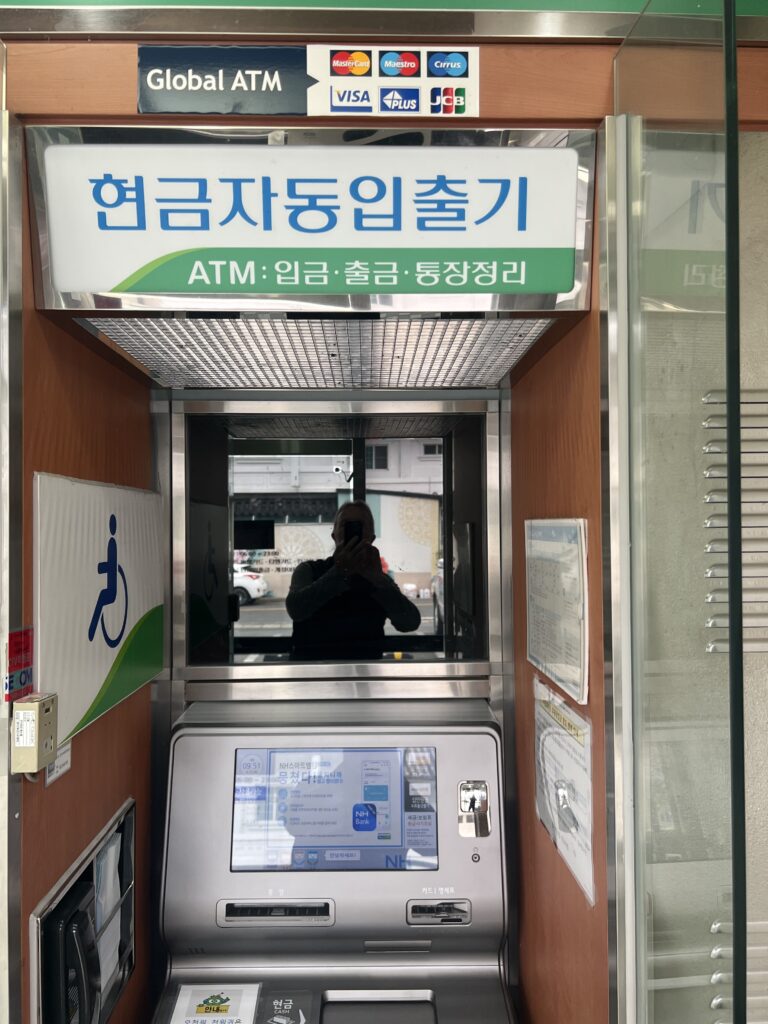
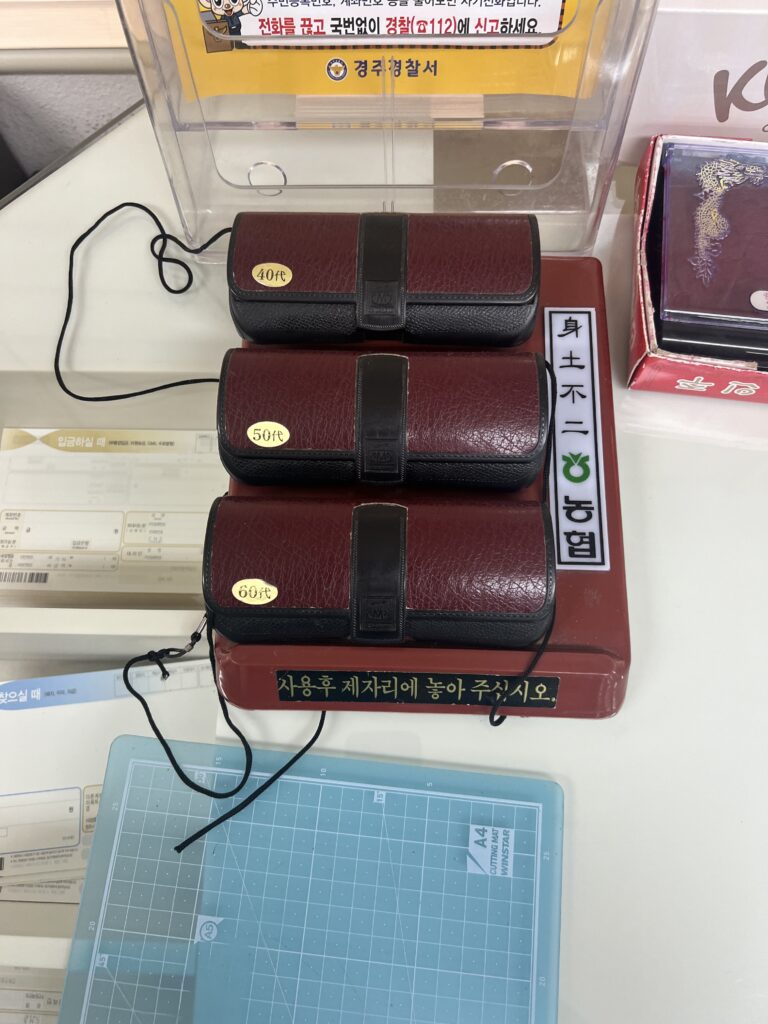
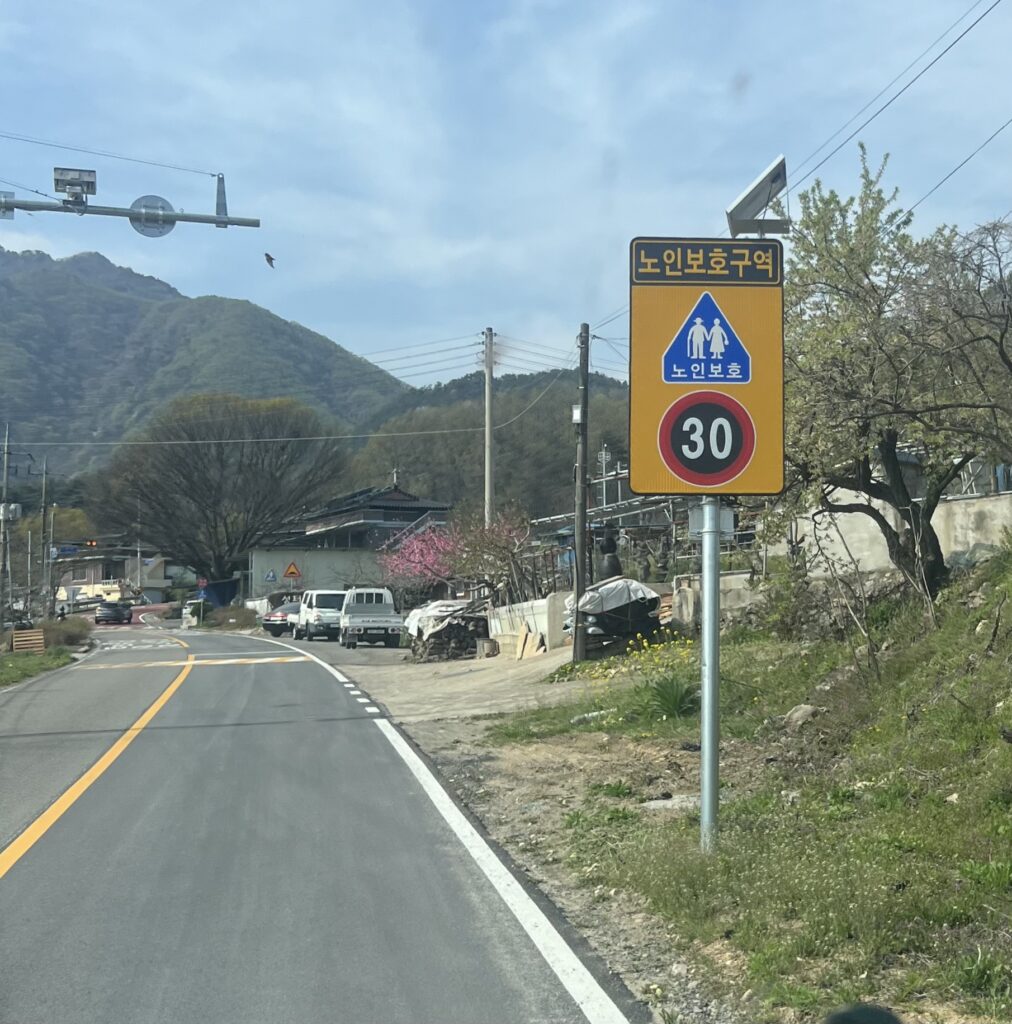
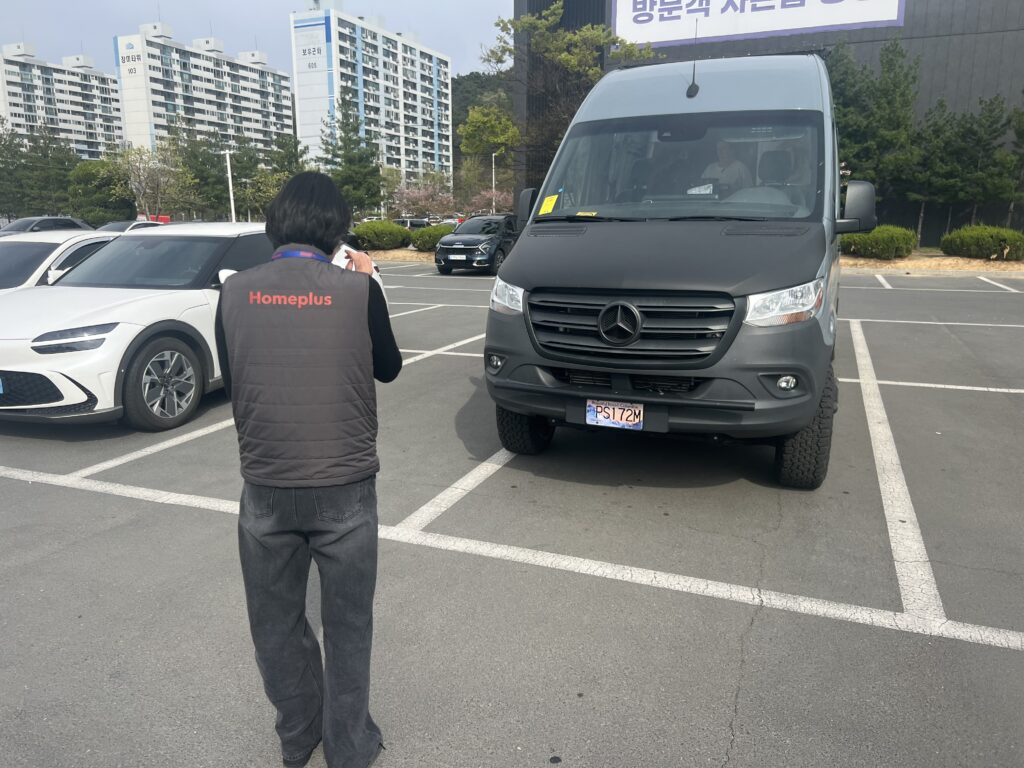
Filling the van ( with water ) required some creativity at times – here, we asked a fuel station attendant if we could use his tap/hose and he graciously obliged. Korean fittings differ from ours – lucky I have a gravity fill input on one side ( it’s saved us often ). Just like any other time we have needed assistance, Koreans have always been incredibly willing to help – no matter how weird our requests might seem !ATM’s are everywhere in Korea, but not all are linked to the global Cirrus/Plus systems. We tried many before we were directed to a specific location with a “Global” ATM. Quite nerve-wracking when you think you’ll have no access to cash ! We were both offered coffee and cookies by the staff, just for making a withdrawal ( a no-fee withdrawal, no less) ! Amazing….While at the bank ( with the Global ATM ) I noticed they provided a selection of reading glasses for elderly customers to use who might come to the bank without their own. They are all about service here……..and are acutely aware of the needs of the elderly.It’s a fact – Koreans are getting old. You see road signs everywhere warning you to watch out for the elderly ( and you see LOTS or very elderly people ); as we approached these signs our Korean “Naver” navigation app would say, “Caution, ‘silver’ zone ahead !”. South Korea also has the world’s lowest birth rate and it is a source of national concern and much discussion.HomePlus is a great grocery store, but in Gyeongju, exiting the gated parking lot required that a code from our shopping receipt be input into a machine that gave us an exit authorization, linked to our licence plate number. Ummm, what to do with a Canadian plate ? The helpful staff member came out and gave us an “override”. Sometimes there is too much technology in Korea !
As we left the Imjingak area I took a rather serendipitous opportunity to deal with a nasty little issue that had arisen just prior to leaving Melbourne. With only days left in Australia the water pump had failed ( camper water pump, not van engine water pump ). No time to deal with it there and we could get by on bottled water short term, but knowing we needed a long term solution I purchased a new one while in Canada and brought it with us to Korea. I had the presence of mind to bring all the small imperial measure fittings that might also be needed, but forgot that I would need a drill to remount the replacement unit. Where to rent a drill in Korea ? Fortunately, as I knocked on the front door of the first “campground” we were to stay at, I noticed the owner had (sitting right there on a nearby counter ) just what I needed! The inclusion of a loaned power drill made the steep campground fee bearable and within a few hours I had the old pump removed and the new one installed – bingo, we had running water again. Pure bliss, and a good start to another week in Korea.
Our first formal Korean campground ( well, perhaps “formal” is a stretch ). We were alone there, too early in the season for most Koreans. Hey, the owner had a drill, which I desperately needed, so we stayed.There, to my left as I walked inside to pay the campground owner, among a slew of other tools, was an old ( but still working ) drill.….and once it was all done, we had running water again.
Folly that we might think just by leaving the Imjingak and Gangwha Island area we’d be done with the heavy South Korean military presence. In fact, as we headed east towards Sokcho ( on the coast ) we saw more military vehicles, more military installations, heard more military jets and saw more military “devices” than we had back nearer to Seoul. On reflection, this should not have been surprising. Although only at certain points were we again close to the border with North Korea, there are of course many points along the northern frontier that a possible invasion might come from ( as was seen in 1950 ); to that end the South lives in a state of constant readiness. Troops, both US and ROK, are based in various camps in the area and all civil infrastructure is designed in such a way to quickly thwart the progress of any North Korean aggression – a few images below will explain that ( pretty clever, the South Koreans ! ):
At random points near the N. Korean border, large concrete blocks are balanced on the roadside, usually on both sides, ready to be deliberately collapsed onto the road. A small explosive charge is all that is required to destroy the supporting “legs” and hence make the road impassible.We passed countless military vehicles like this, and many tanks.
Our travels east took us on a bit of a zig zag route (generally avoiding freeways) through the pretty lakeside city of Chuncheon, Hwacheon, the incredibly circuitous ( but very scenic ) route to the Peace Dam Park and on, eventually, to Soeraksan National Park, our next major destination.
The Peace Dam was constructed solely to prevent South Korea being destroyed by an accidental ( or deliberate ) flood created by a dam breach on the North Korean side of the border.The base of the dam is massive and designed to stop a deluge from the North.We were able to ring the Peace Bell,( made from old shells and casings from past conflicts around the world ).The bell is missing one tiny piece – it will be added when Korea reunifies.Saw some of the fullest cherry blossoms on a lakeside walk in Chuncheon.Ditto.Saw this “campsite” in Chuncheon and asked about staying….….turned out their focus was on selling “glamping” ( for a couple of nights – or more- in an on-site upmarket tent ). We would come across this kind of camp site quite often. They were not interested in us parking on site !
Soeraksan is one of Korea’s top national parks and stunning in its landscape – neither Lois or I expected mountains this high, this rocky, nor ( so late in the year ) to still be snow-capped ! A very pleasant surprise. Sadly, what was not a pleasant surprise were more “Public Alerts” on our phone addressing the poor air quality ( blamed on particulate matter from Chinese factories just across the West sea ) which left otherwise beautiful days with a blue-ish haze; not conducive to good photography, unfortunately. This would follow us for the next few days. We actually spent a couple of nights at Soeraksan and got in some lengthy ( well, lengthy for us ! ) hikes and a spectacular gondola view. Two weeks later and the cherry blossoms would have made it even nicer ( more of that down south we hope ) but we were just a bit early for that this far north and this high.
First views of Soeraksan NP. Surprised to see snow.Mountains, Soeraksan NP..A cable car / gondola made for a speedy ascent.Views from here were wonderful.Selfie, Soeraksan NP.Sheer rock face, Soeraksan N P.
Statue of Buddha, Soeraksan N P.
While in the Sokcho/Soeraksan area we had finally made a couple of important ( to us ) discoveries. First, we discovered a Korean laundromat ( we’d been struggling to find one ! ) and second, we realized that “HomePlus” was in fact a giant Korean grocery store ( which we also desperately needed ) and not ( as we had assumed ) a Korean version of Home Depot ( a large North American hardware store ). Now we could both wash our clothes and, finally, stock up on life’s little luxuries. The selections at HomePlus were indeed impressive.
After getting by with 7/11 type convenience stores we finally stumbled upon a “real” grocery store. Heaven !Been to a lot of laundromats in our travels, never to one that had a special machine for washing shoes ( and a shoe drying machine beside it ) ! Sokcho, Korea.
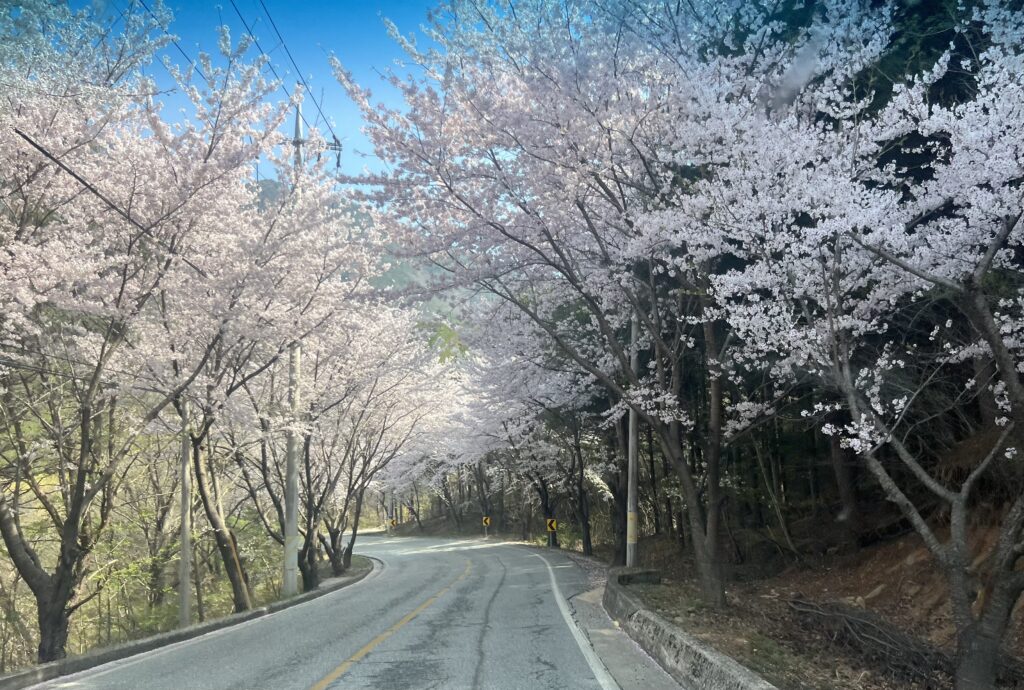
Beyond the attractions up north, there was a geographical gap (further south ) to the next areas of interest to us. Korean’s we’d met encouraged us to fill that with further exploration of more of their excellent National Parks. Beyond Soeraksan we travelled to and hiked in Chiaksan NP, and took a rather twisty, circuitous and very narrow road around Korea’s largest lake, Chungko, which delivered us some of the best cherry blossom viewing on the trip so far.
Lois, Chiaksan NP.Chiaksan NP.
Further south, through Danyang, a popular tourist area for Korean’s, we made a couple of pit stops to check out at least a few of Danyang’s famous “8 views”. These were less than notable, and we were glad we’d not detoured too significantly to take in these “attractions”. If they were a bit underwhelming, the UNESCO recognized Hahoe Folk Village in nearby Andong definitely was not. A very well preserved traditional Korean village with buildings dating to the 1500’s, it was very impressive. Very authentic ( and still lived in ) it was also surrounded by some of the best cherry blossoms we’d seen in Korea so far. Only after we’d almost completed our visit here did we realize that no less than HRH Queen Elizabeth herself had visited in 1999 !
Us, walking the cherry blossom pathway, Hahoe village, Andong.View across rice field and cherry blossoms to traditional Korean village, Andong.Hahoe Village, Andong.Hahoe Village, Andong. Dodamsambong, ( 3 Peak Island ), supposedly representing the typical love triangle of ancient Korea ( husband, wife and mistress )Sainam cliff, Danyang.
I’ll close with a few important learnings from this past week on the road here ( seems there is some tip or trick we pick up almost every day ! ):
Expressway rest stops serve two other useful purposes ( in addition to offering fuel): a) a place to get rid of rubbish ( rubbish bins being VERY scarce in Korea ), and b) a place to park up for the night when all else fails ( they’ve saved us once already ! ).
This is where we usually have to go to dump our garbage bags ( expressway rest stops ). It is very difficult to dispose of rubbish in Korea.Typical highway rest area, this one near Danyang. A safe park-up when nothing else is available.
2. The country has more tunnels than any other we have ever visited ( and yes, we’ve been to Switzerland ! )
3. Almost all car washes in Korea are those low clearance automatic ones – we looked long and hard to find a high clearance hand held spray wash ( and still only just made it underneath ). Ten days in the country before we found one like this.
4. We’ve accepted that we’ll never figure out how to get a Korean toll payment machine to accept our credit card ( or even cash ! ). Wait long enough, though and one of these ever helpful toll collectors will come out of the toll booth and help us out !!!!
5. And, finally, we realized there ARE other campervans in Korea ( many people had us believe we’d be the only ones ). Here, two others parked beside us at Soeraksan and below a few more we saw free camping in a municipally designated free camping area near Imjingak. That said we’ve yet to meet anyone else who brought their rig in – Lois and I have a bet going, I say we’ll see at least one, she thinks not. Who’ll win….?
Here, we’re parked up at Soeraksan, wedged in between a couple of Korean “camping cars”.Korean campers, roadside designated camping area, near Imjingak. Still not mainstream in Korea but catching on.
As our first few days in Korea wrapped up we were feeling optimistic about next steps – namely, getting to Pyeongtaek port and arranging to collect our van. Separated for almost 7 weeks, we were anxious to be reunited with our rig. Staying in downtown Seoul hotels was a nice change of course, but there is nothing like having your own wheels – and bed, and kitchen, and bathroom, and sofa and…..basically, all your stuff in one place ! We had missed that.
Prior to heading down to Pyeongtaek with JB from YCL Logistics, we still had some more sightseeing to do in Seoul. This thriving city of over 10,000,000 is Korea’s economic and cultural hub and offers much to the visitor. Imperial Palaces, famous markets, great restaurants, home of “K-pop”, one of Asia’s hippest suburbs, an amazing War Museum and a truly vibrant downtown. Connecting it all is one of the best, fastest, cleanest and most affordable subway systems we’ve seen anywhere. Especially notable was the lack of graffiti and the fact that the subway information was always posted in 4 languages ( Korean, English, Japanese and Chinese) – there are not many places where you see that and just another great example of the lengths Korean’s go to in order to make navigating this huge city as easy as possible for all visitors. We also found the Korean people to be incredibly friendly – more than once people actually approached us ( when we were staring blankly at maps ! ) to offer assistance. Safe to say that Seoul left a great impression on us and had us hankering to see more of the country.
Street near our hotel. Street name in English, Korean, Japanese and Chinese.Meticulously clean Seoul subway – seen here at a quiet time of day !Must say, this was a first : our hotel in Seoul ( room was on the 3rd floor ) offered a “ Life Line”. Upon opening the box it was a nylon rope you could use to exit via the window in case of fire. Luckily we had no need to use it !Wander the backstreets and you occasionally find a gem. This local restaurant offered the best prosciutto pizza we had eaten in ages.Always nice to get a good “foodie” surprise.Throughout the museum the Koreans go to great lengths to recognize the support of all UN nations who supported the South against the North Korean invasion.One is left in no doubt as to who the “bad guys” were.The museum has Douglas MacArthur’s famous old corn pipe.One of the greatest planes of WW2, the P51 Mustang saw lots of action in Korea.This was touching. A monument at the Korean War Memorial depicting two brothers, separated when the Korean peninsula was divided, leaving one fighting for the North and for the South. They actually met on the battlefield. Monument depicting the split of Korea and the hope that one day the Korean people will see their country unified.General Yi Sun-Shin.King Sejong, Seoul. A revered leader, King Sejong is credited with developing the Hangul alphabet which Koreans now use. Previously they used Chinese charactersNational Museum of Korea – ornate royal garment.Gyeongbokgung Palace, SeoulGyeongbokgung Palace, SeoulModern art, downtown Seoul.First we found Gangnam station……..…..not far away we found Psy !Gangnam – hippest part of town in Seoul. Can’t beat Gangnam Style !
I’ll leave the full “blow by blow” blog of vehicle importation steps in Korea till we leave and merge that with the steps for exporting the vehicle. Putting it all in one place and tagging it appropriately will make it accessible via a general Google search to those that follow us in Korea and wish to see what’s involved. It’s absolutely invaluable to have a current example of what the process looks like. But, more on that in a few weeks.
JB Chang escorted us to the Port of Pyeongtaek and after some minimal signatures, ID checks, and a short wait we walked through the gate to see our van. All alone, covered in a light coating of dust, but otherwise in perfect shape ! The inside was still quite clean (we’d left it sparkling ), things appeared in order and, most importantly, no one had tampered with the Slicklock on our rear doors, which secured them closed. That was a good omen, because in all likelihood everything that we had stored inside the garage area of the van was likely to still be there. Using a key that only I had, the Slicklock was opened, and there before me was everything neatly stacked just as we left in the Melbourne . I can’t overstate what a huge relief that was given that we had seen some serious theft from both previous RoRo passages. No need to fight with insurance companies, no need to pay large excess/deductibles, and most importantly, no need to be living without critical items that are not easily replaceable on the road ! I gave Lois a big high 5 as I drove through the gates to pick her up – she was waiting just outside. A very nice start to our road travels in Korea!
JB drove us from Seoul to Pyeongtaek in his own car, a very nice new BMW.Pyeongtaek International RoRo Terminal ( PIRT ) through which our van was unloaded ( Photo courtesy P.I.R.T. ).Thank you, JB !Out of the port, first step was to fill the van with diesel. Hmmmm, how to distinguish between the diesel pump and the gasoline/petrol pump when everything was written in Korean. No room for error there…!
We had driven a couple of hours south of Seoul to pick up the vehicle and now we would begin our planned route around the country. Step one was to get out of Pyeongtaek and find a rest stop for the night ( it was getting late ) and step two was to head into the city of Incheon where I had really been looking forward to visiting the Memorial Museum of the Incheon Landing ( sort of a Korean War “D Day” equivalent – in WW2 terms ).
First lesson learned in Korea ( which came as little surprise ) – there aren’t many formal campsites here (in the Western sense) so we knew we would be relying on tips from those that went before us who had documented their rest stops on the trusty iOverlander app. A quick glance at the whole country map revealed that there certainly were not very many of these and most of those were three or four years old (hence, probably of dubious relevance today). Furthermore ( as we would soon discover ), of the few campsites that did exist, many were closed because it was not yet high season. Finding a place to stay each might require more creativity than we thought……
Thanks to notes from a lady who last stayed here way back in 2019 we found the parking lot where she rested, near a Catholic Church, not far north of Pyeongtaek. It was late, and we were tired; “any port in a storm”, as they say.
The second lesson came in Incheon. As big and congested as the city is we did not find driving there to be difficult but it certainly helped that JB had tipped us off to some of the unique Korean driving rules. We found the Incheon Landing Memorial with no drama at all but got the shock of our lives when we saw the parking lot. While a memorial like that in most western countries would have a large parking lot for cars and tourist buses, we could see no such provision here, and with the extremely narrow lanes and tight corners, there was obviously no way I was going to navigate a 7m van through the place. Worse, there was absolutely nowhere, within a reasonable distance, where I could park our vehicle. A full hour after trying, we just threw in the towel and headed on out of the city. Note to self – sometimes it might be easier to park on the outskirts and take the subway in to the centre of town !!!
Having wrapped up our sightseeing in Seoul before leaving to get the van in Pyeongtaek, our aim for the rest of the week was to explore the areas north west and just north of Seoul, all of which closely bordered North Korea. From past personal experience, and recent updates from other travellers, we knew there were a couple of great spots for getting as close as possible and thus having a birds-eye view into the Hermit Kingdom. One thing we knew we would not be doing, somewhat sadly, was re-visiting the “truce village“ of Panmunjom. We’d luckily visited it back in the mid ‘80’s but tourist visits were now suspended after an off-duty US soldier dashed across to the North during a tour of the DMZ back in 2023. Over the next few days we travelled to Gangwha Island ( west of Seoul), the Imjingak/Panmunjom area (to the north), and finally the Odusan Memorial Tower – all provided interesting access points and/or harrowing tales of life in North Korea as well as showing the immeasurable pain and suffering caused by the conflict.
Blue dot shows where we visited/stayed on Gangwha Island. The Han River is just 1.8 km wide here.Access to this area is tightly controlled – here, a passport check with a Korean Marine.The 60x binoculars provided a clear image across the river. Easy to see people walking in the fields.On Gangwha Island we met Ahrum, a Korean lady who owned the restaurant at the viewpoint and who gave us some great travel advice (and served up delicious Korean food). She’d lived for 5 years in Canada.Military checkpoint on Gangwha Island. They allowed us to park up nearby for the night. If nothing else it was secure !Parked up for the night at a military checkpoint, one of the stranger places we have camped on the road !Display from the Korean War at the Greaves Museum, Imjingak. Showing the actual demarcation between the Korea’s.One of the saddest displays at the Greaves Museum. A letter from a 16 year student soldier to his mother just before he died in the war. I had no idea so many of that age were involved.Odusan Memorial Tower display of statements from North Korean defectors. It lists examples of the North’s many breaches of the UN Declaration of Basic Human Rights.
Another telescopic viewpoint of the North at Odusan.
We really enjoyed our time along the border with the North.Of the several locations one can visit, we most enjoyed the experience on Ganghwa Island. Quiet, relaxed, far less touristy and yet provided an excellent opportunity to look over the Han River to what goes on in the North. On a sadder note, the Odusan Reunification Tower, while providing probably the closest visual perspective, also provided some rather grizzly examples of what life is like in the North via first hand accounts of recent defectors. We seriously have no idea how lucky we are if we live in any free, Western democratic society.
Our exploration of the North Korean border region complete, we’ll next head east towards some of Korea’s great national parks and northern coastal regions. Stay tuned.
All good things come to an end, as they say, and so it was with our return visit to Canada. After 5 wonderful weeks at home in Kelowna ( while our van transited from Melbourne, Australia up to North East Asia ) it was finally time to re-pack the bags, bid a sad farewell to our kids and new grand-daughter, and head to the airport. The 6.00am departure from Kelowna, though, made for a god-awful early start !
Our grand daughter seemed to enjoy having us back !….and it was so hard to say goodbye to her !
When we left Melbourne back in mid-February I know I left things a little “cryptic” as to where our van was actually headed – so, now for the reveal. By the time this blog is distributed, our van should have been unloaded at the Port of Pyeongtaek, just south of Seoul, in South Korea. Obviously, we are now here to meet it, and to get here we flew from our home in Kelowna, to Vancouver ( 1 hour ) and then from Vancouver on to Incheon ( Seoul ), an almost 10 hour flight. Exhausting, certainly, but as I type this we are finally in Seoul…!
Flights to Asia almost all leave Vancouver late at night. Ours was a daytime flight which made it a bit harder to sleep so the jet lag was worse when we arrived.Our route to Seoul, over Alaska and Russia’s Kamchatka Peninsula.
Ok, I know you’re asking – why Korea ? Indeed (insofar as vehicle-based overland travellers go), Korea is certainly not a common destination. It is, after all, a very small country, and most definitely always a “ship-in” option ( the only land route, in or out, has been rather firmly closed for almost 71 years !). Being a major vehicle producer itself and increasingly affluent, South Korea offers great RoRo shipping options and is a major transit point for vehicle traffic from Australia to either Europe or North America, and ( equally importantly ) is only a short vehicle ferry ride to Japan, Russia and China when it comes to onwards travel. Given the current global status of Russia, we certainly won’t be heading that way, and while China is also a possible option it’s not our priority just now. So, following our time in Korea, and all going well here, it’s our plan to travel ( via ferry) on to Japan next.
The shipping route to North Asia through the South China Sea is one of the busiest shipping lanes in the world. Here, our ship ( the Arc Commitment ) en route, from Melbourne, to Fremantle, Singapore, Bangkok, Kunsan, and Pyeongtaek – about 30 days.
The whole Asia decision itself was actually a bit of a toss up. As it always does, weather at various destinations played an important part in the decision. We had looked at shipping to Europe directly but with the Red Sea situation forcing shipping detours via South Africa, that passage was long – very long in fact, meaning we’d miss some of the optimal weather by the time we got to Europe. The transit to Asia was less than a month by comparison and we’d arrive in what should be optimal conditions there ( here’s hoping anyway ! ). While Korea is not top of most overlanders’ bucket list there have been a number of people we follow who’ve made the effort in the past few years and all their accounts were the same – just go for it ! Thanks especially to the folks at Landcruising Adventures, Tread The Globe, and VanDeViaje for inspiring blog, YouTube and Instagram accounts of their vehicle travel in Korea, your tips and recommendations were invaluable. Hopefully we can “pay it forward” for others by sharing our own experiences.
The Kelowna – Vancouver – Seoul flight was uneventful and in fact, arrived a bit early. The time made up in the air, however, soon got gobbled up in the inordinately long immigration line-up. Still, it was friendly enough and once we got through, purchased a Korean SIM card right away and took the airport bus on into Seoul’s downtown. Funny, only because we were tracking the route on Naver ( Korea’s version of Google Maps ) did we realize just how close Seoul is to the North Korean border ( a bit alarming when you think of it ! ). In places, barely 50kms.
Like everyone else, first stop at Seoul airport was a Korean SIM card. One can’t function in modern Korea unless one is “connected” since everything is touch or tap with a phone.Everyone, and I mean EVERYONE a in Korea has a phone so “Public Alerts” are common. This one only an hour after we got the SIM card. Fortunately, not an air “raid” warning but just an air “quality” warning in this case !
Settled in to the new time zone after a good nights rest, first order of business in Seoul was to meet our Korean shipping agents ( YCL ) , complete some customs forms, and plan for the vehicle collection. We already knew from the Wallenius Track and Trace system that our vessel had just arrived in Pyeongtaek port ( one day early, in fact ! ). I cannot say enough about these good folks, we were simply dazzled by their incredibly warm welcome – from the time we were picked up by James at our hotel till we left them a few hours later, they went way beyond our expectations – it certainly helped a great deal in what is always a stressful situation. We still have the vehicle to collect, of course, but so far so good. I’ll let the following pictures tell the story of their amazing hospitality ( I will, as always, do a full review of the shipping process next week ).
Our shipping line, Wallenius Wilhelmsen, provide a Track and Trace service so you can follow the ship’s progress and specifically the handling of your own vehicle on the ship. It’s the 3rd time we have used this company – hopefully no theft this time..! Shows our vessel had just arrived in Pyeongtaek.What a touching welcome – this greeted us in the foyer of their building. We were then personally greeted by all the senior people at YCL.Discussing importation and customs clearance procedures at the offices of YCL in Seoul. Here with senior staff, Emily, JB and James.Our friends at YCL must have known about my chocolate sweet tooth in advance. There was plenty on the table – and Swiss, no less !The warm welcome continued with lunch at a nearby Vietnamese restaurant – absolutely delicious ! Thank you, YCL !This little yellow sticker is of critical importance – issued by Korean Customs it permits us to drive on the roads for up to 90 days. It’s known as a TIP ( Temporary Importation Permit ), and also allows us to buy vehicle insurance. At the time of this blog we did not have our van from the port but did have this critical permit at least, thanks to Emily at YCL. A huge step in the process !
Our morning filled with the shipping meeting, the afternoon was free for us to start doing some sightseeing in Seoul. We managed to explore a few of Seoul’s historic sights, famous Namdaemun market and in the evening some of its shopping and nightlife backstreets. What a change we noticed since our first visit over 40 years ago !
Shopping in Namdaemun Market we were helped by one of Seoul’s legendary “red coat” tourist information guides. They are present near many of the city’s major attraction and fluent in multiple languages.Historic Sungnyemun Gate, Seoul.Men wearing traditional dress preparing for a ceremony in Seoul.Deoksugung Palace entrance, Seoul.Inside the palace grounds with at least one cherry blossom tree in full bloom. A very pretty time of year.Cherry blossom, Deoksugung Palace grounds.Changing of the guard ceremony Doeksung Palace entrance.Ditto. The colors were stunning.Strolling along the busy backstreets of Myeongdong, the area of Seoul where we stayed,We’ve now confirmed that there are at least some camper vans in Korea. To our surprise we came across this Iveco van right in downtown Seoul, near our hotel. Perhaps we won’t be the only van campers in the country after all !
We’ll spend the weekend in Seoul completing our sightseeing and next week hope to have our van . Fingers crossed !
First, a heads up on this blog; there are fewer pictures and there is no “travel” component as such, it’s been put together more to to provide information relevant to those possibly considering doing something like this in Australia and hence differs from our usual “ sights-based” content. During our travels here by campervan through 2023/2024 we’ve picked up invaluable tips and been given excellent advice from all manner of folks we’ve met along the way. Countless people have asked questions about the “how”, “how long”, “when”, “how much” etc, relating to long term van travel in the country. I promised a few I’d build a summary blog to address as many of those questions as I could in order that so much of what we have learned might be shared with others. Hopefully those contemplating an extended trip down here ( with or without your own campervan ) will find this useful. Most reading this would be coming from North America or Europe.
Iconic Ayer’s Rock ( Uluru ).
When To Go:
Given the great latitudinal difference between the north and south of the country, it’s always a great time to be travelling somewhere in the county. In fact, the Australian winter ( June-August ) is considered high season for travel in the northern part of the country and the outback in general. Simply too hot and/or humid at any other time and subject to heavy rains. A bit of a generalization but the southern half is best in the Australian summer. It’s usually very easy to plan your travels to be in the best weather at least most of the time so it does not really matter when you come unless your time is limited and you have a very specific part of the country in mind.
Beautiful sunny weather, beach near Esperance, Western Australia.
Travelling By Van:
The primary reasons for shipping in our van were:
a) Australia was just one part of a bigger global trip so we had/have no intention of buying and selling ( or renting ) everywhere we go,
b) We’d be here a long time ( 12 months plus ), and
c) We could go anywhere we wanted – rentals place significant restrictions on where you can go and unless you buy something with 4×4 capability many of the best parts of Australia are out of reach. It’s extremely expensive for a long rental as well. Renting was not viable for us.
I’ve previously compiled information on the shipping “to” Australia here, and of course the shipping “out” of Australia was detailed in last week’s blog, so won’t elaborate any further on that this week.
You don’t need to bring your own vehicle of course, and it only starts to make sense economically if a) you already own a suitable van, and b) you plan to spend at least 6 or more months down here. Otherwise, renting may make more sense. Alternatively, buying and reselling is viable and lots of ( predominantly ) younger travellers do it, but almost all of those would be in vans in the sub $A10,000 bracket where any valuation drop on sale would likely be modest. Also, that price bracket has a ready resale market. The more expensive the van, the more difficult the resale process and the bigger the risk of material loss on sale, and possibly a lengthy sale process – one has to allow some “sale time” prior to departing, not the fun part of the buy/sell strategy !
For us a campervan was always the way to go when setting off for global travel ( which included Australia ). Not too big to be awkward to drive, there being nothing to tow, it being easy enough to park, relatively affordable to ship, 4×4 capable and ( veryimportantly ) fully self-contained. For us, simply the ONLY vehicle choice that represented the combination of all the things we wanted and needed for overland travel. We have so far been extremely happy with the choice.
Cost of Living/Travelling in Australia:
We have had lots of questions on this. Generally similar to Canada, very broadly speaking, but probably higher than the US.
Fuel was by far our biggest expense and we probably averaged about $A1.85/litre for diesel. That “average” is probably a bit high because of the long distances we covered in more remote ( and thus more expensive ) areas. Stay near the cities and you’ll pay less. Unleaded gasoline is slightly cheaper than diesel in most places. Fuel cost matters because a) distances are huge, and b) campervan/RV’s tend to use a lot of it. Our 3.0 litre turbo diesel Sprinter averaged about 13.5 litres/100 km or 17.5 miles per US gallon overall ( we did not think that was too bad ). If you are driving a gasoline/petrol vehicle the base grade in Australia is 91 octane, much higher than the standard 87 in Canada and even 85 in some parts of the US, so not exactly an apples and apples comparison I suppose. In North America most folks use the GasBuddy.com ( app ) and in Australia, the PetrolSpy.com.au ( app ) to seek out the best places to fill up. These apps are hugely valuable as prices can move significantly between different centres..
Diesel fuel on the Oodnadatta Track. Here at A$2.99/litre ( US$7.45 per US gallon ). We carried enough to pass this one by.
When it came to food prices ( our next biggest expense ), Lois felt Australian prices were definitely a bit lower than those in Canada, but probably above the US. The current exchange rate helped a bit with the Aussie dollar averaging about 65-66 cents US and 87-88 cents Canadian during our time here. It can often be higher than that thus making it more expensive for visitors. Two huge food retailers dominate in Australia, Coles and Woolworths, ( though Aldi stores, very popular, are also widespread ) – one can simply Google their websites to look at prices for specific items.
I’m a beer drinker, Lois enjoys wine. Australia makes plenty of both ( of excellent quality, the wines probably globally more well-known ). Note – no one I met in 13 months drank “Fosters”, nor does any Aussie consider it the national beer. Advertising myth…! Aussies buy beer typically in a 24 or ( now ) 30 pack and it’s by far the most economical way to buy it. You’ll pay a hefty premium to buy beer in 6 packs ( and almost no one does ). Prices for beer and wine are broadly on par with Canada but again not as cheap as the US. I’m talking prices at major liquor retailers, such as Dan Murphy’s, not prices in restaurants.
For most folks, those would be the big items. Beyond these fairly standard expenses costs will vary depending on lifestyle choices.
Camping:
This was one of the great joys of travelling by van in Australia. Finding free ( or “wild” ) camping spots ( also known as “boon-docking” in North America ) is generally very easy in Australia and the practice is very widespread. Everyone, and I mean EVERYONE, uses an app called Wikicamps which is an excellent camping tool and will save travellers huge amounts of money. There are a host of other free or low cost camping apps and Facebook groups dedicated to helping you find a safe, free ( or very low cost, say $5-10 ) site for the night. “Pub” camping is hugely popular. Many towns and cities advertise themselves as “RV Friendly” ( free dump sites, free water and almost always a flat, safe area to camp often near the centre of town ). We’ve camped pretty widely in many different countries and in our opinion only NZ is in the same league when it comes to making RV camping as easy, safe and low cost as Australia. Paid campgrounds are generally $25-60 depending on location and services ( and whether powered or not ). We very rarely used them, though, and most long term travellers don’t. One of the great things about travelling in a van in mostly sunny weather, with a big battery bank, a DCDC charger and large solar capacity is that we rarely needed to “plug in” ( in fact, only 4 times during our 13 month stay ). It provided us great freedom and flexibility.
THE app used by all campers in Australia. Indispensable.The Sprinter van gave us incredible flexibility, convenience and maneuverability all the while providing a comfortable area to sleep, cook and relax. Here on Tasmania’s west coast.One of our more unique camping experiences: a remote, ( currently unused ) WW2 gravel airstrip, Northern Territory.Dream wild camping spot, Sandy Cape, Western Australia.
Curiously though, no large, national supermarket-type chain ( a la Walmart ) in Australia offers the free overnight experience that North Americans can fall back on (when all else fails !) with a Walmart, Cabelas, Cracker Barrel etc type experience. Not sure why, no one could tell me, but given the smorgasbord of other free camping options it’s not a huge loss (with the exception of big cities where free camping options are definitely more scarce in Australia). As I have indicated often in previous blogs, you can find literally EVERYTHING a camper would want on “Wiki”. If you are reading this you will likely have been following our blogs and I often made reference to places we stayed at, both mainstream and ( occasionally ) the more unique. Both Lois and I would agree that the ease of camping helped enormously to make the trip so easy and enjoyable overall. Almost never any “drama”.
The Roads:
Main roads are of good quality and even the secondary roads have improved greatly over the years. Outback dirt tracks ? Well, they can be pretty rough ! Tolls are only common in Sydney, Melbourne and Brisbane and you can get by without them. Roads are well signposted, speed limits are reasonable, just remember, STAY ON THE LEFT ! The same as driving in the UK. It always helps when there are two in the car and most would be travelling in pairs at least so the extra set of eyes definitely helps with navigating generally.
Overseas visitors do need to be aware of speed cameras. You can be caught speeding ( or make some other infraction ) and not know it until your bill comes in the mail or you get a follow up bill from the vehicle rental company. These can be VERY nasty and, as I have mentioned before, you can ( and people do ) get multiple fines before you ever learn of the first one ! You have been warned. Not a system I like particularly ( give me a good old cop with a radar gun any day ) but, knowing about it in advance, we simply always carefully stayed under the limits ( easy in a van, we did not usually drive fast anyway ).
Fuel is good quality, ( called petrol in Australia, not “gas” ) and we never got any dirty fuel, even in the outback. All diesel is ULSD and lots of vehicles in Australia use it, it’s as prevalent in Australia as it is in Europe. Filling up differs slightly in that Australians customarily pay for their fuel after they have filled up.
Sights:
Australia has a great selection of attractions – we had no problem spending a year looking and some spend even longer. It all boils down to one’s personal tastes. I have commented on all of them as we travelled through so won’t rehash here, but I will add a few random thoughts. Every town, even most small ones, has a visitor information center almost always staffed with friendly, knowledgeable locals who delight in helping travellers out. Maps, guides, and brochures are generously provided at no charge and clean washrooms are almost always on hand. We found this service consistently amazing. Many beachside communities also offer free barbecues so you can cook up what ever you like while enjoying the beach. Yes, propane is included, free.
This building needs no description – Sydney, NSW.While remote, outback roads can be rough, dusty and very corrugated, major highways and secondary roads are generally excellent.Pristine clear waters of the Western Australian coast.Little Penguins, Philip Island, Victoria.On the beach, Great Ocean Road, Victoria.One of Australia’s more famous roads. Many travellers look forward to “crossing the Nullarbor”.Up close with dolphins ( yes, this close ! ), Monkey Mia, Western Australia.Public barbecue, beachside, Townsville, QLD.
Admission fees to sights can vary from free ( National Museums for example ) to ocassionally expensive but most things are in line with what you’d pay in Europe or North America. One thing we did find a little bit inconvenient was National Parks passes. The parks themselves were great, often stunning in fact, but ( despite the name “National” ) park passes are only sold state by state. Yes, you need one for NSW, another one for Victoria, another one for Queensland….and on and on. At $70-80 for a vehicle ( average cost ) in every state, it can get costly. An annual National Parks pass in the US for example ( giving access to all 50 states ) is $US80 for comparison. The Canadian version is about $US115 but both cover every national park in the country. A truly “National” parks pass would make a lot of sense in Australia, alas, not available yet to my knowledge.
Communication:
Everyone, and I mean EVERYONE in Australia has a “mobile” phone ( the term “cell” is, of course, understood but always generates a bit of a giggle ). SIM cards are cheap, (if not free), and pay by the month Data/Voice/Text plans are widely available from multiple vendors. Coverage in the cities and major towns is excellent however it can be sparse between centers in the outback ( as we’d been warned ). It’s amazing how many Australian RV travellers have their own Starlink dish ( paying about $170AUD/month ), especially those who spend serious time in the more remote areas where cell phone coverage is often nonexistent. We often wished we had one !
While Wifi is available in all malls, McDonalds, Starbucks etc as you would expect, it’s not as common in every coffee shop or small business as it is abroad. Inconvenient on occasions, yes, but we simply purchased more data from our supplier- it’s pretty affordable. We got some odd looks when we asked some of the small local cafes if they had wifi. Very few did.
Summary:
So that about covers the issues that most matter to would-be travellers. In addition to the above, as we travelled around we were reminded of some of the customs and practices in Australia that will delight visitors ( especially those from North America ). Tipping is not required ( though it’s never refused ! ) and posted prices in stores represent the actual price you will pay ( taxes are always included in the price ). Almost 35 years of living in Canada (and of travelling often in the US) and I still find the standard practice of adding embedded taxes at the point of sale just odd. I have no idea why it’s done that way. That said, Australia has the odd inexplicable thing, too; why, for example are we not allowed to turn left at a (red) light when there is no traffic coming ? Not sure, but you definitely can’t !
Lois and I truly hope that this closing blog on Australia provides some value to our readers and that at least some of those who have followed our travels “Down Under” through 2023/24 will, at some point find the opportunity to explore the country for themselves. It’s been an incredible experience for us, it offers so much to the visitor and, in what is currently a rather troubled world, offers a fun, safe, and adventurous option for those with a passion to explore.
We’ll now take a few weeks off ( at least ) while we enjoy some family time back in Canada and return to our blog as the ship carrying our van nears its next destination.
Incredible. I just can’t believe we are already at this point. But, almost exactly 13 (amazing) months after arriving, this past week we bid Australia a very sad “adieu”. Completely coincidentally, we realized that global mega star, Taylor Swift, flew in to Melbourne in a lavish personal business “jet” on the same day we flew out on a very late and rather cramped “Jetstar” commercial flight – despite the rather oxymoronic name, (and as all Aussies would know) a “Jetstar” flight is certainly NOT a jet for the stars ! I read this article on how Taylor travels – check it out in case you ever wondered. Lavish !
Our comparatively plebeian m.o. aside, it has been absolutely wonderful to spend this much time in my home country – we have been truly blessed to have seen and done so much and to have been able to spend so much quality time with all our family and many old friends. We would not have missed it for the world. Allow us to bring you up to speed on a very, very busy last 12 days or so ( I’ve sort of rolled almost 2 weeks into one here, so settle in, it’s a lengthy edition).
The almost 5 weeks spent on Tassie just seemed to fly by. Heading down there we were concerned it might be too long in such a very small place but it was, for us, just about right. We met many though, who spent 3, 4 and in one case, 6 months there !
Our last 12 days in Australia.
Sometimes you get a little “payback” when doing a return trip on the Spirit of Australia ( Tasmanian ferry ). Delighted to have enjoyed a dead calm 10hr crossing south to Devonport (you could have water skied behind the ferry on that crossing), Bass Strait gave us a bit of revenge on the journey north to Geelong, with 3 metre swells reminding us that we were definitely on the high seas. Doors to the outside decks were sealed for the duration.
Very calm by the time we got to Geelong ! In the final 3 hours it slowly navigates the shallow depths of Port Phillip Bay. That part of the journey is always sheltered from the high seas.
Back in Geelong we were now at liberty to firm up our plans to ship the van on from Australia. Frankly, we had expected to have had this confirmation on such a sailing long before we even went to Tasmania but upheavals in global shipping of late have meant that passage is now often not confirmed until just a couple of weeks before sailing. It leaves precious little time to make your personal plans (related flights etc ). Requests were placed long ago ( as is the norm ) with a primary route request and a secondary route but as of us getting back to Geelong we still had no confirmation – to anywhere !!!! SeeShipping Out Of Melbourne at the end of this blog for full details of our booking which was ( thank god ! ) firmed up by the end of the week.
While waiting for the shipping confirmation there were still quite a few things for us to do. First up was a trip around Geelong to the scenic Bellarine Peninsula, or, more specifically, the community of St. Leonard’s, home of my cousin Helen and her husband, Bernie. They’d graciously agreed to act as a mail drop for a few Amazon items we’d needed but it was also wonderful just to stop by, catch up and spend a little time wandering their beautiful beachside neighbourhood. St. Leonards, and nearby Portarlington, gave us an opportunity to enjoy a little slice of trendy, almost rural, Victoria before immersing ourselves back in the hustle and bustle of Melbourne – given the perfect weather both were full of summer beach-goers.
Jeff, Lois, Bernie, and Helen, in St. Leonard’s.
Many kilometres of secluded beaches ring the Bellarine Peninsula, with Melbourne visible just across Port Phillip Bay.Bellarine Peninsula, beachside, near St. Leonard’s.Street side cafe scene, trendy Portarlington.
There was another matter to attend to and it made good sense to deal with it before leaving Australia. With 63,000 kilometres on our trusty BFG KO2 tires (42,000 of those on Australian roads – including many on harsh, corrugated outback tracks ) it was time for a set of new All-Terrains. Given the KO2’s had served us so well it only made sense to stick with the brand; the helpful folks at Bob Jane T-Mart took good care of us but had to make the tire changes manually as the van was simply too long to go on the hoist and too high to go inside the work bay.
Manager, Clayton, of the Bob Jane store measuring his hoist to see if our 6.9m long van would fit. Not quite, it turned out.!Even if it was shorter, it was still too high for their shop access. Tires were changed the old way.
Still awaiting shipping confirmation and with its departure imminent ( but now getting encouraging news at least ) the decision was made to do a little exploring of rural Victoria without going too far from Melbourne. Our shipping agent advised that a Port of Melbourne departure was now possible on our requested route. This was great news – earlier, the advice had been that we’d possibly need to drive 3,500 kms to Fremantle in Western Australia, and load there- not a prospect either of us relished ( traversing the Nullarbor once on this trip was interesting – doing it twice, not so much) ! The approval may come at short notice, so “don’t go far”, was his advice !
Spent a couple of nights back at Little River Hotel camping after leaving Bernie and Helen but found the dust not conducive to unpacking and cleaning the van. That, and a desire to do some more exploring took us on to Ballarat.Ok, we’ve seen lowered cars/trucks in our time but this one takes the cake ! Little River Hotel campground.
Ballarat, its history intrinsically linked with Australia’s gold rush era and famous for the Eureka Stockade, seemed like a good option to explore. Just an hour and half north-west of Melbourne, with much to see and an excellent municipally-run campsite, we ended up spending 4 nights in the area with much of that spent preparing the vehicle in anticipation of an impending shipping approval. Nice to be out of the big city and apart from some wind the days were just beautiful. It’s certainly an interesting city.
Avenue of Honour ( to fallen Australian soldiers ), Ballarat Unlike the pub camping in Little River, the municipal campground in Ballarat offered grassy sites, fresh water and much more space – ideal for a big vehicle thorough clean, unpack, repack.Downtown Ballarat .Eureka Stockade memorial, Ballarat.Remnants of what is believed to be the original Eureka Stockade flag, Eureka Museum, Ballarat.Story of Ballarat’s origins. “Welcome Nugget”, the largest single piece of gold found at Ballarat, weighed 69kg ( over 152 lbs ) !
Finally, and with only a week till the cargo cutoff for port delivery, our van was confirmed on the requested RoRo ship. Hallelujah – at last we had our shipment confirmed ! We could now book plane tickets home for a return visit with our kids and new granddaughter while our van sailed to its next destination. There were many days we had doubts it would all come together. We will, for now, keep the next destination “up our sleeve” – it should make for a little more anticipation when our first blog from there is written ( feel free to submit your best guess in the comments………but you might be surprised). I will also put together an “Australia In Review” blog in the next week or so. It’s by far the longest time we have spent in any single country since we began the OneEndlessRoad global journey back in 2019. There’s definitely some valuable information and general tips we can provide to any readers contemplating an extended trip “Down Under”, as we know several readers are. Stay tuned for that.
Our travels over the 13 months and 42,000+ kms we travelled while in Australia.Very much looking forward to reuniting with our son and daughter of course, but especially this little bundle of joy, granddaughter Hadley, who is already 6 months old.Managed a couple of days R&R in Waikiki, Hawaii while en route back to Canada. Nice to break up what’s normally a 15 hour direct flight.
Lastly, we also know there are readers on the OneEndlessRoad subscriber base ( including 3 or 4 we’ve met up with in Australia ) who are keen to hear of our “shipping out” experience. While, as at time of writing, the ship has not sailed, our van has now been delivered to the MIRRAT terminal in Melbourne for onwards shipment. Rather a sad moment actually 😔. Ironically, right back to the very same terminal through which our ship ( and van ) had entered Australia more than a year ago. The addendum below documents our preparation, the step by step process we followed, and the documentation required – costs will be added up once we get to our destination as there are port charges and fees there that we don’t yet know. Heads Up: Unless the excruciating minutiae of an overland shipping tale holds you in thrall, probably best to exit this week’s blog right about now – you’ve been warned !
Till next week…….
SHIPPING OUT OF MELBOURNE:
As mentioned above, this process has taken an extraordinarily long time to get confirmed – months in fact. We were wait-listed on several ships before getting confirmed on ours. In normal circumstances this would not happen but such is the state of global shipping that it is the norm now. Container shipping seems easier right now ( in terms of getting space ) but we are too big for a container thus must go RoRo ( on a specialized car carrier ). So we had to be patient.
Port:
Our preference was for Melbourne or Sydney since they were close to where our travels ended but most shippers offered the option of either of those ports, and Brisbane or Fremantle – all at the same cost. Too late for us now, but based on the conversations we had with several other overlanders who shipped in, Fremantle was the easiest port to clear ( customs/quarantine there just seemed to be easier and it was less congested ). With no quarantine process on exit I don’t think the port of departure matters as much- go to which ever is closest.
Back where it all began ! Almost 43,000kms later, our van back in front of the Melbourne RoRo Terminal ( MIRRAT ), ready for delivery and loading on to a RoRo ship to sail out of Australia.
Process:
Once the agent got us confirmed they issued a Bill Of Lading ( or BOL – in flight terms, your airline ticket ), an Export Receival Advice ( or ERA – a boarding pass of sorts ) and a vehicle condition declaration. This is all done by phone/text/email – you often never meet your agent ( although we did while we were in Fremantle ). The BOL is required by Australian Customs to clear your Carnet ( it was stamped in when we came to Australia and once you have the BOL you take your Carnet to Australian Customs to be cleared out). This must be done BEFORE you take the vehicle to the port. With the Carnet stamped an appointment is made to deliver the vehicle to your chosen port. They give an appointment receipt, review all documents on arrival at the port and assign a port escort to take you to the drop point inside the secured port area.
Our port delivery appointment.Declaration that is completed and left in the vehicle for shipping line review.
Carnet:
In the case of Melbourne, Customs are NOT at the port, they are near Melbourne Airport. Just take your passport, BOL and Carnet – mine was processed in 30 minutes but they can take 24 hours. Likely true of other cities as well.
The indispensable Carnet stamp. The counterfoils are stamped when you arrive and again when you leave. Without every page stamped in and out, your Carnet deposit will not be refunded.
Insurance:
Another very important step is Marine Insurance. Not obligatory but you’d be crazy to ship anything valuable without it. Many shipping agents either sell it or refer you to insurers who cover marine cargo. We have always taken it, as much for the risk of a “general average” claim ( it’s an insurance concept dating back to Roman times, and a risk not to be taken lightly – it could bankrupt you ) as for the protection of our vehicle itself. Cost depends on vehicle value so my quote may differ from yours but ours worked out to about $580 per $100,000 of insured value. Accepting a higher deductible reduces this of course. The vehicle is covered from the time it enters the port here till the time I drive it out at the other end. Our cover is fairly basic – more bells and whistles, more premium.
Marine Transit insurance.
Vehicle:
The vehicle must be clean, working, with no leaks and no flammable contents. Take anything valuable with you on the plane ( we learned, the hard way ! ) and secure things that must be left in the van as best you can. Theft is an issue on any RoRo passage since port staff and shipping staff have access to your vehicle to drive it on an off the ship. Our highly valuable things are with us. We paid a little more for extra baggage on the plane to minimize theft risk on the ship. We’ve also been advised to prepare for the unexpected – what if the vehicle doesn’t start or the driver can’t figure out the controls ? Batteries can go flat over time while a vehicle is sitting idle and to that end we prepared basic jump start instructions in two languages along with a picture of the jump start contact points in the engine bay ( on a Sprinter van the battery is not easily accessible as it’s under the drivers seat). We left details on the passenger seat in the van. Better to be “looking at it than looking for it” as they say !
With solar panels, fans and exterior roof lights, we pegged our van’s height at 2.9 metres. We were pretty close. Here, going in for a final clean before shipment. Highlighted yellow circles show the red and black contact points for a jump start ( if needed ) – this image is included on a laminated sheet on the passenger seat.What to pack, what to leave ? We’d be going from a summer in Oz to the middle of winter in Canada while the ship had our van – but for how long ? All major valuables are with us on the plane. Once bitten, twice shy……..!
Timing:
Sometime in advance of the ship’s load date ( just prior to sailing ) a window of time will be given for delivery of your vehicle to the port. Pick your day, contact the port and book your slot, usually done via the port’s website. We had no one assist us in delivering the vehicle to the port and it all went smoothly. MIRRAT was very organized and we were in and out within 45 minutes. Security is very tight at all ports and in every port we have been to an escort is required to accompany you through gate controls, document checks and so forth. In Buenos Aires we even had to wear hard hats, steel toe boots and a Hi VIZ vest. Just the vest in Melbourne ! The escort is paid for at the port and takes you through the security process to the point where you drop your vehicle . They then take you back out to the port exit, handing you a receipt to confirm that the vehicle is now in their hands. At this point delivery is done. Fingers crossed it arrives unharmed at the other end !
Following the port escort to the drop point.I asked Daniel, our port escort, to stand in front of our vehicle ( all 4 sides ) for photos to confirm what condition it was in when we parted company with it at the port ( lest there be any damage in transit ).Turns out the German folks( Ute and Stefan ) that we met in Tasmania were shipping their Sprinter van out of Australia at the same time, and on the same ship ( but that doesn’t mean we were both going to the same destination ! ). The yellow sticker tells port staff what ship to put it on and where it is ultimately to be unloaded.
Payment:
Sometime after the ship sails, the shipping line will send a confirmation to our agent confirming our vehicle was safely loaded ( hopefully ! ) and that the ship is on the high seas. At that point I will be sent an invoice to pay for the freight and port fees. That’s about it, other than tracking the progress of the ship there is not much to do until it nears its destination but I’ll outline that process as and when we get closer to it.
I hope this helps those shipping, or even contemplating shipping, out of Australia. I’ll provide detailed costing when the journey is complete. Feel free to reach out to me on 1endlessroad@gmail.com if you require any further information.
The PanAm completed in April, 2022 and with the truck camper sold, we shipped our new Sprinter van to Australia in late 2022. We travelled there through all of 2023 and into 2024 before shipping it up to North East Asia where we travelled for 4 months between Korea and Japan, before shipping it back to North America. It’s our plan to continue exploring the world in 2025.