We’d both heard nothing but good things about Romania from all of the folks we knew who had been there. That, plus the fact that it was completely virgin territory had us really looking forward to its offerings. While it did not start so well, it quickly improved and we absolutely loved it.
First night in Romania – after a bit of a challenge to find it we eventually located the Bobota Monastery, a popular wild camping spot near Satu Mare. Safe, flat, and quiet ( always our top three criteria, but scenic as well ).Downtown Cluj Napoca.
Cluj Napoca is a lively university town famed for its historic old town and the nearby “Salt Mine” ( Salina Turda ). Not a top destination for us per se but it fell right along our planned route so we decided it was worth a look. Here we came up against one of the rare shortcomings of the “Park4Night” app which had served us very well so far. Recommendations for where to park are compiled by previous camper users which updates the app – we chose a great spot close to the old town. Sadly, some users do NOT state that they are driving very small vans ( in some cases even just cars ! ) and the “highly recommended” area was both very full and the spaces way too small for even our small campervan. Other nearby options were equally cramped so the only choice was just to drive through the old town ( quaint, from what we saw anyway ! ) and on to the Turda salt mine just outside Cluj.
Parking was impossible here !!!Who would have imagined a “salt mine” could be so interesting. This one was.The “time-tunnel” like entrance was a bit eery but did provide dramatic impact. Thirteen stories high ( low ? ), or deep and cavernous once at the bottom.Apparently great acoustics as well !
From others we spoke with ( and several Romanians we met ) Sibiu, Sighisoara, Brasov, Bran castle and Bucharest were some of the most popular and impressive destinations so we built our intinerary around them. Arguably the crown jewel in Romania, Braşov, gave us a bit of Sibiu, a bit of Sighisoara and tossed in famed Bran castle to boot – in fact, all were beautiful, exceeding our somewhat managed expectations for Romania. Absolutely perfect travel weather the whole time we were there just added to the appeal.
Historic Saint Mary Evangelical Cathedral, Piata Huet, Sibiu.Grand Square, Sibiu.Piata Mica, Sibiu.Old town, Sighisoara.You always know what part of Romania you are in…..….and see regular reference to Dracula ( Dracul ) !Backstreets, Sighisoara.A restaurant we ate in, Sighisoara. Loved the umbrellas.Castle ruins,, Rupea, near Brasov. Many such ruins dot the countryside here.
To the above list we added Romania’s famous Transfagarasan, a scenic high mountain road made famous by legendary British motoring journalist, Jeremy Clarkson ( Top Gear ), who deemed it the “most impressive road in the world”. High praise indeed and with an endorsement like that we felt it worth a small detour. Click on the link below to see how stunning this road “was” and might one day be again, but for now it is closed in the middle leaving the best bits off limits ( or certainly from the north side that we approached from ). It was certainly high, green, and generally scenic but the switchbacks we drove ( quite a few ) were not quite as stunning as the video. Hopefully someday it will re-open.
Driving the “full” Transfagarasan. Sadly, one can no longer do this.Typical Transfagarasan scenery.
There were two nice consolation prizes of sorts – getting to the Transfagarasan took us via some bucolic rural roads giving us a taste of the Romania of yore, while some very fortunate European bear sightings created great delight for ourselves and the other motorists fortunate enough to see them. Definitely lifted our spirits after not being able to completely drive the full Transfagarasan.
We’d seen so many moose warnings in Finland and Norway ( and never saw a single moose ) that we were sceptical of the bear warning sign. Not 5 minutes later we came upon them !And there they were !Bonus for taking the Transfagarasan, even to the half way point ( end of the road now ) – brown bear sightings !Farmer driving a horse and cart. We saw quite a few of these in the remote rural areas when we ventured off the highway.
If there is doubt ( and there certainly is ) that Count Dracula in fact ever visited Bran castle, the good folks in Bran are not letting the facts get in the way of a great story; Bran castle is a local legend gone global. This impressive castle attracts visitors from all over the world and the line up to get in stretched for blocks – and that was early in the day, well outside high season. While less impressive inside than out, the position of the castle high on a rocky outcrop, its dark tones, and its unmistakable “Dracula-like” appearance make for a worthy visit – its setting is definitely impressive. Between the ambience of Braşov town itself and the sight of nearby Bran castle, Braşov probably took the nod for our favourite place in Romania. As always, the people you meet ( and sometimes the place you stay ) add to the appeal and for us Braşov was a winner on both counts.
Old town Brasov. It was a holiday when we were there. The place was packed.Main square, Brasov.Black church, Brasov.Brasov from a higher viewpoint. Very reminiscent of places in Italy when viewed from above.Bran castle, supposedly Dracula’s lair……..hmmmmm ?Inside the castle.Some of the torture weapons !Even had real hidden passages !
At this point we’d gone as far east in Romania as planned so turned south towards the capital, Bucharest. While it does have some wide boulevards, leafy suburbs, and notably, the Ceausescu-era monstrosity that is now the Palace of Parliament, Bucharest is just not the kind of capital that otherwise captivated us. The graffiti, the litter, and unkempt parks were just a bit of a turn off and detracted from what otherwise might have been a much more appealing place. Our encounters here with locals though, were amazing – in Bucharest and elsewhere. Curious as to where we were from, excited that we’d come so far to visit and falling all over themselves helpful anytime we asked for assistance ( we often did ). Truly delightful to deal with – we also found the food great, and enjoyed some of the best beers and coffee so far ( always a good barometer of a county’s appeal !).
Busteni, a pretty resort town near Bucharest. The mountainous scenery in Romania was always a great backdrop. Reminded us of Banff.Water fountains, Boulevard Unirii, Bucharest.Carol 1 Univesity, Bucharest. In places Bucharest seemed like Paris….but only in places !Now the Palace Of Parliament, legacy of former dictator, Nocolae Ceausescu.I mentioned the friendliness we experienced – here we camped outside Bucharest and the owner of the business allowed us to wash our van AND use the washer and dryer at our leisure ( such things were not always easy to find ). He provided all kinds of other help and support that we needed as well. It was typical of what we experienced. The Romanians we spoke to were all very happy to be “in” the EU now, and the country is developing very quickly.Well, not exactly the Danube “cruise” I promised Lois ( one day ! ) but we did cross the Danube on a barge as we left for Bulgaria !
Having reached this point in our journey the decision now was which route to take back to Northern Europe ( it is here that we will store the car for three months while we return to Canada for the summer ). But, more on that next blog.
Well, not quite a “detour” in the strict sense of the word I suppose, since travel in the Balkans was in the “Europe” plan – it was, in fact, always to be the other half of the first leg of our Europe trip ( after Scandinavia ).
Here I will back up just a bit, so the whole route might make some sense to the casual reader of our blog. Just as we had not travelled extensively in the north of Scandinavia during our first European experience in the 1980s, nor had we the opportunity to travel in any significant way in the former Eastern bloc. So this time we wanted to get out and explore the Balkan states that we had missed before, with a specific focus on Romania and more or less by way of transit, which ever other states we might pass through in getting down to Romania and back. Knowing we would return later in the summer, headed to Turkey and focus on the Adriatic coast, on this final month for now we’d travel to Romania ( primarily ), but then loop back to Northern Europe via Bulgaria, Macedonia, Kosovo, Montenegro and Bosnia ( Serbia we needed to rule out once the decision was made to enter Kosovo directly ). So, that was the plan – now we had to get to Romania and back with about 5 weeks of “Schengen” time left in Europe “phase 1”.
Route to Romania
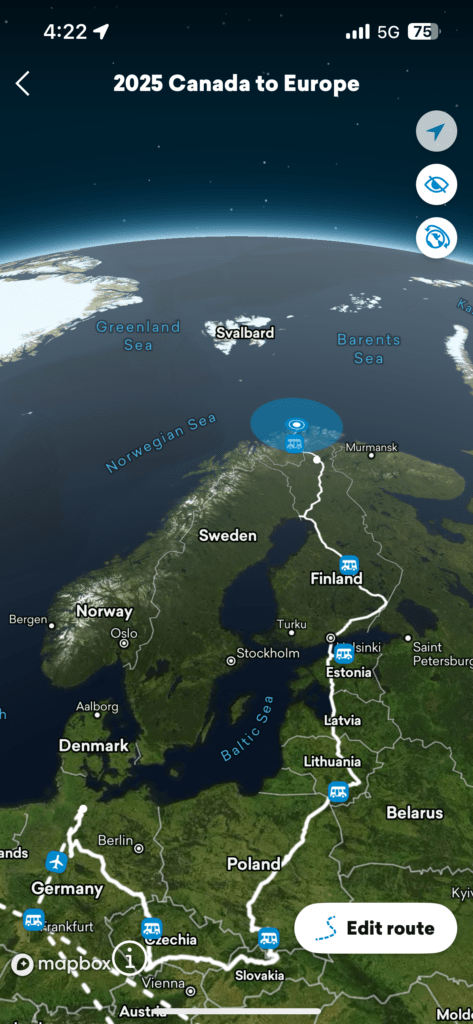
We applied two criteria to determine our itinerary; firstly, which route was more or less the most direct, and secondly, (where possible ) which route took us through places we had never been before. The first part of this was easy – south through Germany, crossing into Poland, then hopping over the Tatra Mountains across Slovakia, touching Hungary in the east before reaching Romania in the north-west of the country. This did involve a couple of days solid driving and with the stops we made en route- came to almost a week. Here is the week that was !
Crossing from Denmark, Kiel and Lubeck in Germany’s north were new to us so along with Berlin ( not new, but where the weather was simply too awesome not to make a stopover ) we spent time in both places. Kiel’s big attraction ( to me ) was the chance to go inside a real WW2 German U-boat ( submarine U-995 ), and while less appealing to Lois, it absolutely made my day. Hard to imagine those guys living for weeks and months on end in those things – and getting depth charged regularly ! A fascinating experience to actually get inside one. It was a very dangerous job – of 41,000 German submariners, 30,000 died and 5,000 were captured, a fatality rate of close to 75%.
U995, a German U-Boat ( submarine ) that saw service in WW2, now on display at the naval museum in KielFascinating to actually go inside and see how confined life was living in a submarine. Here in the engine room. Not for the claustrophobic!It had 4 torpedo tubes.All the technical stuff..!
Lubeck is one of Germany’s gems and lived up to every superlative we’d heard about it. So much history, so many stunning buildings and all so well preserved or restored. Being able to camp across the river from the old town was just icing on the cake – so convenient. While in Lubeck the vehicle had to go in for a major scheduled service which, while draining our budget somewhat, did give us more time in this beautiful little city. Magical place.
Picturesque Lubeck, one of Germany’s prettiest cities. Historic Holestentor, Lubeck.A cobblestone backstreet, Lubeck.Our van was due for a 90,000km Service “B” ( a big one ). We were fortunate to get squeezed in to a dealer near Lubeck who took good care of us.Mercedes Reinfeld saved us when many other dealers advised of 3 week waits for a simple service !
Berlin fell right on the route to Bucharest – a city one could easily visit over and over, so we did not mind a repeat and the sunny weather just added to the experience. The Tiergarten, the Brandenburg Gate – and this time, no wall ! Getting here in 2025 was much simpler than doing so in 1986 back when “West” Berlin was an oasis of capitalism in the sea of communism that was “East” Germany.
The Reichstag, Berlin.Camped between the River Spee and Berlin’s famous Tiergarten, just 15 mins walk to the Brandenburg Gate. . Germany has certainly made camping very easy for us.Enjoying Berlin’s Tiergarten on a beautiful sunny day.Brandenburg Gate.Siegessaule, or victory column, Berlin.A handful of Nazi era buildings still survive. Here, the former Aviation Ministry building – presumably Herman Goering himself strutted these halls. “Checkpoint Charlie”, obviously no longer in use ( but we passed through it in 1986 when it still was ! ). Now a tourist attraction which we passed as we drove out of downtown Berlin.It was a Sunday as we left Berlin and we wanted to do some shopping so stopped at IKEA- we were stunned to find an IKEA that would ever be closed ( anywhere ) on a Sunday ( busiest trading day in Canada ! ). We noticed this trend in Scandinavia as well.
A long haul then took us through generally nice scenery, with good weather making driving easy and we made full use of Germany’s excellent Autobahn’s and Poland’s modern highways. Crossing the Tatra’s to Slovakia was especially picturesque given the weather was vastly improved since the last time we were in these parts. While we crossed Hungary in the far east, it was very brief, and the only reason we went that way was to avoid the need to transit western Ukraine ( Google Maps actually had planned a route out that would have taken us there – Lois said no 😟). Our return would bring us to much more interesting parts of Hungary.
Crossing into Slovakia – much better weather this time !One of our nicest wild camp spots, by a ski hill in Slovakia.A memorable little campground in Poland – high up and with views out over the valley, Gora Swietej Anny.Southern Poland with views to Slovakia over the Tatra mountains.While there are technically no internal borders in the Schengen zone, in some places they still do customs checks to make sure you are not smuggling contraband or excess quantities of alcohol. Here, some very friendly Slovakian soldiers checked us out Slovakian scenery, Tatra mountains.Passed briefly through Eastern Hungary on the way to Romania. We always take a picture of the speed rules ( they differ within Europe ) – fines can be heavy for any infractions.Nothing like the “old days” but you’ll still see the odd horse and cart in parts of Eastern Europe. Here in remote rural Hungary.
So, with that all done we were at the Romanian border- the crossing was easy ( Romania is “in” Schengen now ) and we look forward to exploring all its charms in the days ahead.
Oslo is barely a couple of hours from the Swedish border and like most others in the Schengen zone one crosses it almost without noticing.
Stromstad – suddenly LOTS more RV’s around when we are looking for a place to park up at night.
On the advice of our friend, Gil, our first stop in Sweden was Stromstad, a cozy little seaside town often frequented by Norwegians chasing cheap(er) Swedish alcohol and a weekend away. This was indeed one such weekend since a public holiday in Norway had pumped up the volume of Norwegian reveller’s who also traditionally flock to Stromstad on this particular day for a “car show” of sorts – every imaginable type was on display with visible bias to larger, older US vehicles. Lots of music, lots of drinking, you know the drill – welcome to Sweden !
Crowds waiting for the liquor store to open. It’s a long weekend and the Norwegians are in town !!! Swedish liquor is cheaper than the Norwegian stuff.just one example of some of the classic cars that were being paraded around Stromstad. Party weekend !
Moving south towards Gothenburg there was one more recommendation from Gil ( another good one ), scenic Marstrand. Famed for its fort and picturesque homes Marstrand provided us a very relaxing stopover en route to Gothenburg.
Moved down the coast to Marstrand – an excellent camping spot right on the bay. Just a few others around.Marstrand harbour with castle in the background.Ditto. A beautiful setting.Marstrand.
Not sure where we got the notion that Gothenburg was worth visiting – perhaps it was simply the fact that it laid directly on our route south to Helsingborg, the jumping off point for Denmark. Perhaps it was the fact that we’d already visited, and very much enjoyed, Stockholm on our last trip to Sweden, and didn’t really want to head substantially east to visit Stockholm again when we had not yet been to Gothenburg. Whatever it was, Gothenburg was definitely a little bit of a letdown. With hindsight, we probably would have been wise to drive east to Stockholm, revisit it, and then drive south to Helsingborg – but we didn’t. The rest of the trip south towards Helsingborg was definitely worthwhile, giving a very real, close up of rural Sweden, highlighted by our farm camping experience in Tvaaker.
We were very unimpressed with Gothenburg, but at least the cherry blossoms were in full bloom !Rural scene, near Marstrand.Sunset, farm camping, Sweden.Farm scenery, Sweden.Ditto.
Helsingborg, on the Swedish side of Oresund strait, is the closest point to Helsingor ( of “Hamlet” fame ) on the Danish side and is a popular entry point to Denmark. Yes, one can now drive further south in Sweden (to Malmo) and take the Oresund bridge more or less directly to Copenhagen, but it involves more driving, goes somewhat out of our way, and is quite expensive. The ferry for us just made more sense ( we still had one VERY expensive Danish bridge ahead but more on that later !).
On the ferry to Denmark, a view of our van I do not often see !
Helsingor ( a city also known for its shipbuilding past ) will forever be associated with Hamlet ( Shakespeare having chosen Helsingor castle as the setting for perhaps his most famous play – Elsinore, of course, is simply the anglicized version of ‘Helsingor’ ). Much is made of this naturally but the castle is quite impressive in its own right, above and beyond the Shakespearean connection.
Elsinore castle.
Barely an hour south of Helsingor is beautiful Copenhagen. The weather gods provided us an awesome day to wander around and explore its charms and the Copenhagen marina offered us a great camping stopover. Not for the first time did a marina make for a great defacto campground, offering campers all the same things that “yachties” require. Not surprisingly the marina at Kastrup (near Copenhagen airport) was packed with RV’ers like ourselves.
Little Mermaid, Copenhagen.Amalienborg palace, Copenhagen.Guard, Amalienborg.Picturesque Nyhavn, Copenhagen.
In addition to visiting several of Denmark’s popular attractions ( Little Mermaid, Nyhavn waterfront and the Amelianborg palace ) we had a “job” to do ( of sorts ) in Copenhagen – to VOTE in the Canadian election. Sadly, despite our considerable efforts, much forward planning and arranging that our voter registration documents be forwarded to the embassy in Copenhagen, they did not arrive in time for us to cast our vote. It can’t be said that we didn’t try, and I must add that the system in Canada for voting from abroad is inordinately complicated and extremely slow. Fortunately, as it turned out, our two votes would not have changed the outcome in our riding.
No luck voting at the Canadian Embassy, Copenhagen.
On this visit to the country we took the opportunity to explore a little more of Western Denmark before heading south into Germany. Odense was the major city on our route so we made a stop there. Typical of Denmark the city is beautifully maintained and has some interesting historic architecture and, of course, is the hometown of perhaps that most famous of Danes, Hans Christian Andersen. Getting there involved crossing the 2nd of Denmark’s two massive bridges, the Great Belt Bridge. An impressive piece of engineering, indeed, with a very impressive price tag for those crossing it – we paid 635 Danish Kronor or $136 Canadian ( almost $100 USD )…..just to cross a bridge !! We thought Norway was expensive – Denmark is next level.
We saw quite a few of these in Denmark – father’s riding these bike/stroller combo units ! Baby up front. Backstreets, Odense.
Denmark was certainly nice, but we were definitely happy to move on to Germany which would position us for the final 5 weeks of our Schengen time in Europe – more on that in the next edition !
As much as we loved Norway we knew our time there was drawing to a close. With the Schengen visa restriction you simply can’t spend too much time in one European country or else you are left scrambling everywhere else. While Norway was definitely a major attraction for us, there was still much more we wanted to see before heading home to Kelowna for a summer break. We made this week in Norway our last.
Bergen is a major attraction in Norway, a beautiful city with a ton of history and is also a very popular cruise port, even this early in the season. Sadly for us, Bergen turned on some of ( what the locals called ) its more typical weather and left us sightseeing in misty rain the whole time we were there. Our Bergen memories from before were much better. While the city is as beautiful as ever, it’s definitely one that you ideally want to see on a nice sunny day – such was not our day this time around 😔.
Bergen waterfront – locals told us we experienced the “real Bergen” because this is the weather they live with most of the time ! We would have preferred “tourist” weather Bergen. Much of Bergen is built on steep hillsides, giving it a dramatic look – and practically everyone has ocean views.Classic Bergen street scene on the harbourfront.At least some blossoms were out !Scandinavia is famous for sleek style- even the laundromat looked “cool”.
Our route east to Oslo ( and on out of Norway ) took us through Dale, Vos, Flam and Gol, all towns with various attractions to offer and where we made enjoyable stops – fortunately, on this section the weather help up nicely, not letting us down again until we actually reached Oslo.
“Dale of Norway” is famous for Norwegian sweaters and they have an interesting museum which we visited. They have outfitted the Norwegian winter Olympic team ( often the team that wins most golds ! ) since the 50’s and their designs are known globally.Falls, Skulestadmo.The picturesque fjord town of Flam. Camped up just outside Flam on one of our most scenic spots ever. Joined soon after by a young couple from Chile.Fellow travellers from Chile/Argentina.A fjord shot as we left Flam.Gol. Two stunningly beautiful days here.Occasionally we do visit a regular campground – spent a couple of lovely days here at Gol. The same family has owned and run it since 1928.All across Norway we kept seeing this road sign. The image of a young girl fading away. It warned of the risks of speeding- had a powerful impact.
While Oslo is a beautiful spot and we took in what sights we could on another miserably rainy day, the main attraction this go around was actually to visit with some old friends. Gil, best man at our daughter/son in law’s wedding, gave us a wonderful tour of downtown Oslo. Ole ( and his wife Britt ) hosted us to a wonderful dinner where we spent hours catching up on each others lives – it had been 42 years since we first met ( backpacking in Asia ) and 40 years since we last visited them at their home south of Oslo. Amazing how, despite the passage of such significant time, you can so easily pick up right where you left off. They’ve promised the next visit will be them coming to see us in Canada.
Selfie – OsloOslo’s rail station is a tourist attraction in itself. Stunningly beautiful inside.Abstract art, Oslo harbour.The “Guggenheim-like” museum in Oslo.The unique work of Gustav Vigeland, Vigeland Park, Oslo.Almost Oslo’s most famous son – “The Brat” statue at Vigeland Park.Wonderful to catch with family friend, Gil, who lives in Norway. He flew to Kelowna to be best man at our daughter’s wedding.He gave us great sightseeing tips but could not deliver on the weather (lol ). We made the best of it !Britt and Ole.Just wonderful to connect with old friend Ole and his wife Britt. First met Ole in Thailand in 1983, then visited in Oslo in 1985. Then a 40 year gap. Lots to catch up on and thoroughly enjoyed our visit!
With our time in Norway drawing quickly to a close we made plans for our final month in Europe ( we’ll be taking a summer hiatus and returning to Canada for a few months ). Next week we’ll travel down through western Sweden and across Denmark to Germany, in preparation for the final month of this first leg of Europe 2025.
Can’t “win ‘em all” as they say. Travel long enough and you’ll get rained on somewhere – the typically beautiful Lofoten’s were largely a washout for us, so due to the poor weather there we moved on quickly. The Lofoten ferry took us out through the short route, across the mouth of Vestfjorden to Bodo on the mainland. In Bodo, in just one day, we saw the weather change frequently ( usually for the worse ! ) but managed to salvage at least a delightful seaside evening out by the fjord. The bad weather days of course, have not all been in vain – we’ve learned from experience to use those productively as well, and typically spend them doing our laundry, grocery shopping or any other such endeavor that can be done equally easily no matter the conditions.
Camped here at Bodo. A beautiful evening and enjoyed a long seaside walk.Out for an evening walk by the fjord at Bodo catching the late afternoon sun.
It was quite a long ( but interesting ) run from Bodo down to Trondheim, our next area of interest. A few images below will tell the story. By Trondheim conditions had changed quite dramatically and we really felt that we were by then ( more or less anyway ) out of the snow zone. Warmer weather, greener fields, leaves starting to appear in trees – all a welcome relief !
Leaving Bodo and heading south we crossed the Arric Corcle again. And it felt like the Arctic !!!Stopped for a tea break and caught a guy “mushing” with his sled and dogs. This is a bank of Tesla electric charges near Trofors ( a small town )in Norway. They have one of the highest levels of electric vehicle ownership in the world ( and probably the highest ownership level of Tesla’s ! ).Among our stranger experiences in Norway. In the tiny ( and I mean TINY ) town of Trofors on a Sunday morning we were pulled over to do a breathalyzer test. Zero reading of course !
Trondheim turned on the best of days for us and most of the days south of Trondheim out into the western Fjords varied from at least reasonable to very good. Andalsnes, Alesund and ( what many consider to be Norway’s best fjord) Geiranger were all a sight to behold and in each of these places the weather held up nicely. The drive through this whole area was just spectacular – we had high expectations based on our 1985 travels and we were not disappointed. As an interesting aside for many of the days we spent in the area we ended up ( purely coincidentally ) tracking the great Cunard ahip, the Queen Mary 2 all around the Alesund and Olden area. Nothing like a giant Norwegian fjord to make a massive cruise ship look like little more than a toy !
Road scene near Vinjeora. Once around Trondheim we started getting back to lots of green in the scenery. A nice change from white !Spectacular Nidaros cathedral, a pilgrimage sight in Trondheim. First opened back in 1300.The “Old Town” bridge, Trondheim.Pretty waterfront buildings in Trondheim.Trondheim waterfront.Ski jumps, here near Trondheim. We’ve seen many in Norway, no wonder they win so many golds at the Winter Olympics !Sadly, leaving Trondheim we had hoped to drive the famous “Trollstigen” but it was closed for repair 😞😞
One of the benefits of being this far south again was that the snow was just on the very tops of the mountains and fields all around us were green – trees were even getting leaves, so the general scenery was much improved from farther north. One of the things that has not changed ( all over Norway ! ) is the number of “cottages” we see everywhere – it seems that every Norwegian family has a small cottage somewhere – up in the hills, down by the sea or nestled in by the fjords, anywhere there is a flat piece of land ! These places are all seasonal and as we travelled in these parts we could see that people were starting to open them up for the coming summer.
Isfjorden.Pretty waterfront at Andalsnes.
Pretty ( and very popular ) Alesund is a city with an interesting history. Completely destroyed by fire in 1904, the city was completely rebuilt in the ( then ) fashionable “Art Nouveau” style. It’s beautiful, distinctive and timeless. It reminded us in a way of Napier in New Zealand – destroyed by an earthquake in the 1930’s the politicians of the day had the wisdom to decree that all new building follow the Art Deco theme that was then all the rage. Like Alesund, Napier now has a unique style and beauty that continues to draw visitors from all over the world.
Alesund, typical art nouveau architecture. As we walked around we often remarked that the whole place looked like a film set!More of same.Ditto.Ditto.View across to Alesund from our park-up spot across the bay.A popular wild camp spot across the harbour from Alesund. We had it to ourselves- perfect tranquility. In 2 months it will be jam-packed.First bumped into the Queen Mary 2 at Alesund. We would cross paths again.The sheer walls of Geiranger fjord.Part of Geiranger fjord.View over Geiranger village and the fjord.Van parked at Olden, Innvikfjord, Queen Mary 2 moored nearby.QM2 up close !QM2 dwarfed by the fjord. At a distance it looked like a toy.Scenery near Eidsdal.Overlooking pretty Byrkjelo.
It must be said that the Norwegians have done a stunning job connecting this mountainous country all together with 1100 tunnels and hundreds of ferries to get you over ( or under !) the long fjords that run in from the coast. This was not an easy country to tame, but they have made traversing it extremely easy. Everything works, it’s all well kept, and it all runs on time- it’s a very easy place to love ( just ignore some of the highest fuel prices in the world and you’ll be fine – crazy, because they have lots of oil ! ). They make life easy here for campers which just adds to the allure- Norway ( and other Scandinavian countries ) are all a dream for wild camping due to a centuries old law known as “allemannsretten”, something we wish more countries would adopt. Sadly, in some parts of Europe the attitude is completely the opposite.
We’ve always considered this one of, if not, perhaps THE most beautiful countries in the world and we’ve not seen anything on this visit that would cause us to change that view. They don’t consistently rank at or near the top of global living standard rankings by accident.
In closing, here’s a little joke for the week – good reason not to wait too long to get some travelling in !
We’ll continue on next blog with the drive on to Bergen and on across the south of Norway to Oslo, wrapping up our stay in this beautiful country.
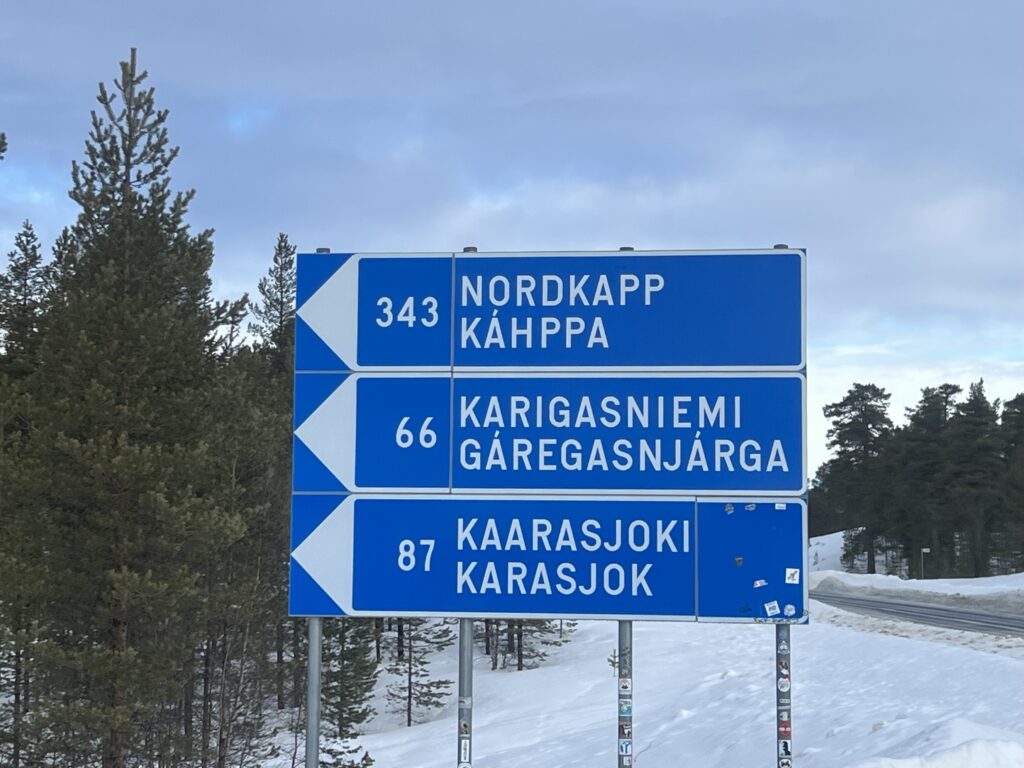
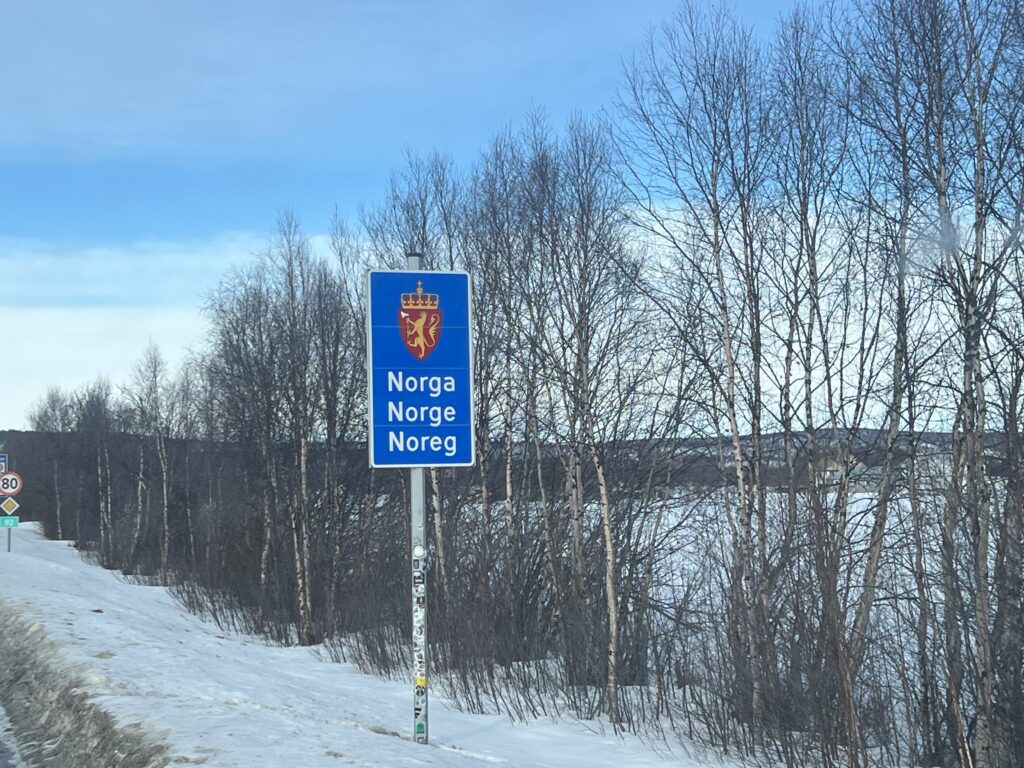
Inari ( Finland ) is only a short hop across Hwy 92 to the Norwegian border at Karasjok. From there it was only a 4 hour drive to the very top of Europe – to some a mystical place, to the Sami people of this region a place of spiritual significance, and to many others ( like us ) simply the remote and foreboding far northern extremity of the continent. We had waited decades for this moment, and here it was just a few hours ( mind you, some very nail biting hours ! ) drive away.
Our final day drive to the cape, from northern Finland.
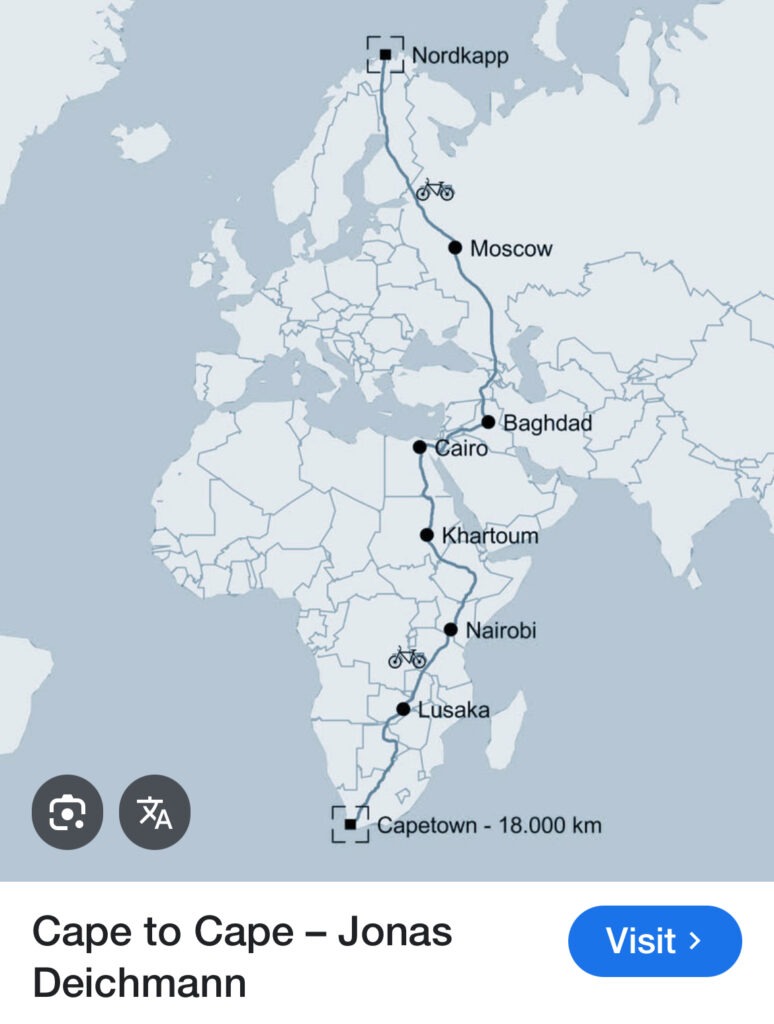
If I’m entirely truthful, the magnitude of the moment was still a bit less than it should ( and could ) have been. Rather than starting in Canada ( as we did ) we should have been starting in Cape Town ( South Africa ) and completing the grand daddy of all overland treks, the “Cape To Cape”. Alas, a global pandemic and a few inconvenient African civil wars put paid to that ( it was to have followed our PanAm adventure back in 2020/21 ). Such is life. But hey, it’s been a heck of a ride from our home in Kelowna, to Baltimore, to Hamburg and on through mainland Europe and Scandinavia to get this far and we are truly excited about this day we’ve looked forward to for so long.
One of the Cape to Cape routes. This fellow did it on a bicycle, alone ( just before the pandemic ). Impressive !
By northern Finland we were already into heavy snow conditions, sub-zero temperatures, howling winds and we knew this last stretch would throw all that at us and more ( narrower roads, icier surfaces, and more challenging visibility) but with our 4×4 set up, good ground clearance, and heavy duty all- weather tires it should not present us any problems. And, with our inside creature comforts we’d be comfortable doing it. The fact that we were in the ONLY vehicle up here without studded winter tires was a tad disconcerting😳.
How it looked as we left Finland.
The run to the Norwegian border was uneventful and while we were not required to stop at the border ( a Schengen benefit ) we did pull up and take the time to talk to the very friendly Norwegian customs and immigration lady. Same question we had fired at the Finn’s when we arrived in Helsinki – was there any way that we could use Canada’s historic bilateral visa agreements with the Scandinavian countries to circumvent the limitations of the 90 day Schengen visa rules which all three of these countries now subscribed to ? In short, as polite as she was, she could not deliver the news we wanted. No, after 90 days in Europe, we had to exit one way or another. End of story. Hey, we tried.
”OK, but where’s ‘Norway’ ? “ 🤣🤣
Having somewhat anticipated this we had moved a little more quickly than we would’ve liked in this first month in order that we had a little more time up our sleeve at the back end and this last bit of bad news from the Norwegian’s only confirmed to us that the strategy had been a good one. At least it now left us with what should be enough time to do what we wanted to do in the first 90 days- if perhaps at the cost of arriving here in northern Norway just a bit sooner than would have been ideal. So far, no weather issues but this would be the tough stretch.
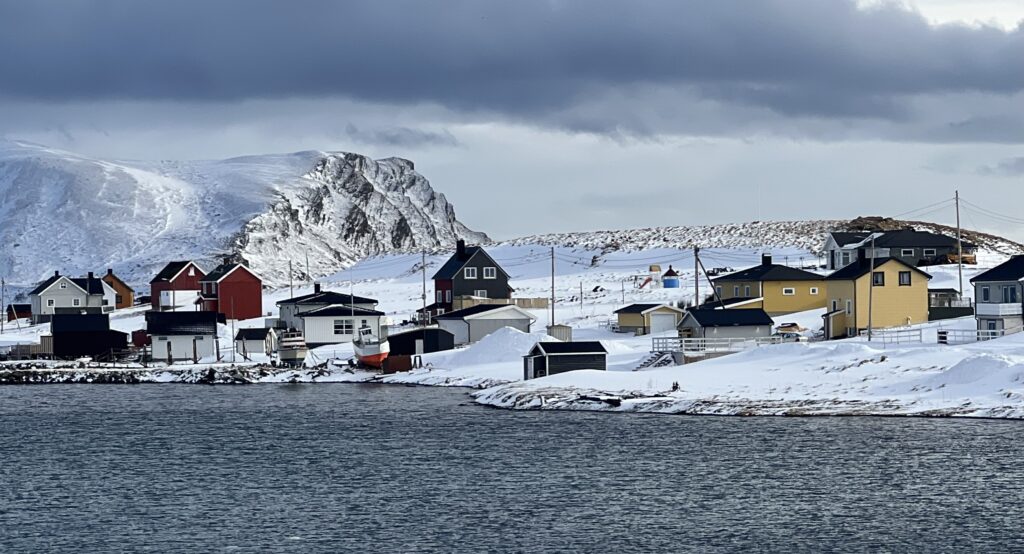
Norwegian town en route to Nordkapp.
The biggest difference between Finland and Norway is unquestionably the mountains. As in, Finland doesn’t have any and Norway is absolutely covered in them ! Big, beautiful, high rocky ones, some of which we had to cross to get to Nordkapp. That was one concern. The other was just the extreme latitude and remoteness ( hundreds of kilometres north of the nearest town of any size ) and of course now well above the Arctic Circle. Just how far ?
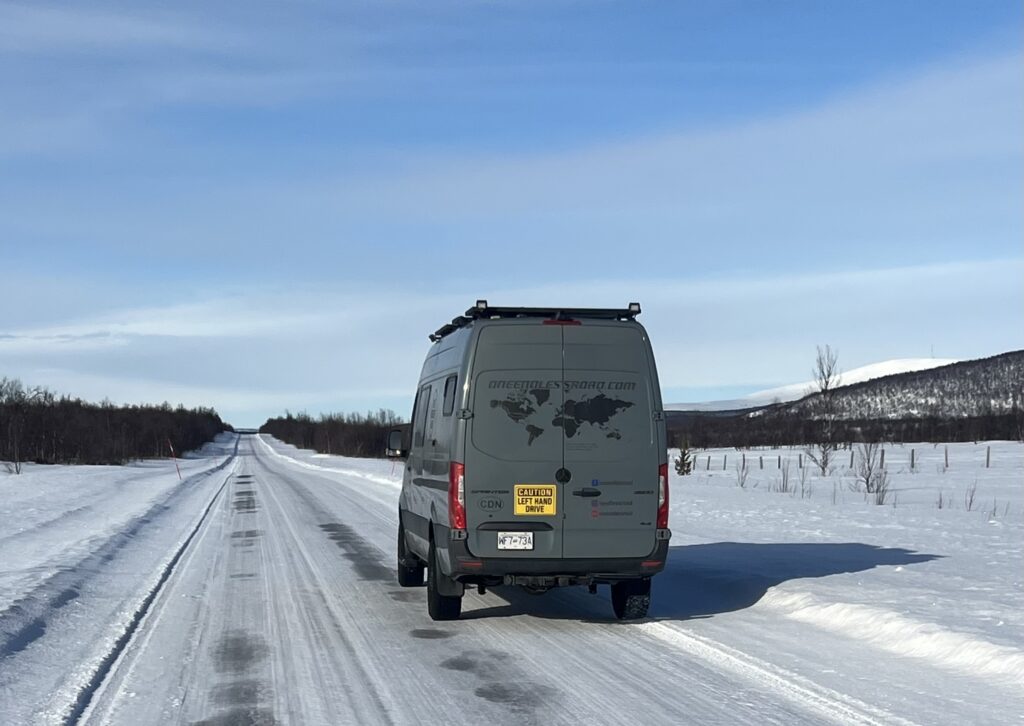
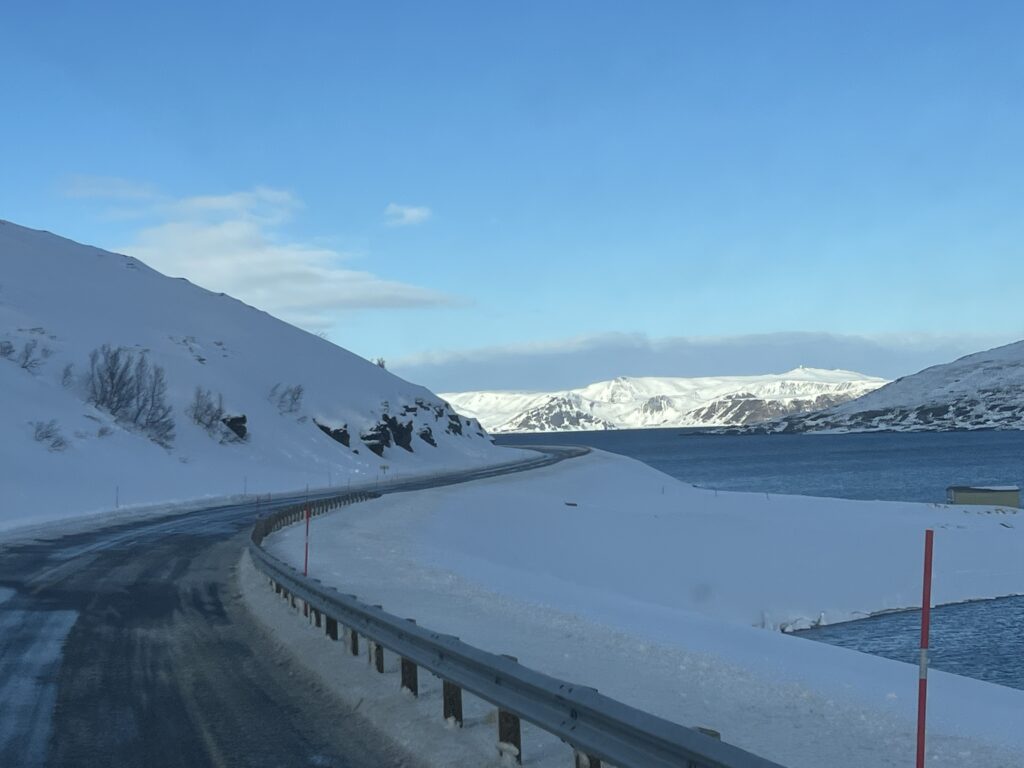
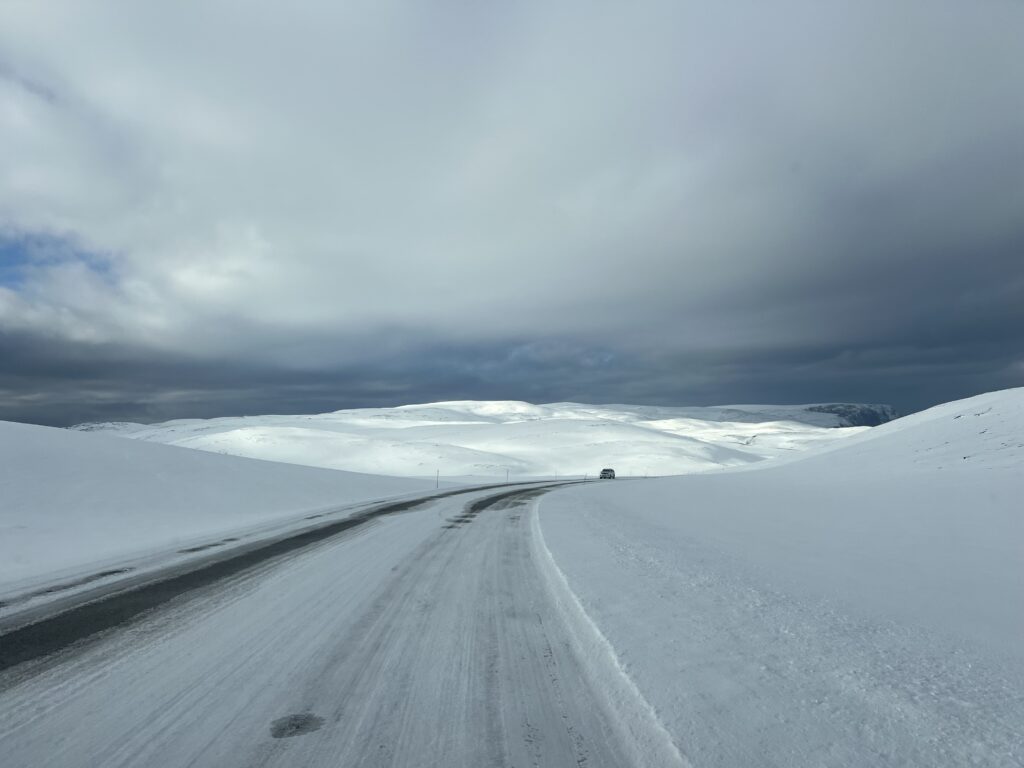
Lower on the E39 to Nordkapp.But the roads soon got like this, and much worse….
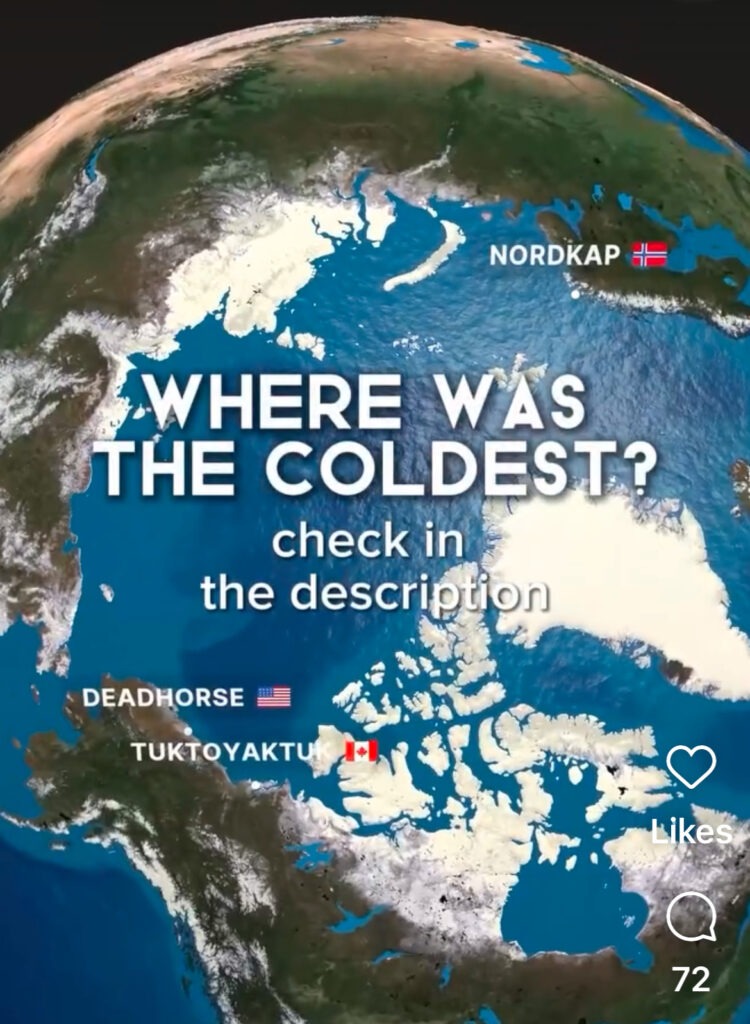
I googled Deadhorse, in Alaska, and Tuktoyuktuk, in Canada’s NWT – the former at approx. 70 degrees north and the latter at just over 69. At Nordkapp we’d be well over 71 degrees. So, way, way, north – officially farther north than we’d ever been in our lives. A few years back the BBC did a story on the E69 ( the road to Nordkapp ), an interesting read (here).
Pulled this off a website that covered the expedition of a couple of motorcyclists to each the worlds 3 most northerly driveable roads. Nordkapp coldest for us as well !
As we saw the terrain change once in Norway it started to actually feel more remote. Fewer vehicles, the roads narrowed, the roads were in parts completely snow-covered and of course we had long since stopped seeing any trees. It was, in places, almost lunar-like.
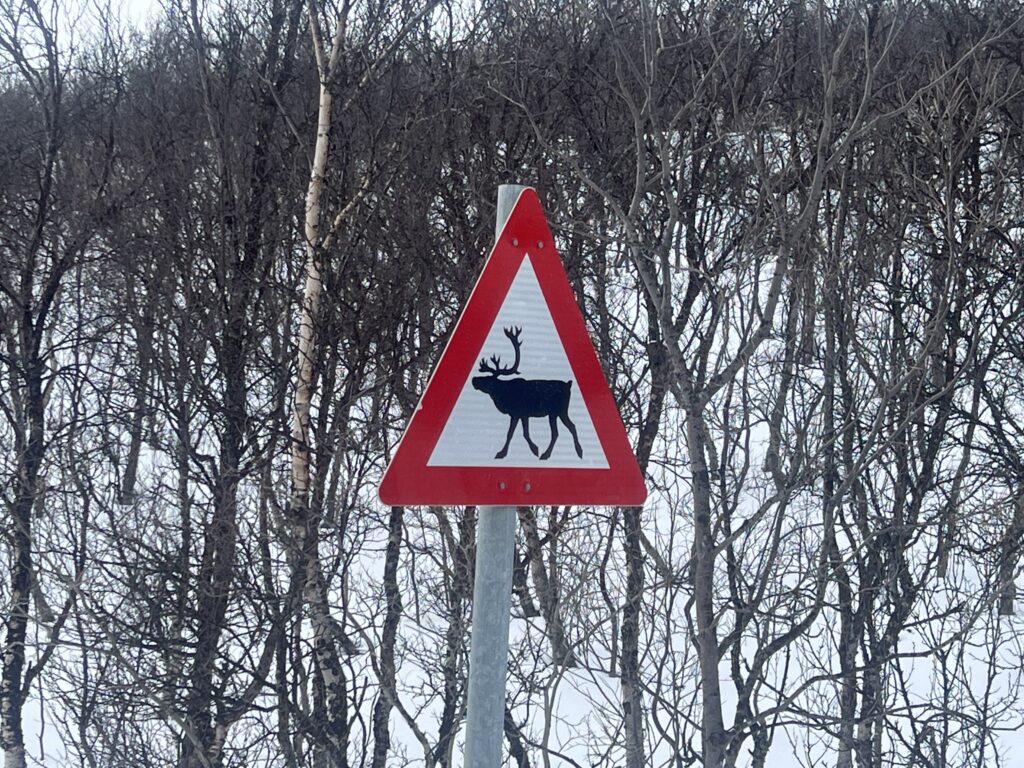
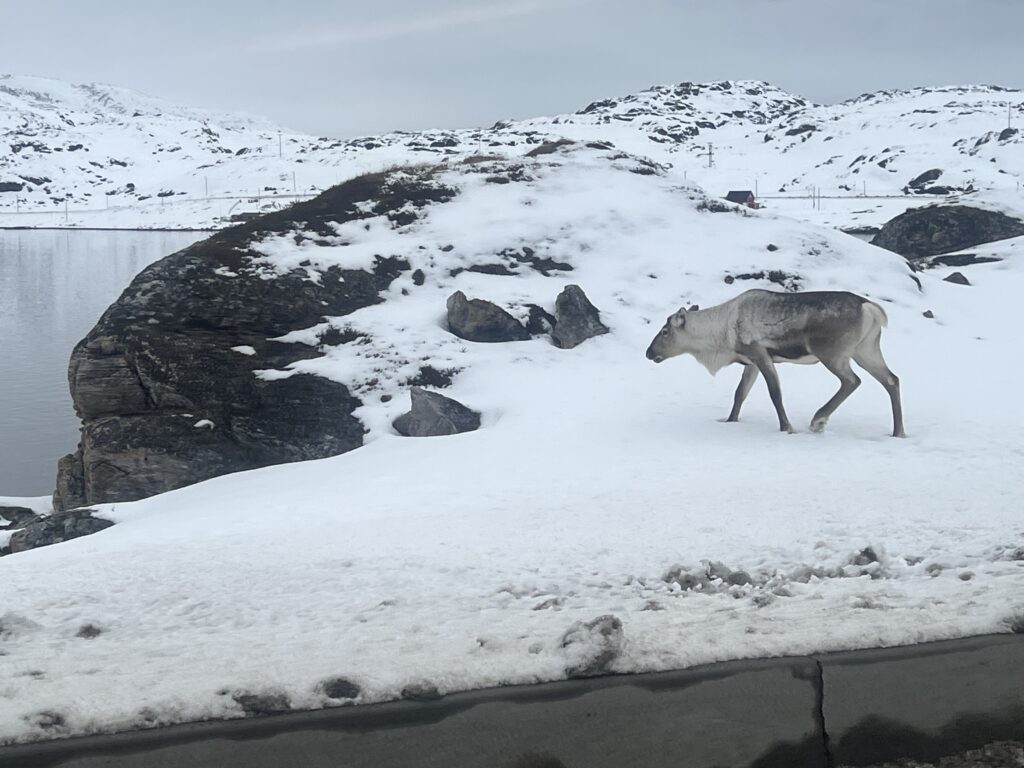
Nordkapp actually sits on the island of Mageroya which is connected to the mainland by a tunnel almost 7km long. It’s long, and DEEP – it actually goes under the seabed. Just another bit of eeriness to add to the moment. We passed the sheer sides of fjords, more ( shorter ) tunnels, some small remote settlements and then the last town of any size- Honningsvag. There were now countless reindeer warning signs ( but no more moose warning signs – they are smart enough not to come this far north it seems ! ).
As we went further north, moose warning signs gave way to reindeer signs.…and shortly thereafter we saw one.
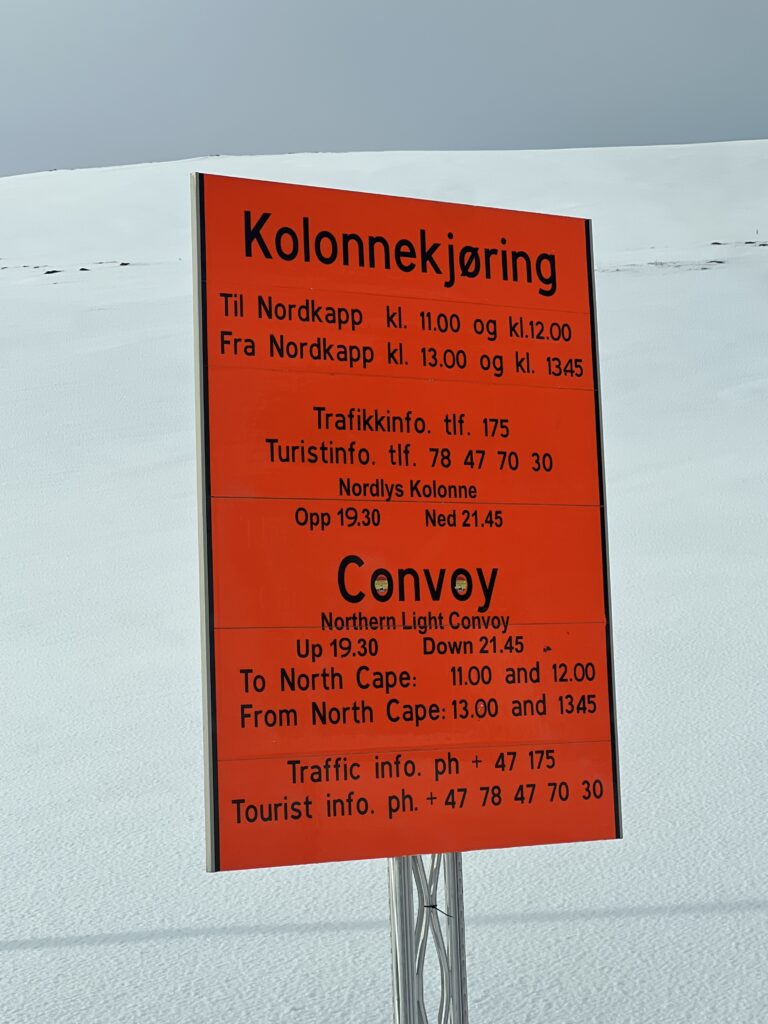
Just outside Honningsvag is the turn-off for the final run to the top – and a warning that we may need to join a snowplough “convoy” which goes only twice a day. The road seemed ok at this point although snow was in places banked up almost 2m high on the road sides, at times making it seem like we were driving in a tunnel with no top. “Fortune favours the brave”, it’s said – we’d come this far without assistance, we’d go it alone.
Apart from some steep climbs and descents, some slippery ice here and there and fairly continuous snow drifts, the last 20kms was actually not too bad. Slow, very narrow in places, and with 4×4 engaged all the way to maximize traction, but at no point was it frightening. We had noticed as far back as Helsinki that almost all the vehicles here at this time of year have studded tires and certainly all vehicles this far north have them. We do not since they would be terribly impractical for the other 95% of our journey, but it does mean that we have to exercise. an extra degree of caution on the icy roads up here. Some of the campers did not have 4 x 4 but they ALL had studded tires – and frankly, in these conditions, the studded tires would offer a lot more safety and security than any 4 x 4 system.
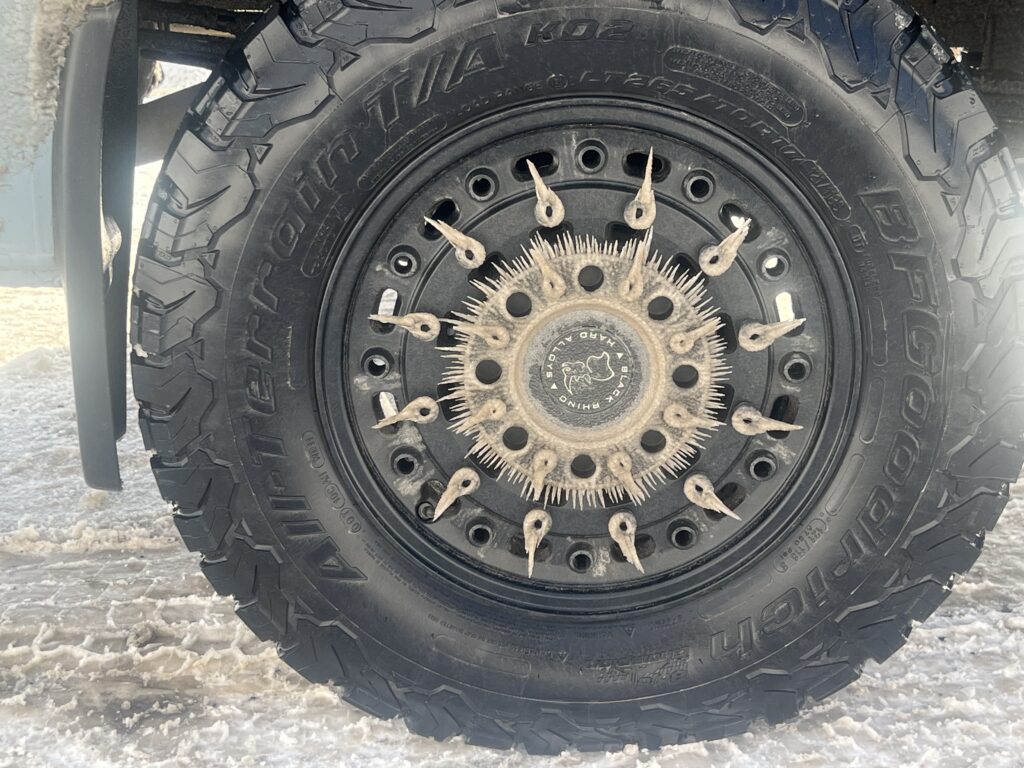
Stopped for a break and noticed some very weird crystal formations on the rims – so perfectly symmetrical.
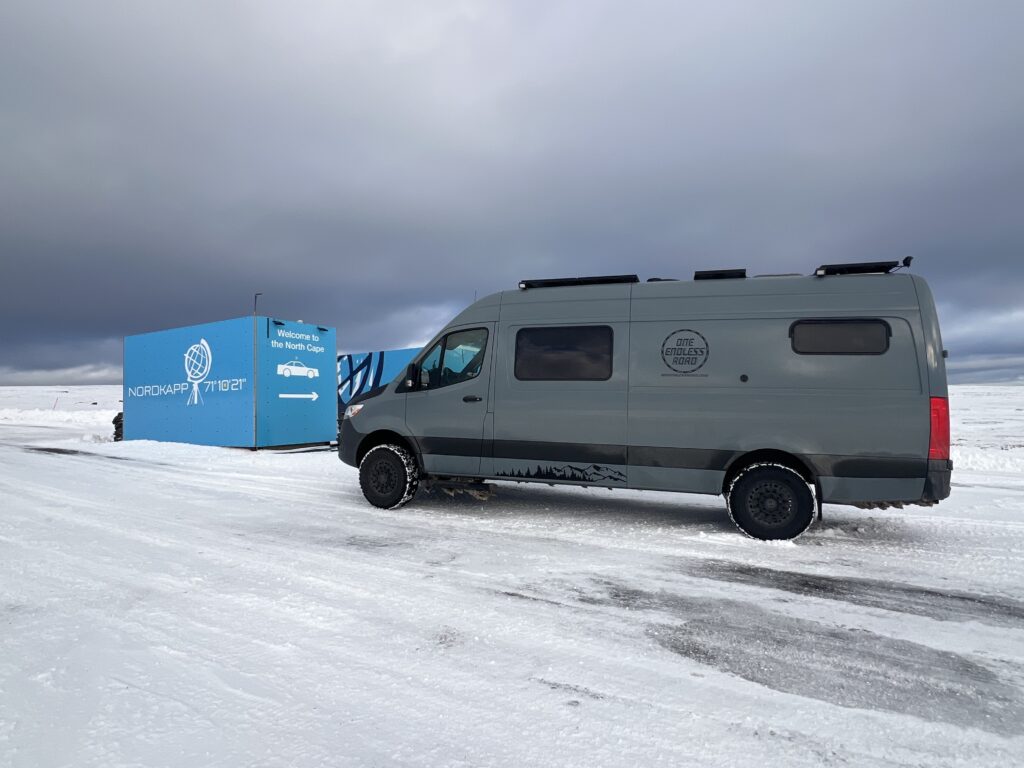
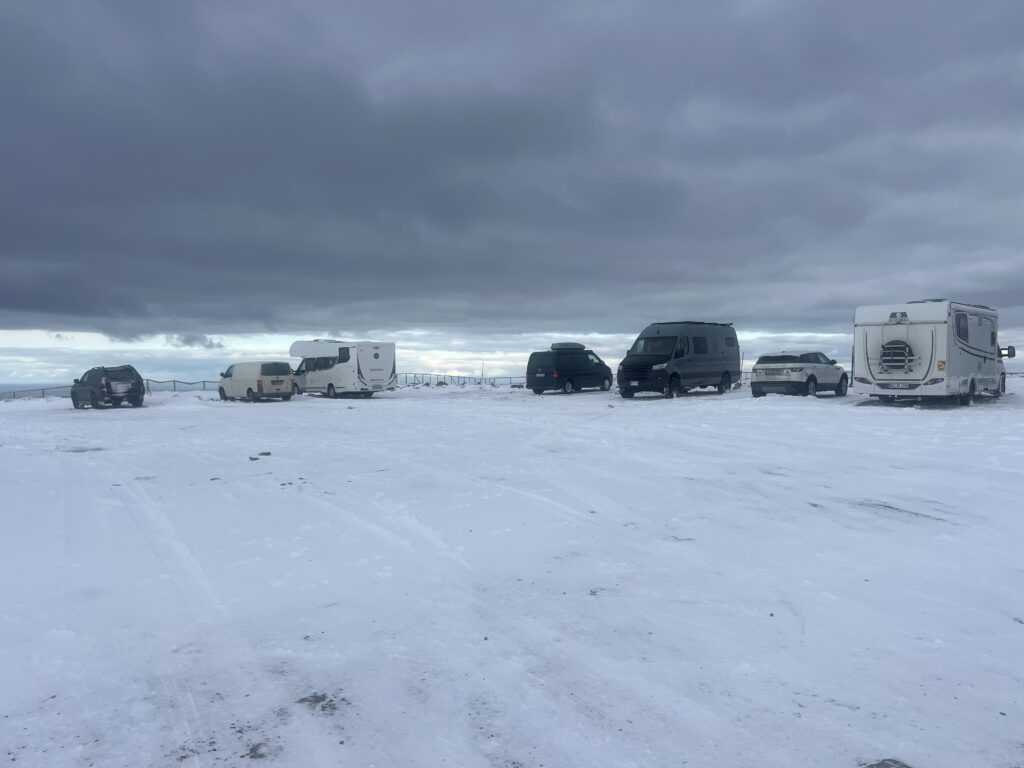
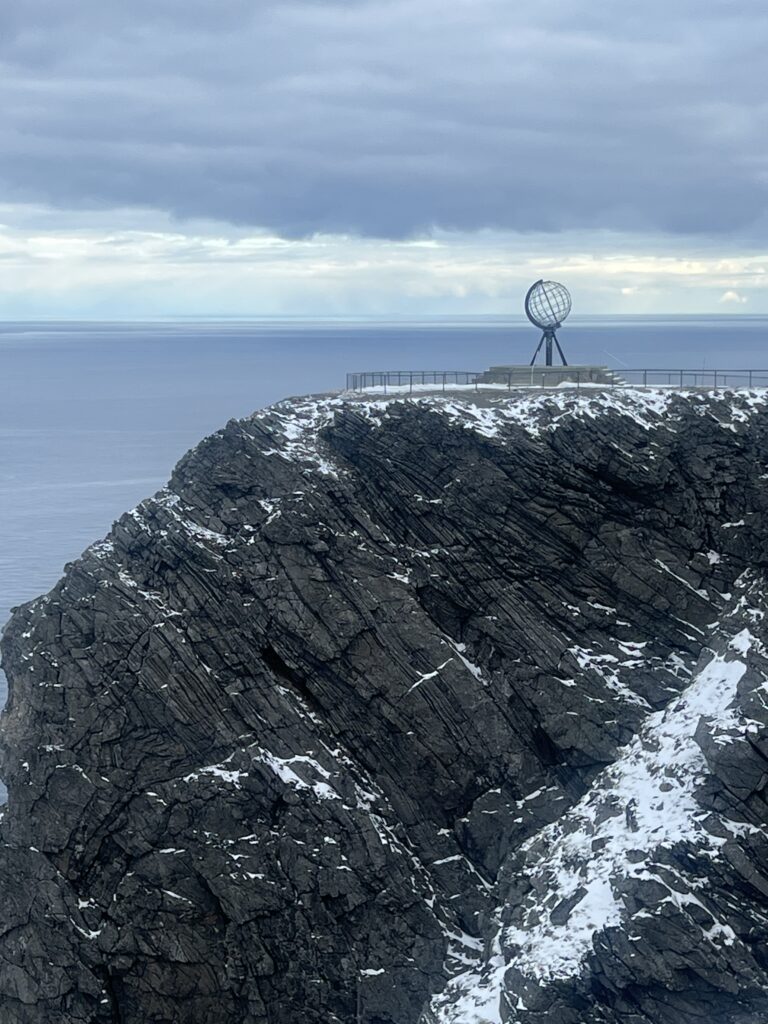
Just after lunch time we could see the unmistakable dome that marks the Nordkapp centre and we pulled in joining the dozen or so vehicles ( most were campers ) already there. We had made it – and I had won a bet. At one point a couple of days before Lois said, said “Jeff there’ll be no one up there at this time of year. There’s no one crazy enough to do it”. She agreed, reluctantly, that nine vehicles counted as just a few more than “no one”, and, like me, began to just soak in the moment – here we were, finally, certainly as far as “drivability” goes, pretty much on top of the world. It felt good, very, very good.
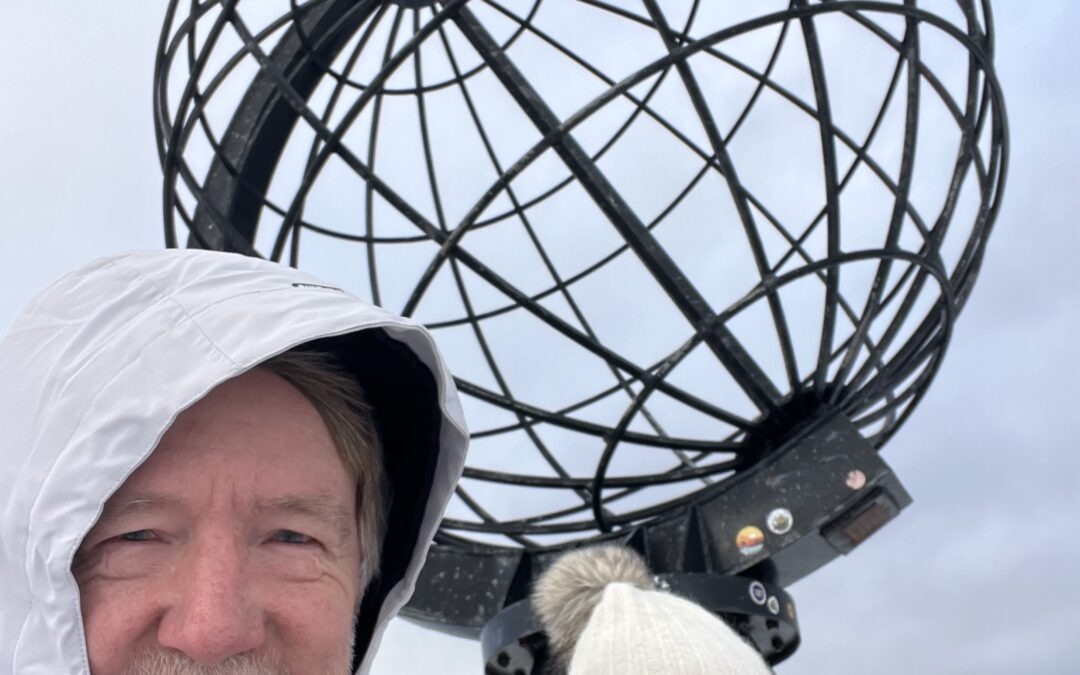
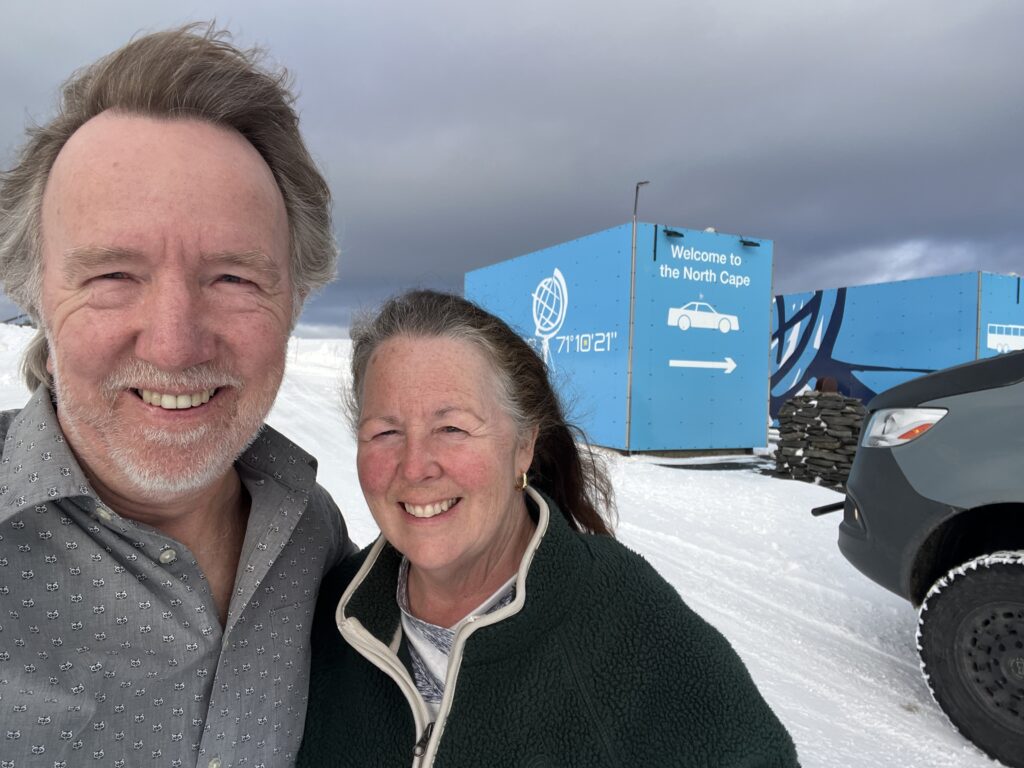
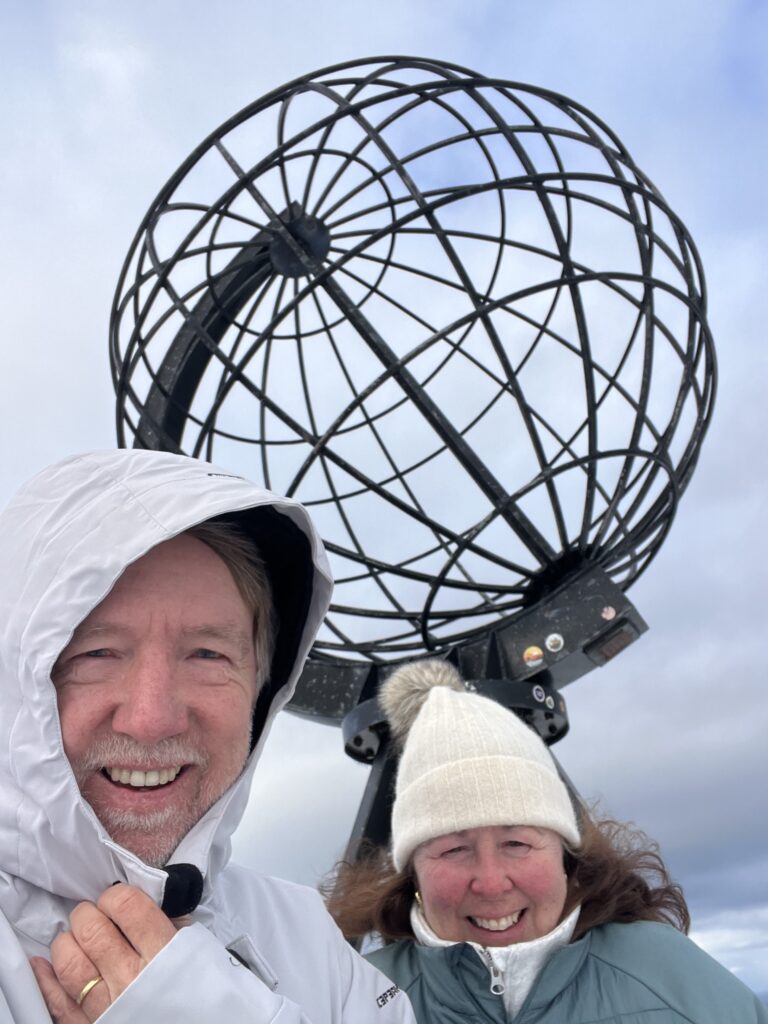
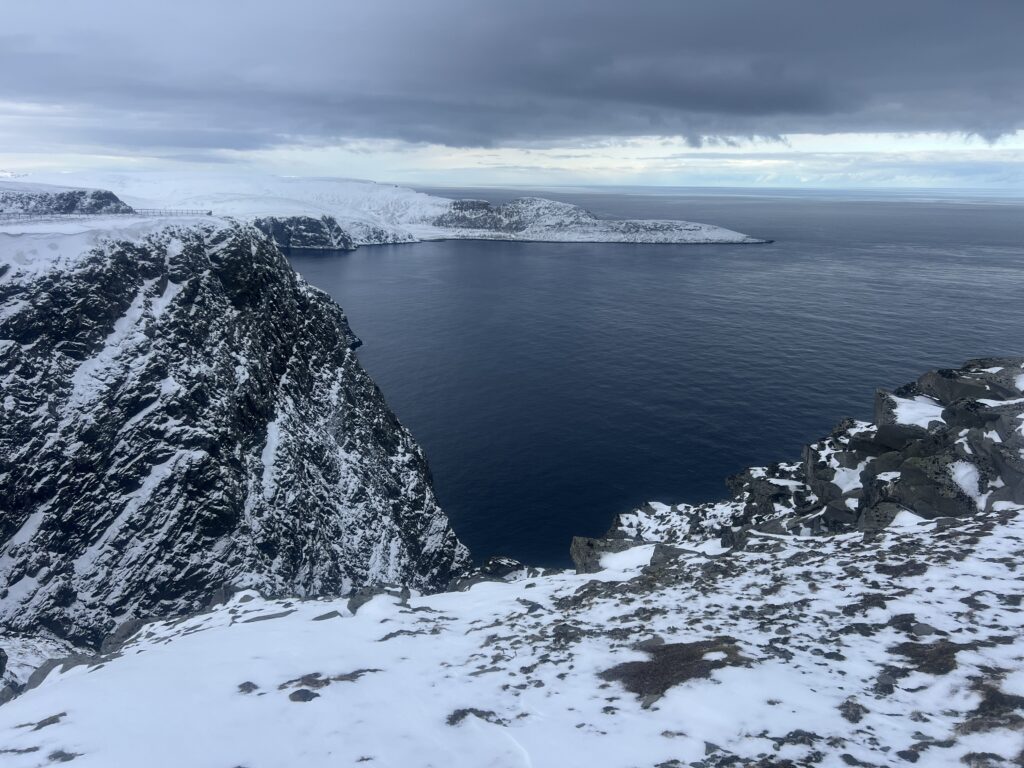
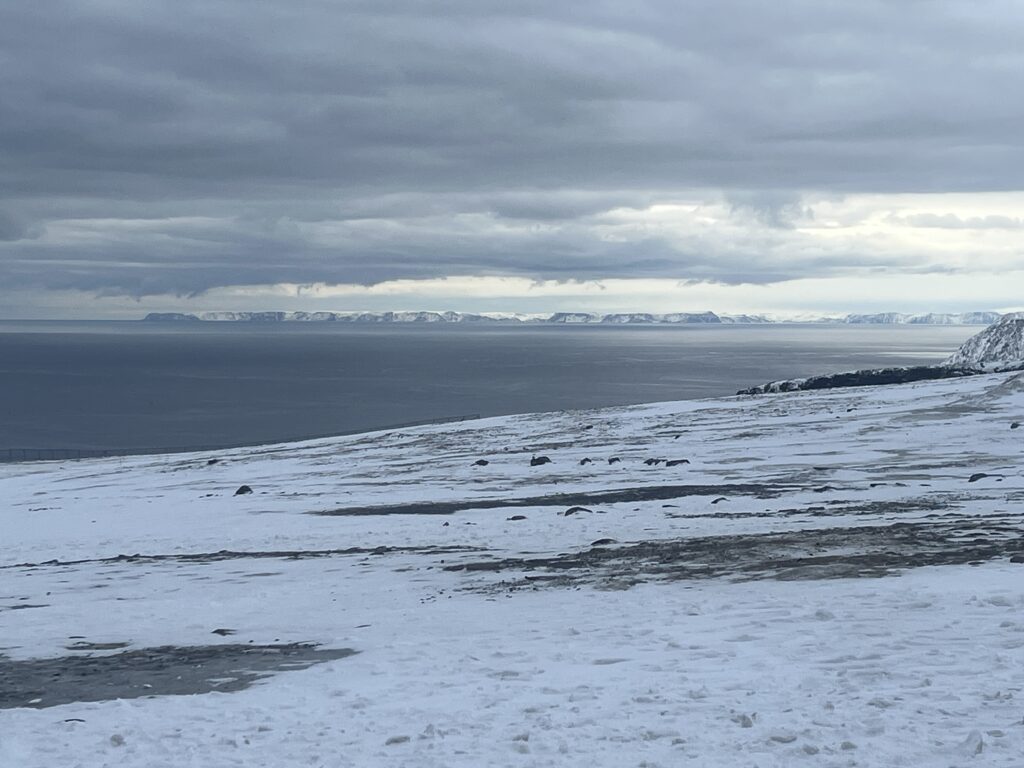
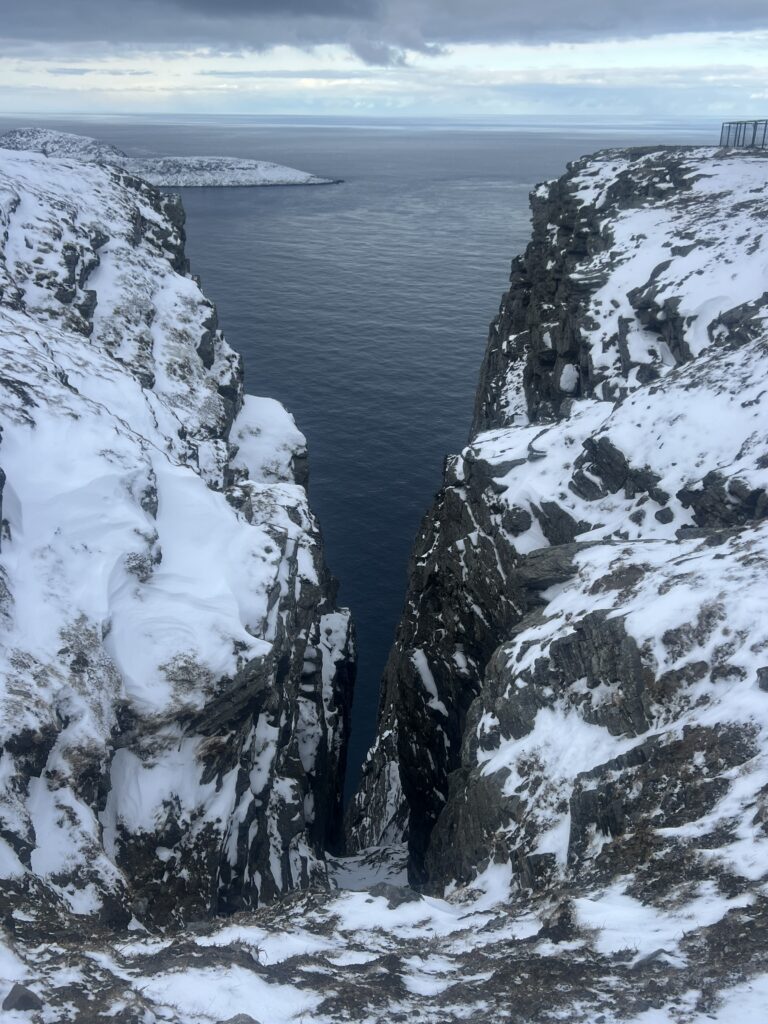
Pulling in to Nordkapp !Stopped for a selfie….…then went to the Nordkapp “globe” marking the northernmost point reachable by road in Europe.View west from Nordkapp.View east ( towards Russia ) from Nordkapp.The route we have taken through Europe.
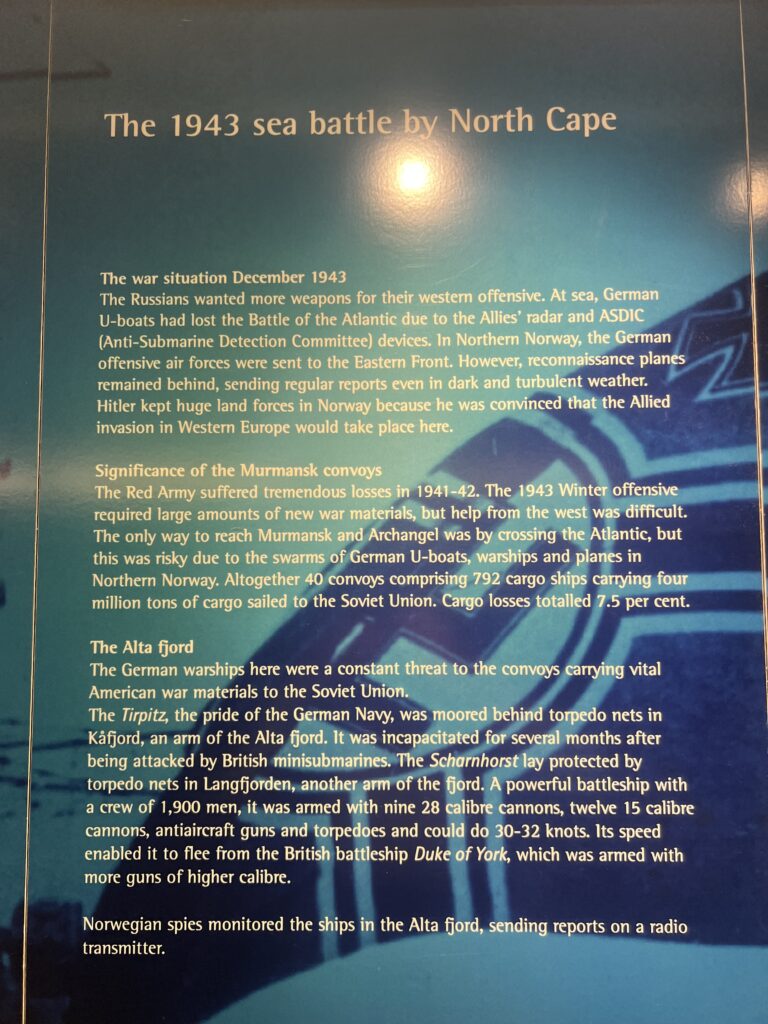
So, you’re here now, you’ve made it to one of those milestone places you’ve long thought about – what’s to do ? Well, much more in summer than there is in early spring, but but there are various monuments to explore sculptures, a museum, a very nice restaurant, a cinema telling the story of North Cape, and lots of history around the place that speak to its early discovery and the many famous people who have come this far. Folks with any interest in World War II history will probably be aware that just off the north Cape a very famous battle was fought between the German and British Navy that resulted in the sinking of the great German battleship, the Scharnhost, and there is a gripping story of the cat and mouse naval manoeuvres that led to it.
A museum display detailing the Battle of North Cape and the sinking of the Scharnhorst.Seven of us stayed overnight. Every other vehicle was from Germany.A view to Nordkapp.
We had a full afternoon taking in all that and chatting with others, congratulating ourselves on the achieving of getting here. There was also one unexpected gem – a huge pod of whales passed the cape as we were taking our pictures. Conditions were bad, light was fading and snow was falling, and as we were up so high the whales were far far away. The still pictures just did not turn out as it was very difficult to focus on what looked like small objects on the ocean surface however, the short video I shot clearly shows a couple of the whales surfacing and the spouts of water they created. The holy grail is to be at Nordkapp at this time of year and observe a beautiful aurora borealis ( northern lights ) display – too much cloud on the night we stayed, so we missed that but took the whale sighting as a good consolation prize.
Ok, the worst quality video EVER ( blowing snow, strong wind and a very distant clip ), BUT, you can see two whales spouting just off Nordkapp.Nordkapp sits on a plateau about a thousand feet above sea level. Looking down to the Barents Sea.
Like most who make it up there in a camper vehicle we spent the night and toasted with a celebratory drink and dinner we’d prepared. Interesting sidebar – we were the only camper van there that wasn’t from Germany, Nordkapp obviously being very high on German travellers’ bucket lists. It then occurred to us that we may possibly have been the only Canadian campervan that’s ever been there !
So, now to head south – the days will get longer, the weather should get warmer and we still have so much of Norway’s beautiful coastline to explore. We are looking forward to it.
After the ( almost ) micro-states of the Baltics, Finland loomed large on the map of Europe. Like the Baltic countries, a place with its own distinctive culture and language ( and some incredibly long place names ! ) it has also been controlled by others over its history. The Swedes controlled it for centuries, the Russians for a period, and during WW2 the Germans even took control for a while. Finland’s geographic position means it’s always had to carefully balance relations with its neighbours but today it’s a rich, safe, clean and in many places very beautiful country. The only one of the Scandinavian countries we’d not visited before, there was much anticipation as the Viking Line ferry carefully navigated us into Helsinki harbour on a crisp but sunny Spring day. While the ferry entry to Finland is definitely scenic, the city itself ( in contrast to many others ) has a strikingly low profile. That surprised us, especially the real abscence of tall buildings common elsewhere.
Our Viking Line “ferry” – much more like a cruise ship, inside and out !It’s one of Helsinki’s popular attractions – just watching all the ships and ferry’s come and go through its narrow harbour opening.When we landed I asked the Finnish immigration folks if there was any chance of getting more time in Finland “outside “ the Schengen 90 day limit – a flat “No” !
Once off the ferry a park-up spot was located ( right by the harbour ) giving us a great base to explore the city. It was a Sunday, it was sunny, and the Finn’s were out in droves. Walking, hiking, shopping, with the dogs, sipping lattes in outdoor cafés, and just enjoying life ( apparently this was the first sun they’d seen in quite a while ).
Downtown Helsinki.Helsinki’s kauppatori, famous enclosed harbour front food market.
The day was spent doing the requisite exploration of downtown plaza’s, squares, churches and historic monuments – Suomenlinna, the historic fortress on a small island in the harbour, was a definite highlight. Just east of Helsinki lies the historic waterfront town of Porvoo, unusual among small towns in that it has an exceptionally well-preserved Old Town – well worth the extra day we spent there.
Suomenlinna Fort.Old Russian gun, Suomenlinna Fort.The historic fort was used in WW2 as a base for submarines.Porvoo.Porvoo Old TownPorvoo historic church.The outdoor cafe’s in Porvoo were great…!Porvoo
What most excited us about Finland (in contrast to the more densely populated countries we’ve been travelling in ) was the potential to get out into the country, among the lakes and forests, and do some remote camping. The kinds of places you might need a 4 x 4 to get to – after all, we had one ! That opportunity did present itself, and the potential camp spots are endless here, however, the fact that there was still much snow on the ground (and that most lakes were frozen over ) as soon as we moved north, limited some of the activities we could engage in – hiking, for example, became a challenge. We of course expected that in the north of the country, we were just surprised to see it not far north of Helsinki itself.
Yes, they have moose here. Such signs everywhere.
Finland provided us with one other big surprise – how flat it was. We had just imagined the place would’ve had more mountains and while there are hills here and there, certainly there were no mountains to speak of, and we drove all the way from Helsinki almost to the very top of the country before turning west in to Norway. It’s covered in forests, lots of birch, especially, and logging is a huge industry here, reminding us very much of British Columbia where we live.
Much like BC, where we live, logging is huge in Finland.
Travelling north took us through the Lakes District in the south, we swung out to the east towards the Russian border before continuing directly north through the castle town of Savonlinna. A prettier setting you couldn’t find and the castle just looked so picturesque on the lake, yet once again when we tried to enter, we found it was closed on the day we were there – another Monday ( getting to be a pattern here – note to self ! ).
Birch trees everywhere up here !Not far out of Helsinki and most lakes were still frozen over.Olavinlinna castle from the 15th century. Savonlinna.Ditto.Finland has famously long names – try pronouncing this !Oulu’s toripolliisi (fat policeman) statue. Scandinavia has a number of such unusual art works.A great “snowy” camp spot near a Finnish ski hill.
Probably the biggest highlight heading north, into what we often call Lapland, was crossing the Arctic circle, and spending a little time in Santa’s “hometown” of Rovaniemi. The Finn’s will have none of this “North Pole” nonsense, it’s firmly entrenched here that Santa’s hometown is the little village, just north of Rovaniemi, and a veritable cottage industry has been built around it. I’ll let the picture tell the story ( the place was absolutely packed with tourists from every corner of the globe so they have pitched it well !!).
The “Santa clause” brand is everywhere in Rovaniemi.Lois, downtown Rovaniemi.A typical Finn, out enjoying the cold. A foot on both sides of the Arctic Circle.Signpost, Santa Claus village.Letters to Santa.Getting a card off for Christmas delivery. We were shocked – there were tourists here from all over the world.Even had real reindeer !Pretty scene near sunset. Cold outside but we are always warm in the van !Nice scenery on our hike north of Rovaniemi.In colder weather the hiking trails offer “lean to’s” and firewood to keep you warm.Northern lights viewing requires clear skies and so far we have often had clouds. Best we have seen so far 😔.
Beyond Rovaniemi, lies the Sami ( Lapp ) village of Inari, the last Finnish town we visited before heading west to Norway. The town itself is rather non-descript but the museum depicting the Sami people‘s history and their integration into modern Finnish life was fascinating. Some interesting parallels with Canada’s own situation.
Was not aware the Sami were present in all 4 countries.Just an excellent museum in Inari.The only sign, or reference, we saw to the word “Lap”. Sami is the preferred word for the indigenous people of the far north.
Next blog we cross into Norway – we’ll head straight to Nordkapp ( North Cape ), and the very top of continental Europe.
Next blog, the drive to Nordkapp – the very top of Europe.
While Poland spent 45 years under the Soviet sphere of influence, the three Baltic states of Latvia, Lithuania and Estonia were actually part of the Soviet union during that same period – an unwilling part mind you, but nonetheless an integral part of the former Soviet Union. Unlike Poland, each each of the three still has a significant percentage of ethnic Russians in their population. As such, we were very curious as to what we might find driving through each of these tiny countries.
Historic Trakai castle, near Vilnius. The first of several attractions we would visit, which were “closed” on Mondays.
Coming from the south ( Poland ) our first Baltic state was Lithuania and we headed towards the beautiful capital of Vilnius which nudges up close to Belorussia. Just prior Vilnius is the historic castle town of Trakai with its 13th century castle set on a very picturesque lake. A superb sunny Monday had us enthused to wander inside only to find on arrival that the castle ( undergoing renovations ) was closed on Mondays ( a situation we would encounter at another castle barely a week later – what is it with castles in Europe on Monday’s ? ). Enjoyed what was possible from the outside.
Trakai castle is on a most picturesque setting – could not go on so we walked the grounds as it was a gorgeous sunny day.
All three states have scenic capital cities with exceptionally beautiful old towns, and in normal circumstances, Vilnius, capital of Lithuania, is probably the pick of the three – but it was just a bitterly cold and windy day when we were there so the visit was shorter as a result.
Cobblestone street, Vilnius Old Town.Ditto.Vilnius CathedralDitto.
From Lithuania it’s just a short hop to Latvia – it was super easy driving, with great roads and it was easy to navigate our way to historic Riga, it’s capital right on the Baltic Sea. A much improved day gave us the opportunity to explore at a more leisurely pace. Again it was easy to park ( right on the waterfront in this case ) giving easy access to the heart of the city. As for Vilnius, plenty of historic sights and excellent cafe’s and patisserie’s which we took full advantage of ( easy to get hooked on that stuff in Europe ! ).
Lithuania was very flat ( like Holland )! We would soon discover it was true of most of the area of the Baltic states.. One of the more unusual overnight parking locations. A fuel station near Vilnius ( we were kind of stuck, and “any port in a storm” as they say ). Safe, flat, access to amenities and fast WIFi, just €3 per night. They saved us.House of the Black Heads, RigaHistoric St Peter’s Lutheran Church.View of Riga from St Peter’s Church spire.Wall with coat of arms of all Latvian cities and municipalitiesMuseum of the Occupation of Latvia details the period under German occupation in WW2. Another one we hit on a day it was closed – fortunately some of the material was displayed outside.Great parking in downtown Riga, right on the waterfront and just 10 minutes from the Old Town. Courtesy, Park4Night.
Most of our time in the Baltics, however, was spent in and around Tallinn, the capital of Estonia, the northernmost of the three Baltic states. For a few reasons, it was probably our favourite of the three – we enjoyed the best weather, found our favourite cafe in Europe so far ( 3 visits, no less ! ) and explored not just Tallinn, but a bit more of the area outside it, including scenic Lahemaa National Park. Beyond just the sights, though, it was in Tallinn that we had to arrange our ferry crossing to Helsinki ( Finland ), and a few other personal things so we just spent more time there and consequently got a better feel for the city. It definitely enchanted us.
A beautiful drive up the Baltic Sea coast from Riga to Tallinn – taking morning coffee break at a rest stop and soaking up the view.After Riga, destination Tallinn, in Estonia. Our last stop before shipping to Scandinavia.Tallinn Old TownOne of the entry gates to historic Tallinn Old Town.Same gate, from inside.A very frank and candid look at the methods of the KGB.Former KGB “interrogation” cells in Tallinn. Very interesting visit to see and hear what transpired inside.Inside the KGB interrogation cells.Beautiful old church inside the Old Town.Main square, Old Town.Main Square, Tallinn Old Town.Alexander Nevsky Cathedral, a beautiful Russian Orthodox Church, Tallinn Old Town.Needed a prescription filled and obtained it from Europe’s longest continuously operating pharmacy in Tallinn- dating back to 1422. Fascinating to check it all out.Lois insideWe’ve become quite addicted to our morning ritual and sampling some of Europe’s best. The cafe beside the Tourist Info office in Tallinn became our “regular” during the days we spent there. Simply delicious drinks !
In all three of the countries we took in their main museums and and explored their recent history- they only regained their independence in 1994, have fully embraced it and are all firmly now in the European camp. It’s like they never left ! These counties may be small, and probably deserved more time than we allotted to them ( certainly the first two anyway ) but one can’t spend forever in every country, especially with the new Schengen rules so after a week between the three we loaded our van on the Viking Line ferry and crossed the Baltic Sea to Helsinki. More on that in the coming blog !
Farewell Estonia – on board the Viking Line ferry. It was an excellent day for the crossing to Helsinki, sunny and calm.
Our only previous experience of Poland was in early 1986 when we ( very briefly ) transitted the country on a train from London to Shanghai. It was January, hence cold and dreary, and despite the early stirrings of “Solidarity”, Poland was still firmly in the “Eastern Bloc”. That would dramatically change a few short years later so we were anxious to experience a newer, modern, and very “Western” Poland. The country is amazing and did not disappoint. We were, in fact, very impressed by it.
After the rough back road we had taken across the Tatra’s and into Zakopane, things improved quickly and the roads soon resembled those we’d seen everyone else in Europe. Zakopane itself reminded us very much of Banff in Canada, the same kind of feel, the same “look”, although we were quite shocked by the lack of snow considering we were still well within what would’ve been considered the ski season. Directly north of Zakopane lies Krakow, probably Poland’s best preserved historic city. Unlike Warsaw ( flattened in WW2 ), stunning Krakow ( particularly its “old town” ) was left untouched. Its old town square is huge and contains the typical town halls, churches and other historic buildings, monuments and the ubiquitous cobblestone streets common to such old European cities. It was a great to be able to drive right into the heart of the city and camp just by the old town, giving us easy access to everything. Sadly, rainy weather and an inordinately long queue kept us away from the Oskar Schindler factory tour ( it’s in Krakow ), only getting to see it from the outside. That’s the “Schindler” from Schindlers List.
Rynek Glowny, the main square in Kraków’s old town.Old town main square at night.St Mary’s church, old town, Krakow.Krakow, old town.
The vibrant, resort feel of Zakopane and historic charm of Krakow soon gave way to the sombre, deathly vibe of our next destination, the nearby Polish town of Oswiecim – better known around the world by its German name, Auschwitz. It’s here one can see first-hand the horrors of this infamous Nazi murder factory, along with its sister camp, Birkenau. There are few, if any, places we have been where I would say that cold, foggy, rainy weather actually added to the experience but here it did. The whole place is incredibly impactful. We’d seen Dachau many years back, but it’s just not on the same scale as Auschwitz-Birkenau. The place sees over 2,000,000 visitors a year and recently celebrated 80 years since its liberation ( yes, survivors are still with us ). Warning, some of the following images are quite graphic.
Entry to the Auschwitz-Birkenau complex.Entry passageway to Birkenau, through which many walked.Typical rail cart/carriage into which millions were crammed for the journey to Auschwitz.Entry pathway to Birkenau.Section of electrified fence.Picture of inmates on the day Auschwitz was liberated. Note the quote – frightening to even consider it.Possibly the image most synonymous with Auschwitz and the Nazi’s biggest lie ( “work shall set you free”).Most who were marched through it ultimately died.Auschwitz guard tower.Inmates uniforms.Sleeping quarters.Sealed concrete bunker where inmates were gassed.Next door was the crematorium where the bodies were incinerated. An estimated 1,000,000 in total.
Warsaw is 5 hours north of Oswiecim and it was a quiet, uneventful drive – I think for most of the journey we both sat thinking about the experience of the day before – Auschwitz just has that kind of haunting feel about it. Getting into (and out of) Warsaw was easy – the highways and roads were easy to navigate and again we opted to drive right downtown. Fortunately we were tipped off to a great App ( Park4Night – the “bible” of European RV’ers ) that identifies suitable 24 hour overnight parking sites all over Europe and it has been an invaluable tool for us. iOverlander saved us in South America, Wikicamps in Oz and it’s been Park4Night so far in Europe- good for camp spots and a host of other essential services for those like us.
Highways were excellent in Poland with many Poles now driving exotic cars ( and they like to drive fast ! ). No more Lada’s or Polski Fiat’s in Poland ( that we saw, anyway )..!Warsaw’s beautifully rebuilt old town, which had been flattened in the war.Street scene near Warsaw’s old town.Warsaw old town.Main square, Warsaw old town. It was a beautiful sunny day, too.Poles enjoying the sun in the old town.More old town. So much to see, it was great getting lost in its cobblestones streets and alley’s.
In addition to Warsaw’s beautifully restored old town, there are a few other sites, including some great museums, two of which we saw – the more mundane Museum of Warsaw and the immensely interesting, if slightly eclectic Museum of Life Under Communism. Poland is a super interesting country with a complicated history but has developed in leaps and bounds in the past few decades. You’ve got to look hard now to see any evidence of the old days. This Museum takes a frank, and at times humorous, look at how difficult life was in Poland during the almost five decade long communist era.
Easy to miss – a rather non-descript entry to the museum, but it was fascinating.Samples of old Eastern bloc technology – back in the day little was imported from the “capitalist west”.Lenin and Brezhnev.The Soviet influence was pervasive in the communist era.Typical communist propaganda poster urging young workers to produce more for the state!
As we moved north in Europe, only the three tiny Baltic states lay between us and Scandinavia (our primary destination).. More on that in our coming blog.
Till next week….
PS: given the solemn nature of some of the images in the weekly video I thought a less upbeat and more philosophical tune might best capture the moment. Enjoy “Imagine” ( https://youtu.be/iJt3sbCuiEE?feature=shared )
From Celle we continued south-east towards Dresden, a cultural mecca which had for 45 Cold-War years been under the yolk of Soviet directed communism. One is reminded of that terrible era when driving to Dresden as you pass through the town of Marienborn, one of the places that was right on the former East/West frontier. The name definitely rang a bell and I remembered why shortly after we pulled up at the monument to that era. It was through this very place that we passed, back in 1985, when we drove our old Volkswagen Kombi across the former East Germany and into West Berlin. Many of the search light towers and military control buildings are still visible, but now all enclosed in a type of outdoor museum to an era that once was. Fascinating, as a student of history, to walk around it and think that we lived through it all. At the same time, hard to believe today, looking back 35 years, that there ever was once two Germany’s.
Marienborn memorial to a divided Germany.Display at the memorial.
We had some concerns coming to Europe that getting good overnight parking near the big cities might be a challenge but Hildesheim and Celle proved that fear to be unfounded. Dresden, much larger, might be tougher. Not at all, as it turned out, the city provided a huge parking area for campers right by the Elbe River (within minutes of the old city) that was very popular. Probably tough to get a spot here in the middle of summer, but right now, in March, there was plenty of space. An easy walk along the Elbe got us right into the middle of a busy Saturday afternoon in the old city and it was wonderful to walk the streets and admire the baroque architecture for which the city is justifiably famous. Especially so when one realizes that Dresden was practically obliterated during the final days of WW2, so much of what can be seen has actually been substantially rebuilt. Prior to the war it was called the “Florence of the Elbe” and considered one of the world’s most beautiful cities due to its architecture and art treasures.
There were probably 20 or 30 campers near us us, right by the Elbe, in the heart of Dresden.Old town, Dresden.DittoThe father of all Lutherans himself.Old town, Dresden.The Europeans love an outdoor cafe and the weather was perfect for it. People were out in droves.Dusk shot, Old Town roofline.Dresden, seen from a bridge on the Elbe.What we do late in the day – FaceTime to family and friends . Well, mostly to our granddaughter who is just waking up in Canada as we wrap up our daily sightseeing in Europe !
As wonderful as Dresden was, our next destination was one we had anxiously anticipated visiting for many years – Prague. While Dresden was a little bonus of sorts ( we did not initially plan on stopping there ), Prague was always high on our European agenda. Of all the cities we’d previously not seen in Europe, it was one we were really looking forward to.. Don’t know how many times we had heard from others ( who’d been ) just how beautiful it was, and it did not disappoint. An absolutely perfect couple of sunny days showed the city in all its historic glory and it was, unlike the other cities we’ve been to so far, absolutely jam-packed with tourists. Not so many that you couldn’t enjoy it, but certainly enough that it made you wonder what it must be like here in the middle of the summer high season. Taking in all the sights, using its Metro, sampling its famous beers, its unique ice-cream filled pastries, as well as simply soaking in the atmosphere occupied all our time there. It’s fairly compact so an easy city to walk – our high Prague expectations were definitely met !
.
Wenceslaus.Some absolutely beautiful old hotels on Wenceslaus Square.Sipping a Pilsner, Prague !Looking down Wenceslaus Square to the National Museum They were serving these everywhere in Prague – “trdelniks”, a hot pastry-type cone with ice-cream. The pistachio flavour was divine. They are very famous here and the recipe goes back 200 years.Specialty shops prepared them.Astronomical clock, Old Town.Old Town scenes.DittoUs, on Charles Bridge.Church inside Prague Castle grounds. St Vitus Cathedral is home to the Czech crown jewels and burial place of many former kings.Trams give Prague a quintessential traditional European feel.Winding our way back from the steep climb to Prague Castle.The “John Lennon Wall”, which has become a magnet for tourists in Prague.
Prague was quite an assault on the senses- almost overwhelming in its attractions. We were not sure what could top it but a day later we would visit Cesky Krumlov – the second most visited place in Czechia, and it certainly gave Prague a run for its money.
En route to Cesky Krumlov we made a brief stop in Cesky Budejovice, ostensibly to see the famous “Budovar” or original Budweiser brewery. Missed the tour unfortunately, but enjoyed the town.
While Prague had all the offerings of a large, historic European capital city, Cesky Krumlov was the very definition of that small, traditional European town/village, with a castle, big protective wall, classic bridges, spires and delightful cobblestone streets and the most stunning traditional Bohemian architecture. The kind of place you could wander for hours just finding interesting side streets and boutique shops and stores. Unlike Prague we managed to avoid the worst of the crowds here which only added to its appeal. Easy to see why this place is so popular.
Entering Krumlov through what appeared to be aqueducts, above which was a covered entrance to the castle.The setting was almost fairytale-like.A village of many interesting and historic doors.Cesky’ Krumlov’s famous St. Vitas church, dating from the early 1400’s.Rooflines of Cesky Krumlov.The castle from the village.When one has a castle, one needs bears to guard it I guess !Coffee and hot chocolate has become a bit of a daily ritual, especially when the setting is so beautiful.Cesky , as seen from the castle.Another view.
As hard as it was to drag ourselves away from the picturesque setting of Cesky Krumlov, there was still a bit more we wanted to see in Central Europe before heading more or less directly north up through Poland and to the Baltic states. Poland could be approached from the west or the south and while it took a bit longer, the southern route gave us the chance to ( briefly ) explore the High Tatra’s ( mountains ) of western Slovakia and then enter Poland through its legendary ski area of Zakopane. That all seemed like a great idea ( and it was ) except that two consecutive days of cloudy ( and slightly rainy ) weather really put a bit of a damper ( excuse the pun ) on the experience. We saw enough to appreciate what a beautiful part of Slovakia and Poland it was ( or could be, in ideal conditions ) but the incredible weather we’d enjoyed so far just did not hold up.
One can easily miss crossing a border in Europe these days – no checks, no stopping – you have to look closely even to see the border sign. Here, entering Slovakia.On the south side of the Tatra’s, in Slovakia, was Stary Smokovec, a renowned winter playground. More snow than Zakopane, but still equally lousy weather for us. We moved on.Took somewhat of a backroad into Poland and were almost forced to turn back by a 3.0m height barrier. We just managed to clear it !Trendy Zakopane, just on the north side of the Tatra’s and Poland’s premier winter playground, reminded us of Banff. Sadly the area had very little snow, a trend that is happening in other European ski areas. Just very wet and foggy, too.
Coming in through Zakopane did have one other advantage – an easy drive on to historic Krakow, truly one of Poland’s highlights. More on that in our next edition.
The PanAm completed in April, 2022 and with the truck camper sold, we shipped our new Sprinter van to Australia in late 2022. We travelled there through all of 2023 and into 2024 before shipping it up to North East Asia where we travelled for 4 months between Korea and Japan, before shipping it back to North America. It’s our plan to continue exploring the world in 2025.